
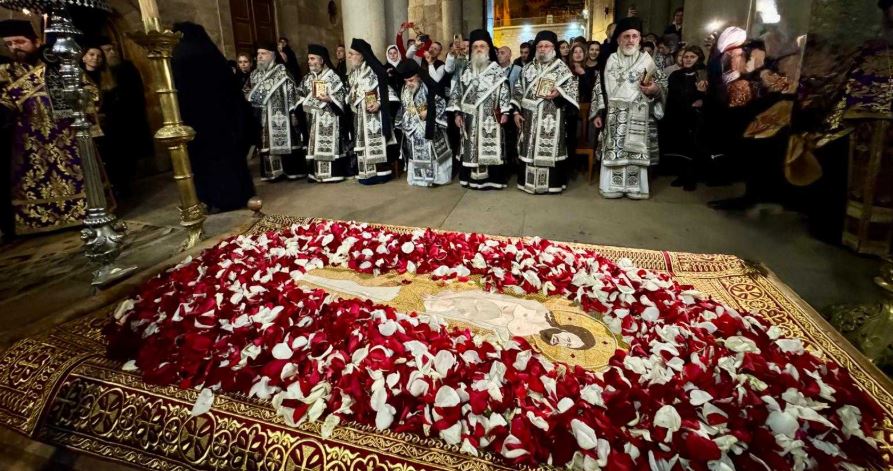
On the evening of Great and Holy Friday, 28 March / 10 April 2026, the contrite and majestic Service of the Epitaph—that is, of the burial according to the flesh and the repose of our Lord Jesus Christ—took place at the Patriarchate.
This Service, presided over by His Beatitude our Father and Patriarch of Jerusalem Theophilos, began in the Katholikon of the Church of the Holy Sepulchre with the Canon of Holy Saturday, until His Beatitude, the Hierarchs, and the Priests took their appointed places.
Thereafter, the procession commenced from the Katholikon and proceeded around the shrines within the Church, with a Supplication offered before each chapel. The Patriarchal retinue then ascended to the Horrendous Golgotha, where the Seventh Gospel of the Holy Passion (Matthew 27:33–35) was read by His Beatitude. He then venerated the place of the Crucifixion, followed by the Hierarchs, the Priests, and the Consul General of Greece in Jerusalem, Mr Dimitrios Angelosopoulos, and the Consul, Mrs Anna Mantika.
Thereafter, the Hierarchs took up the Epitaph silk corporal from the Holy Altar of Golgotha and descended to the place of the Holy Deposition from the Cross, where the Eleventh Gospel of the Holy Passion was read, concerning the burial of the Lord by Nicodemus and Joseph of Arimathea (John 19:38–42).
Following this, the procession proceeded three times around the Holy Tomb, the Hierarchs bearing the Epitaph silk corporal, which, after the third circuit, was placed upon the Holy Tomb. Thereafter, the three Stases of the Lamentations commenced. At the third Stasis, the sermon of the Epitaph was delivered by the Elder Chief Secretary, His Eminence Archbishop Aristarchos of Constantina, as follows:
“The thief on the same day Thou didst make worthy of Paradise, O Lord;
by the wood of Thy Cross do Thou enlighten me also, and save me.”
(Exapostilarion of the Service of the Holy Passion)
Your Beatitude, Father and Master,
Venerable choir of hierarchs,
Your Excellency, Consul General of Greece,
Reverend clergy,
Pious pilgrims,
The precious Cross contains within itself the whole mystery of Christ, for the Cross presupposes the Incarnation and leads unto the Resurrection. The risen Lord is known as the Crucified One. Thus, the radiant angel within the tomb announces unto the myrrh-bearing women: “I know that ye seek Jesus, which was crucified. He is not here: for He is risen” (Gospel of Matthew 28:5–6).
Likewise, the Apostle of the Gentiles, he who was “caught up to the third heaven” (2Corinthians 12:2), declares unto the Corinthians that he preached unto them none other “save Jesus Christ, and him crucified” (1Corinthians 2:2).
The Cross of Christ is a mystery to be believed, lived, and partaken of, not explained “with enticing words of man’s wisdom” (1Corinthians 2:4), that is, not through persuasive and ingenious arguments of human reasoning.
The Church approaches the mystery of Christ’s Cross in adoration, with thanksgiving and glorification, inseparably united with His Resurrection, chanting: “We worship Thy Cross, O Master, and we glorify Thy holy Resurrection.” This she does daily, yet most especially today, on Holy and Great Friday: the day of remembrance of the Crucifixion, when pre-eminently she chants, “Today He is hung upon the Wood”; the remembrance of the Deposition, when “The noble Joseph” is chanted; and the remembrance of the Burial of the Lord, when the Church proclaims: “In the grave bodily, but in Hades with Thy soul as God.”
In the Cross is confirmed the word once spoken by the righteous Simeon the God-receiver, when he took the forty-day-old Christ into his arms and said: “Behold, this child is set for the fall and rising again of many” (Luke 2:34): for the fall of those who reject Him, and for the rising again those who receive Him.
Indeed, as the Apostle Paul teaches, the Cross of Christ has been unto the Jewish world, from the day of the Crucifixion, even until now, a “stumbling block” (1 Corinthians 1:23). It is not accepted, but scornfully rejected. For how could it be accepted that the One expected as the national deliverer of Israel should be hanging upon a wood?
And unto the Greek world, and unto those formed by the rational discipline of Greek philosophy, the Cross appears as “foolishness”, that is, absurdity and folly, for victor is accounted he who triumphs over the corpses and spoils of conquered enemies, and not He Who is “hanging upon a wood.”
Yet unto those who believe in Him, whether Jews or Greeks, that is, unto the Church, the crucified Jesus is revealed as “the power of God, and the wisdom of God… righteousness, and sanctification, and redemption” (1 Corinthians 1:24, 30).
In accordance with this faith of the Church, Christ upon the Cross wrought victory “against spiritual wickedness in high places” (Ephesians 6:12). By His death the Lord stripped the devil of his dominion over man. In His crucifying death, He conquered death itself: death was trampled down and overcome by death.
The Cross of Christ is not defeat, but sacrifice. The Lord approached death willingly, as the Church chants of Him: “Who wast voluntarily lifted up upon the Cross.” He accepted death of His own will, though He had power to avoid it. His condemnation to death by the Jewish priesthood and the Roman authority did not imply compulsion upon Him. As He Himself says: “I lay down my life, that I might take it again. No man taketh it from me, but I lay it down of myself: I have power to lay it down, and I have power to take it again. This commandment have I received of my Father” (John 10:17–18), and this was so “that the scriptures might be fulfilled, that thus it must be” (Matthew 26:54).
The Lord endured the Cross in His human nature. For the Church, He is the One crucified in the flesh, that flesh being hypostatically united unto His divine nature. In that human nature He sorrowed, was troubled, deeply distressed, and trembled before the death set before Him, as is evident from His own words: “My soul is exceeding sorrowful, even unto death” (Matthew 26:38); “O my Father, if it be possible, let this cup pass from me” (Matthew 26:39); and again, “Now is my soul troubled; and what shall I say? Father, save me from this hour: but for this cause came I unto this hour” (John 12:27).
The Lord assumed our human anguish wholly before death and within death itself, yet without sin. As the Church sings: “Thou hast wholly taken me unto Thyself in an undefiled union.” His voluntary ascent upon the Cross did not mean suffering without pain. The Lord truly suffered upon the Cross. He thirsted, and vinegar was offered unto Him. He felt not only abandonment by His disciples, but also the depth of dereliction before the Father, unto Whom He cried: “My God, my God, why hast thou forsaken me?” (Matthew 27:46).
For obedience unto the Father, for the fulfilment of the Scriptures, and for our salvation, the Lord, through the theandric cooperation of His divine and human natures, ascended the Cross, and from the Cross opened the closed Paradise of Eden again for all who choose to enter therein.
He invited even His crucifiers, saying: “Father, forgive them; for they know not what they do.” Yet they, by their own will, did not enter. He also invited the thief crucified beside Him, who, after confessing and saying unto the other blaspheming thief, “We indeed justly; for we receive the due reward of our deeds” (Luke 23:41), made of the words “Remember me” the very key of the Kingdom.
Concerning him, John Chrysostom fittingly says: “Seest thou the boldness of the thief? Seest thou how even upon the cross he forgetteth not his craft, but by confession stealeth the Kingdom?”—hearing in return: “Today shalt thou be with me in paradise” (Luke 23:43).
The mystery of the salvation of our human race, namely its redemption from the curse of the law and its deliverance through incorporation into the Kingdom of Grace, was accomplished by the outpouring of the crucified Blood of Christ upon this very place, wherein we now perform this contrite service; and it was entrusted to the Church of Jerusalem, and through her to the whole Church. This place, together with the Precious Cross, we venerate, following Saint John of Damascus, who says: “The precious wood itself therefore, truly venerable, upon which Christ offered Himself for us, having been sanctified by the touch of His holy Body and Blood, is rightly to be worshipped; likewise the nails, the spear, the garments, and His sacred dwelling-places, namely the manger, the cave, saving Golgotha, the life-giving Tomb, and Zion, the citadel of the Churches.” (Exact Exposition of the Orthodox Faith, p. 188).
From this holy place, the Mother of the Churches, sorely tried by cruel war, sends forth unto all the world the wishes and prayers of her revered Primate and Officiator of this rite, our Father and Patriarch of Jerusalem, His Beatitude Theophilos III, together with those of the concelebrating Hierarchs and priests, seeking the prayers of the sister Churches for the continuation of the agreed ceasefire, and praying that her next solemn observance may take place with the participation of devout pilgrims. So be it.”
The service then continued with the Evlogitaria, the Praises, the prophecies, and the Biblical readings, together with the reading of the Gospel according to John (27:62–66), the Litany, and the Dismissal.
After the Dismissal, the Patriarchal entourage returned to the Patriarchate in preparation for the Service of the Holy Fire on Great and Holy Saturday, for which the police had already taken measures, with barricades along the Via Dolorosa and before the Patriarchate.
From the Chief Secretariat


