From 18 – 22 August 2025, His Eminence Archbishop Nikitas of Thyateira and Great Britain, serving in his capacity as President of the Conference of European Churches (CEC), took part in the World Council of Churches (WCC) Ecumenical Week in Stockholm. The events marked the centenary of the 1925 Universal Christian Conference on Life and Work, an important step towards the WCC’s founding and a major milestone in cooperation between Christians of different traditions.
At the heart of the week’s celebrations was the prayerful leadership of His All-Holiness Ecumenical Patriarch Bartholomew, whose ministry and witness inspired the gathering’s theme, “Time for God’s Peace.” Together with clergy, and faithful from across the Christian traditions, His All-Holiness and Archbishop Nikitas joined public events and conversations dedicated to cooperation, reconciliation, and common Christian witness.
In his address to the Ecumenical Celebration on 22nd August, Patriarch Bartholomew stated, “We owe it to our global community to be united in faith and action,” in an increasingly divided world, presenting “radically new circumstances which demand of us a revolutionary commitment to peace.”
The following day, the Patriarch began his homily with a petition from the Divine Liturgies of St. Basil the Great and St. John Chrysostom, “Let us pray for the peace of the whole world, the stability of the holy churches of God, and the unity of all.” His All-Holiness stressed that the peace and unity for which we pray can come only from repentance, and that real change in the world comes through “conversion of the heart and mind.”
A revolutionary commitment to peace, said the Patriarch, must go beyond faltering human efforts and must rely on God’s peace, “the peace that comes from above (James 3.17), that is not of this world (John 14.27), that surpasses all understanding (Philippians 4.7), that emanates from the depth of silence and prayer.” Recalling the words of Abba Isaac the Syrian, the Patriarch reminded all that “if you make peace with yourself, then heaven and earth will make peace with you.” This kind of peace,” he said, “allows and enables us to “love our enemies and do good to those who hate us” (Luke 6.27).”
Both the Ecumenical Patriarchate and our fellow Orthodox Churches were early pioneers in cooperation between Christians, and were founding members of the WCC. Participating in inter-Christian dialogue can present challenges for Orthodox Christians, who understand the Church, the nature of worship and Sacrament, and even the words ‘ecumenism’ and ‘ecumenical’, quite differently from our Protestant and Catholic brethren, but, if we participate with both humility and commitment to the truth of the Gospel, we heed the Lord’s prayer on the night before His death:
“I ask not only on behalf of these but also on behalf of those who believe in me through their word, that they may all be one. As you, Father, are in me and I am in you, may they also be in us, so that the world may believe that you have sent me.” (John 17:20-21)
The Archdiocese of Thyateira and Great Britain gives thanks for this blessed occasion and remains committed to strengthening cooperation, fostering dialogue, and striving for God’s peace alongside all who gather in the name of Jesus Christ, in Europe and beyond.
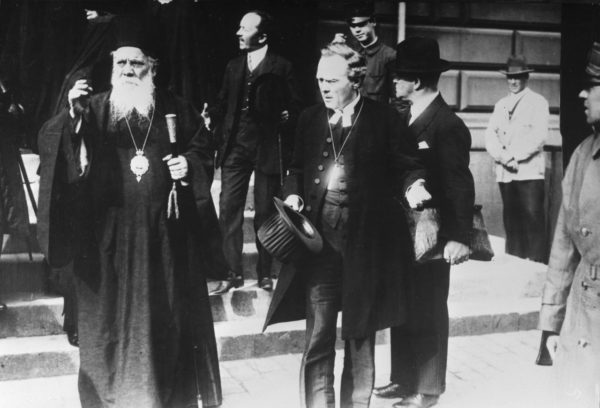
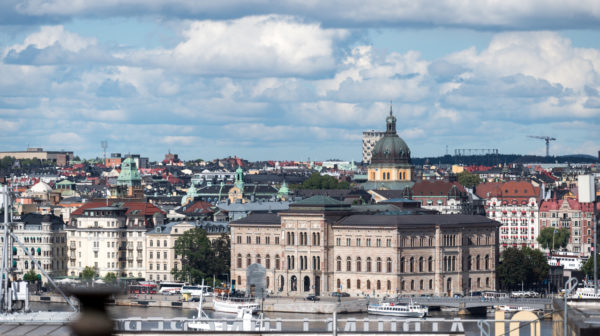
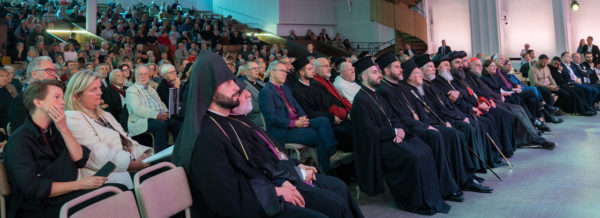
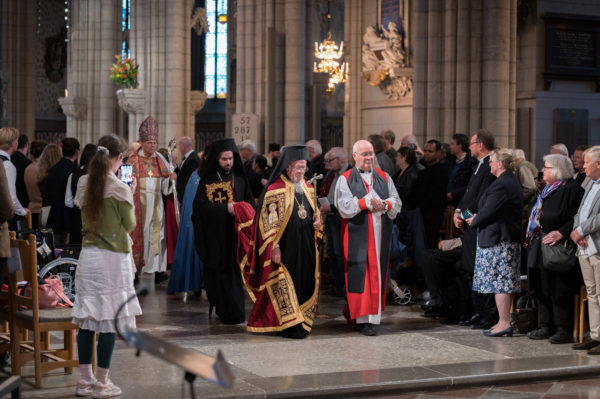


Photo credit: WCC