
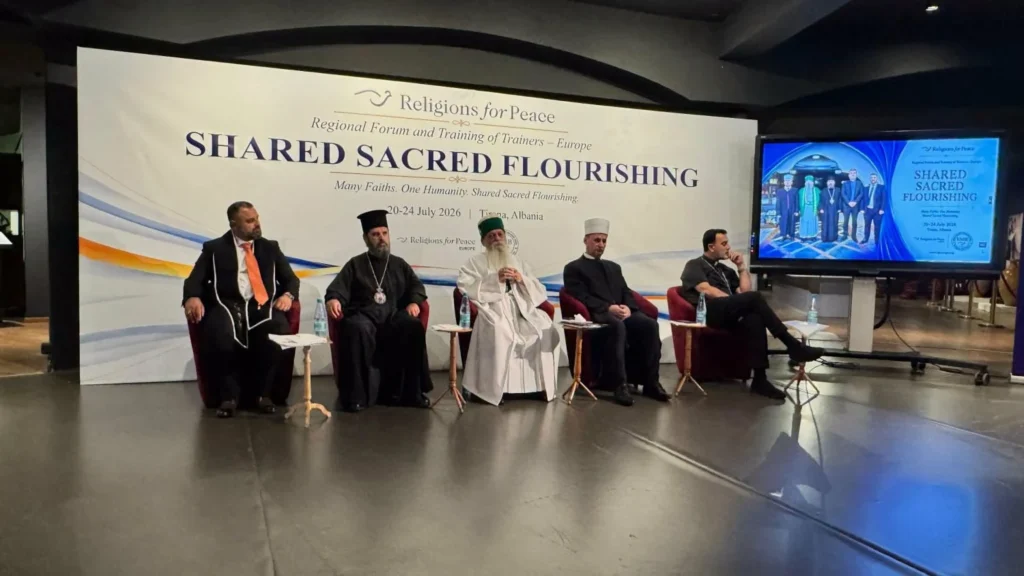
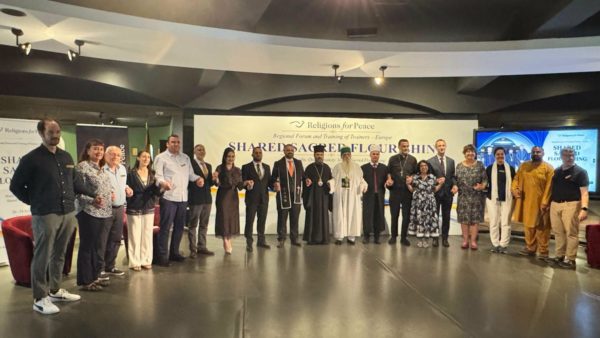
With particular emphasis on the importance of faith, interreligious dialogue, and the responsibility of religious communities in building peace, His Beatitude Archbishop Ioannis of Albania addressed a greeting to the European Regional Forum of Religions for Peace Europe, held within the framework of the educational programme “Shared Sacred Flourishing.”
In his address, the Archbishop stressed that the search for the Sacred is a timeless characteristic of human existence and can serve as a bridge of peace, mutual respect, and fraternity among people. At the same time, he underlined that faith can never be used as a cause of division, hatred, or violence; rather, it is called to serve human dignity, reconciliation, and the common offering of service to one’s fellow human being.
Referring to the spiritual legacy of the late Archbishop Anastasios, he highlighted the significance of the “search for the Transcendent” as a profound human need, while emphasising that religious communities bear a particular responsibility to become living examples of peace and coexistence.
Read below the address of Archbishop Ioannis of Albania:
Esteemed representatives of religious communities,
Distinguished participants,
It is with profound respect that I extend this greeting to all of you at today’s interreligious gathering. Our presence together in this place is not merely a formal meeting of representatives of different religious traditions. It is a public witness that human beings can remain faithful to their own spiritual identity while, at the same time, approaching the other with respect, understanding, and love. It is also a reminder that religious communities bear a special responsibility to serve peace, to heal wounds, and to strengthen the bonds that unite society.
The late Archbishop Anastasios dedicated a significant part of his work to the study of religions, focusing on what he called, in the title of one of his distinguished books, the “search for the Transcendent.” This brief phrase conveys a profound reality: in every age, in every culture, and in every place, human beings turn their gaze beyond the limits of the visible world and beyond whatever offers only immediate benefit. They seek the Divine, the Sacred, the eternal. They ask questions about their origin, the purpose of life, the meaning of suffering, the mystery of death, and the hope that can transcend decay and mortality.
This search is neither an unnecessary luxury nor an activity detached from everyday life. It constitutes a profound spiritual need. At the same time, the search for God must never become a cause of conflict, hatred, or violence. The name of God can never be used to humiliate human beings. Faith cannot become a tool for exclusion, the cultivation of fanaticism, or the imposition of power over others.

Certainly, the way in which each religious tradition approaches the Sacred differs. There are substantial theological differences, which it is neither honest nor beneficial to ignore. True dialogue does not require us to weaken our faith, remain silent about our convictions, or create an artificial uniformity. Rather, let us strive so that the search for the Sacred may reveal not what separates us, but the responsibility we share to live as brothers and sisters.
Some values must never be sacrificed in the name of any difference: peace, love, understanding, and respect for every human being. A person is not a means for the pursuit of ideological, political, or even religious objectives. Every human being is a person of unique and incomparable worth. Life, freedom, and dignity are non-negotiable foundations of a just society. No argument can ever justify contempt, mistreatment, or the destruction of another human being.
Those of us who represent religious communities bear, at this point, an even greater responsibility. It is not enough merely to issue general appeals for peace. We are the first who are called to become examples of peace. Our words, our decisions, and the way in which we treat those who differ from us must bear witness to the fact that faith can liberate human beings from fear and prejudice. Our communities must be places where people learn not only to defend their own identity, but also to respect the identity and dignity of others.
Peace, ultimately, is not simply the absence of armed conflict. It is a daily work of justice, mutual trust, and reconciliation. It is built when we avoid speech that wounds, when we defend those who suffer injustice, when we refuse to condemn an entire community for the actions of one individual, and when we reject the transformation of fear into collective prejudice.
The safest path upon which we can walk together is the concrete ministry of service to humanity. For, before any other distinction or identity, we are all human beings. We all know need, illness, loneliness, insecurity, suffering, and, ultimately, the mystery of death.
This cooperation does not abolish our theological differences. Rather, it places them within a framework of maturity and mutual respect. We can disagree without hating one another. We can bear witness to our faith without offending others. We can cooperate without confusing our traditions. And we can serve humanity together, because we recognize that suffering has no religion and that human need knows no borders.
The unique historical experience of Albania offers us valuable lessons. Our people lived through periods in which attempts were made to eradicate every reference to God from society and to violently suppress religious consciousness. Yet Albania also experienced the power of renewal, peaceful coexistence, and cooperation among religious communities. This legacy is one that we are called not only to preserve, but also to deepen, so that future generations may never again experience fear, intolerance, or violence committed in the name of faith.