And God said, “Let us make man in our image, after our likeness: and let him have dominion over the fish of the sea, and over the fowl of the air, and over the cattle, and over all the earth, and over every creeping thing that creeps upon the earth.” So, God created man in his own image, in the image of God created he him; male and female, he created them. (Genesis 1: 26-27)
As we see, the Holy Scripture speaks of one man—he speaks of the singular, even though, at first glance, he has to speak of two men: man and woman.
What do we know about God? That there is only one God in three persons: the Holy Trinity. So, the only God made a single man in many persons of two kinds: male and female. Unfortunately, however, this original unity does not exist today because this unique Adam was cut in pieces by sin. This unique mirror, this unique image of the one God, has fallen and broken in many pieces. This is the fall of Adam.
Because of this, God the Word has incarnated—Jesus Christ—saying, “Let's rebuild Adam because, otherwise, you are in the hell which you alone have generated. Whoever wishes to be united with Me and, through Me, among you?”
What did God create? A created god, a gigantic mind. All the persons were meant to cooperate in real time, mentally, without any disagreement, for the fulfillment of the same purpose, yet retaining their specificity. So, the gift of knowing thoughts is a natural gift and speaking is actually a lower level of communication. For the people who are approaching God (the saints), this gift of knowing thoughts reappears.
How, however, could this union be realized concretely for the same purpose, while preserving our specificity? It is as in the case of a body that, for example, climbs a ladder: the feet do something, the hands do something else, the eyes do something else—each member does something else, but all the members work together in real time to achieve the same goal: the person climbing.
When the Apostle Paul says that the Church is the body of Christ and we are members in part, the Saint does not speak poetically but in a very concrete way, as we have shown above. In this body, Christ is the head and the Holy Spirit is the spiritual blood that gives life to the members.
We cannot find our happiness and resurrection in any other way than only in this spiritual nation. The true nation is the communion between the living, the communion between the dead, the communion between the living and the dead in the midst of the Holy Liturgy.
Based on Saint Sophronios Sacharov of Essex, Genesis 1: 26-27, 1 Corinthians 12: 3-30
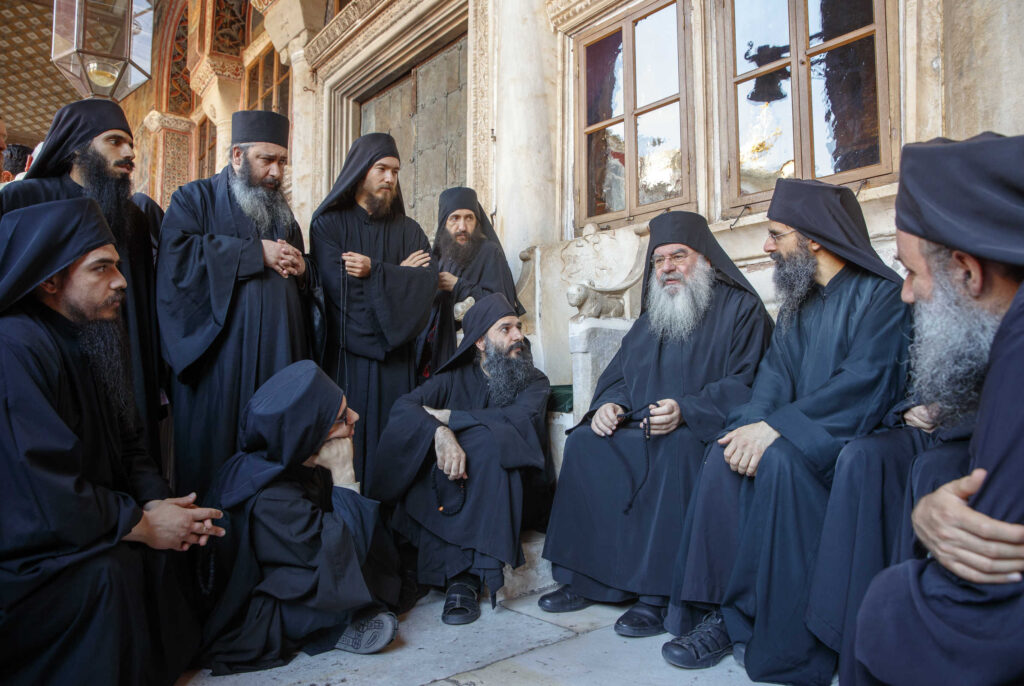
In the photo, Metropolitan Athanasios of Limassol surrounded by monks. Vatopedi Monastery, Mount Athos.
Şi a zis Dumnezeu: „Să facem om după chipul şi după asemănarea Noastră, ca să stăpânească peştii mării, păsările cerului, animalele domestice, toate vietăţile ce se târăsc pe pământ şi tot pământul!” Şi a făcut Dumnezeu pe om după chipul Său; după chipul lui Dumnezeu l-a făcut; a făcut bărbat şi femeie. (Facere 1:26-27)
După cum vedem, Sfânta Scriptură vorbește despre un singur om – vorbește la singular, chiar dacă, la prima vedere, a trebui să vorbească de doi oameni: bărbat și femeie.
Ce știm noi despre Dumnezeu? Că este un singur Dumnezeu în trei persoane: Sfânta Treime. Deci unicul Dumnezeu a făcut un singur om în multe persoane de două genuri: masculin și feminin. Din păcate, însă, această unitate originală nu mai există astăzi pentru că acest Adam unic a fost îmbucățit de păcat. Această oglindă unică, acest chip unic a unicului Dumnezeu a căzut și s-a spart în multe cioburi. Aceasta este căderea lui Adam.
Din cauza aceasta S-a întrupat Dumnezeu Cuvântul – Iisus Hristos – spunând: haideți să refacem pe Adam pentru că altfel vă chinuiți în iadul pe care singuri vi l-ați generat. Cine dorește, să se unească cu Mine și prin Mine între voi.
Ce a creat Dumnezeu? Un dumnezeu creat, o minte gigantică. Toate persoanele urmau să coopereze în timp real, pe plan mintal, fără nici un fel de dezacord pentru împlinirea aceluași scop, păstrându-și însă fiecare specificitatea sa. Deci, darul cunoașterii gândurilor este un dar natural iar vorbirea este de fapt un nivel inferior de comunicare. La oamenii care se apropie de Dumnezeu, la sfinți, acest dar al cunoașterii gândurilor reapare.
Cum, însă, se putea realiza concret acestă unire pentru același scop, păstrându-ne, însă, specificitatea? Este ca în cazul unui trup care, de exemplu, urcă o scară: picioarele fac ceva, mâinile fac altceva, ochii fac altceva – fiecare mădular face altceva, însă toate mădularele conlucrează în timp real pentru îndeplinirea aceluiași scop: urcatul pe scară a persoanei respective.
Când Sfântul Apostol Pavel spune că Biserica este trupul lui Hristos iar noi suntem mădulare în parte, Sfântul nu vorbește poetic ci într-un mod foarte concret, după cum am arătat mai sus. În acest trup, Hristos este capul iar Duhul Sfânt este sângele duhovnicesc ce dă viață în mădulare.
Nu putem găsi în alt fel fericirea și învierea noastră decât numai în acest neam duhovnicesc. Neamul adevărat este comuniunea între vii, comuniunea între morți, comuniunea între vii și morți în mijlocul Sfintei Liturghii.
Bazat pe Sfântul Sofronie de la Essex, Facere 1:26-27, 1 Corinteni 12:3-30
În fotografie, Mitropolitul Atanasie de Limassol înconjurat de părinți. Mănăstirea Vatoped, Muntele Athos.