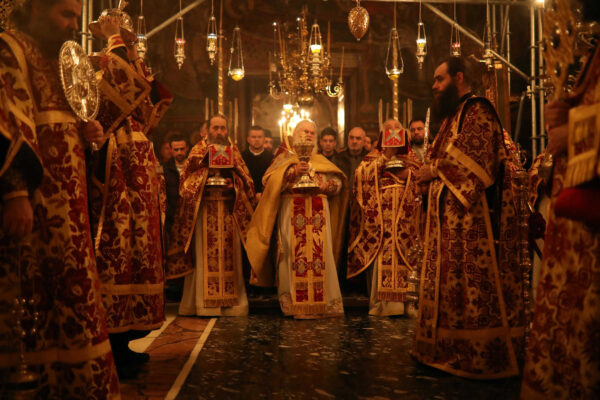
Condacul Nașterii Domnului este de inspirație divină – fotoreportaj de la Nașterea Domnului
Διαδώστε:
During the reign of Emperor Anastasios I (491-518), a young deacon moved to Constantinople. He led an ascetic life of prayer and fasting, but in his humility he thought of himself as being rather worldly.
He was not at first considered to be either a talented reader or singer. He was, however, loved by the Patriarch of Constantinople because of his great humility. Once, around the year 518, while serving in the Church of the Panagia at Blachernae, during the All-Night Vigil for the Feast of the Nativity of Christ, he was assigned to read the kathisma verses from the Psalter. He read so poorly that another reader had to take his place. Some of the lesser clergy ridiculed him for this, and being humiliated he sat down in one of the choir stalls. Overcome by weariness and sorrow, he soon fell asleep.
As he slept, the Mother of God appeared to him with a scroll in her hand. She commanded him to eat the scroll, and as soon as he did so, he awoke. He immediately received a blessing from the Patriarch, mounted the ambo (pulpit), and chanted extemporaneously his famous Kontakion of the Nativity, "Today the Virgin gives birth to Him Who is above all being…."
The emperor, the patriarch, the clergy, and the entire congregation were amazed at both the profound theology of the hymn and his clear, sonorous voice as he sang. According to tradition, this was the very first kontakion ever sung. The Greek word "kontakion" (κοντάκιον) refers to the shaft on which a scroll is wound, hence the significance of the Theotokos' command for him to swallow a scroll, indicating that his compositions were by divine inspiration.
His name? Saint Romanos the Melodist.
During his later life he composed thousands of kontakia (between 1000 and 8000). Below is the audio of the kontakion of the Nativity.
The photos are from the feast of the Nativity
În timpul domniei împăratului Anastasios I (491-518), un tânăr diacon s-a mutat la Constantinopol. Ducea o viață ascetică de rugăciune și post, dar în smerenia sa se gândea la sine ca fiind mai degrabă lumesc.
La început nu a fost considerat a fi nici un cititor talentat, nici cântăreț. El a fost însă iubit de Patriarhul Constantinopolului din cauza marii sale smerenii. Odată, în jurul anului 518, în timp ce slujea în Biserica Maicii Domnului din Vlaherne, în timpul privegherii de toată noaptea pentru Sărbătoarea Nașterii Domnului Hristos, a fost desemnat să citească catisma din Psaltire. A citit atât de prost încât un alt cititor a trebuit să-i ia locul. Unii dintre clericii inferiori l-au ridiculizat pentru acest lucru și, fiind umilit, s-a așezat într-unul din standurile corului. Învins de oboseală și întristare, a adormit în curând.
În timp ce dormea, Maica Domnului i-a apărut cu un sul în mână. Ea i-a poruncit să mănânce sulul și, imediat ce a făcut acest lucru, s-a trezit. El a luat imediat binecuvântare de la Patriarh, a montat amvonul și a cântat într-un mod extraordinar faimosul său Condac al Nașterii, „Fecioara astăzi pre Cel mai presus de fiinţă naşte…”.
Împăratul, patriarhul, clerul și întreaga adunare au fost uimiți atât de profunda teologie a imnului, cât și de vocea sa clară, sonoră, în timp ce cânta. Conform tradiției, acesta a fost primul condac cântat vreodată. Cuvântul grecesc „kontakion” (κοντάκιον) se referă la axul pe care este înfășurat sulul, de unde și semnificația poruncii Maicii Domnului de a înghiți un sul, indicând că aceste compoziții ale sale erau prin inspirație divină.
Numele lui? Sfântul Roman Melodul.
În viața sa ulterioară a compus mii de condace (între 1000 și 8000). Mai jos este o înregistrare sonoră cu condacul Nașterii Domnului.