There was a man who had two sons. The younger one said to his father, “Father, give me my share of the estate.” So, the father divided his property between them.
Not long after that, the younger son got together all he had, set off for a distant country and, there, squandered his wealth in wild living. After he had spent everything, there was a severe famine in that whole country, and he began to be in need. So, he went and hired himself out to a citizen of that country, who sent him to his fields to feed pigs.
Why does the Holy Scripture remind us of pigs and not mention other details in the life of the prodigal son that may have been more important? Because, in this way, the Holy Scripture shows us the whole process of drowning in sin:
Man departs from God, represented in the parable by the father from whom the prodigal son separates. Then, the son becomes attracted to and fades into the centers of pseudo-pleasure he finds far from God, wasting his wealth of God's grace. After spending all the grace, his soul begins to starve and is sent to guard the pigs. Why pigs?
Because the pig has several properties that make it very suitable for this parable:
- The pig, due to its anatomy, can never look up but only toward the ground.
- The pig always likes dirt. Even if you wash and clean the pig again, it returns to the dirt from which it came.
- The pig does not eat as much as it needs but as much as it can, only for the pleasure of eating
- The pig even eats its own feces. This is very disgraceful and, because of this, people tend to throw stones at the moment they see pigs such an act. But the pig, however, faces the stones and, by nodding, continues to try to eat its feces. People say that, at this point, the pig shouts "Only this one, only this one! It is hot!"
This is the state to which sin brings us: the state of the pig, a state in which we never imagined we would reach before committing sin—and yet it happens.
We say, "I will never get this far! I will never fall that low" And yet, we get there.
The key is not to demand our wealth—if it means parting from God.
Our power is to be found in God Himself—nothing lower and nothing else.
Based on Saint Luke 15: 11-15, Elder Joseph of Vatopedi
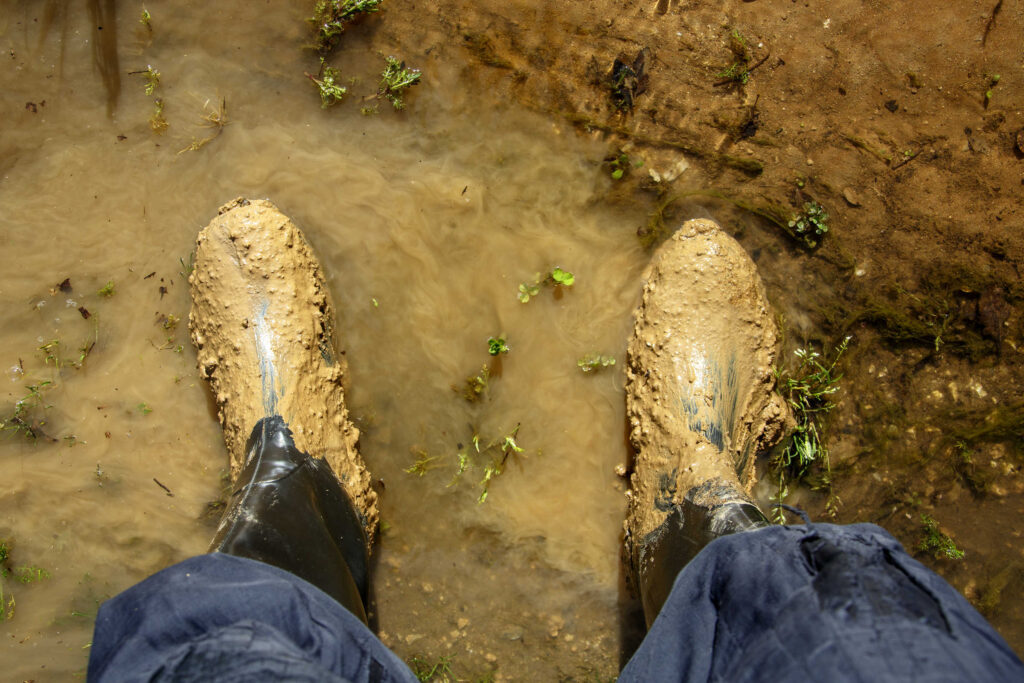
A glimpse from a footpath near Vatopedi, Mount Athos after a heavy rain
Un om avea doi fii. Şi a zis cel mai tânăr dintre ei tatălui său: Tată, dă-mi partea ce mi se cuvine din avere. Şi el le-a împărţit averea. Şi nu după multe zile, adunând toate, fiul cel mai tânăr s-a dus într-o ţară depărtată şi acolo şi-a risipit averea, trăind în desfrânări. Şi după ce a cheltuit totul, s-a făcut foamete mare în ţara aceea, şi el a început să ducă lipsă.
Şi ducându-se, s-a alipit el de unul din locuitorii acelei ţări, şi acesta l-a trimis la ţarinile sale să păzească porcii.
Luca 15:11-15
De ce Sfânta Scriptură amintește despre porci și nu menționează alte detalii din viața fiului risipitor care poate erau mai importante? Pentru că, Sfânta Scriptură ne arată în acest fel tot procesul înecării în păcat:
Omul se depăratează de Dumnezeu, reprezentat în parabolă prin tatăl de care fiul risipitor se desparte. După aceasta, este atras și se desfrânează în centrii de pseudo-plăcere pe care îi găsește departe de Dumnezeu, risipindu-și averea harului lui Dumnezeu. După ce a cheltuit tot harul, sufletul să a început să înfometeze și a fost trimis să păzească porcii. De ce porcii?
Proprietățile porcului
Pentru că porcul are câteva proprietăți care îl fac foarte potrivit pentru această parabolă:
Porcul, datorită anatomiei sale, nu se poate uita niciodată în sus ci numai în pământ. De asemenea,
Porcului îi place totdeauna în murdărie. Chiar dacă îl speli și îl cureți iarăși se întoarce la murdăria din care a ieșit.
Porcul nu mănâncă cât are nevoie ci cât de mult poate, numai din plăcerea de a mânca
Porcul își mănâncă până și fecalele. Acest lucru este foarte dizgrațios și din cauza aceasta oamenii dau cu pietre în clipa în care văd porcii făcând acest lucru. Însă totuși porcul înfruntă pietrele și, guițând, încearcă să-și mănânce fecalele. Oamenii spun că în această clipă porcul strigă „Numai acesta că-i cald!”
Aceasta este starea în care ne aduce păcatul: starea de porc, stare în care niciodată nu ne imaginam că o să ajungem înainte de a comite păcatul – și totuși se întâmplă.
Spunem: eu niciodată nu voi ajunge așa! Și totuși ajungem. Cheia este să nu ne cerem averea noastră pentru că aceasta înseamnă despărțire de Dumnezeu. Averea noastră să fie însuși Dumnezeu – nimic altceva.
Bazat pe Luca 15:11-15, Starețul Iosif Vatopedinul
Un detaliu de pe o potecă în apropierea mănăstirii Vatoped, Muntele Athos după o ploaie torențială