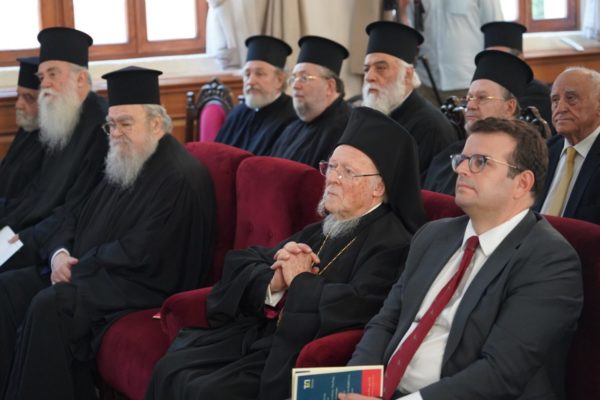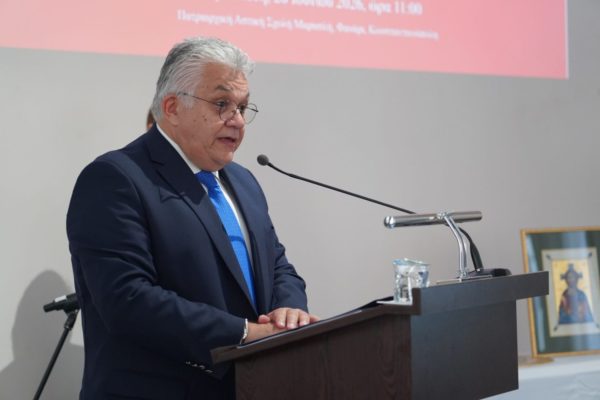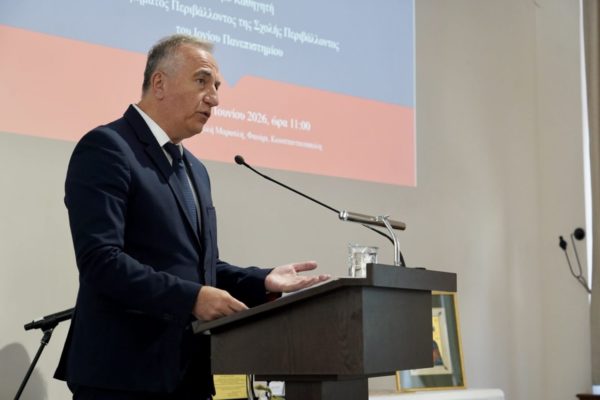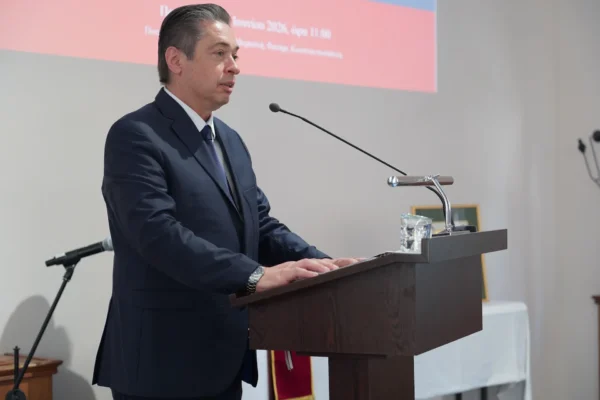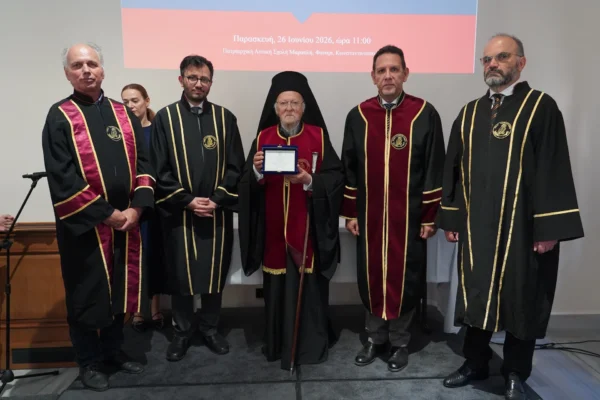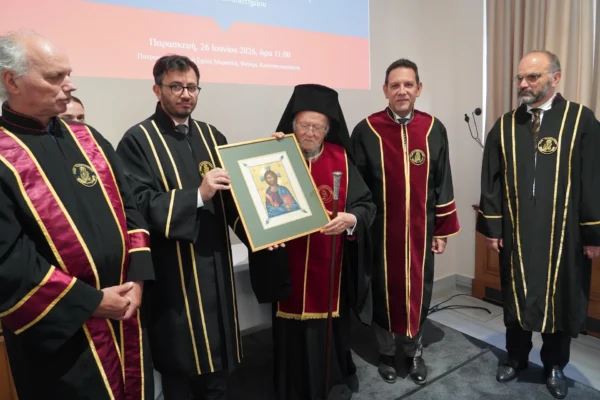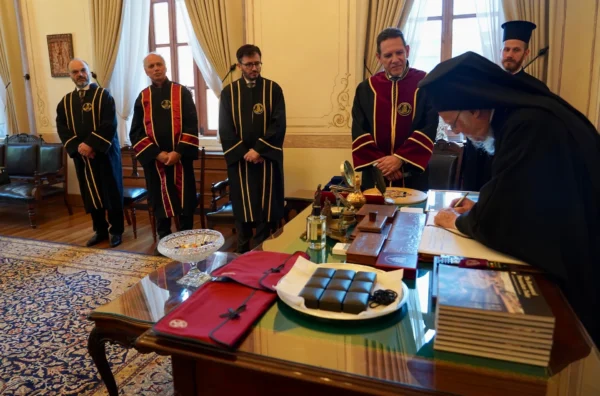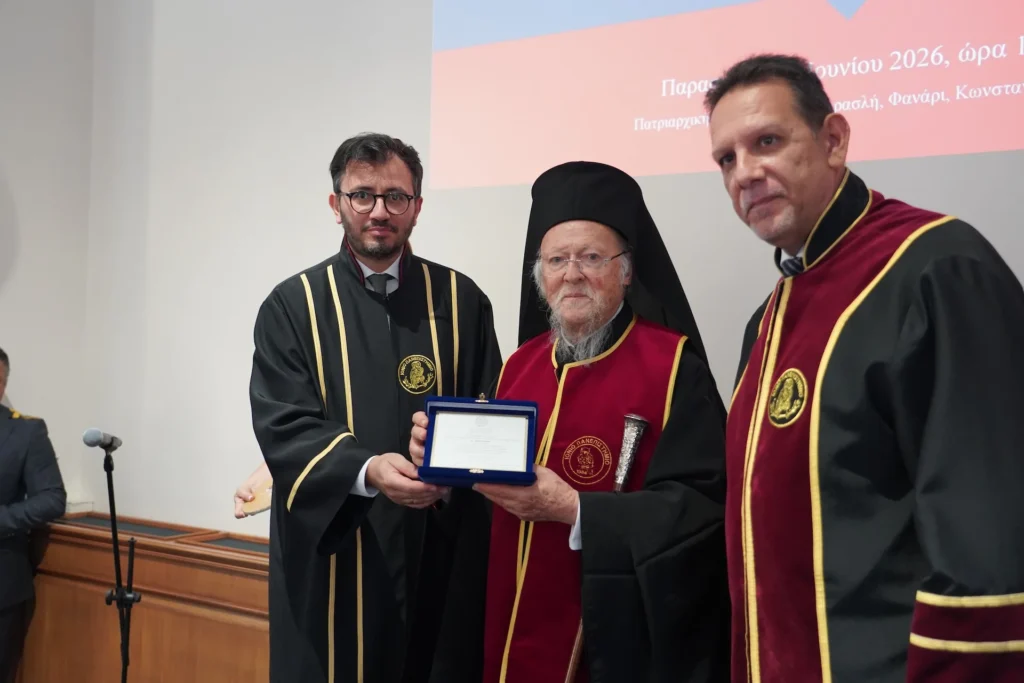
His All-Holiness Ecumenical Patriarch Bartholomew was conferred the title of Honorary Professor of the Department of Environment of the School of Environment at the Ionian University, following the unanimous decision of the University’s Senate. On the same occasion, he was also awarded the Municipality of Zakynthos’ special Honorary distinction entitled “High Protector of Zakynthian Letters and the Environment,” during an official ceremony held on Friday, 26 June 2026, at the Patriarchal Maraslis Urban School in the Phanar.
Among those in attendance were Their Eminences, Elder Metropolitan Apostolos of Derkoi, Elder Metropolitan Dimitrios of the Princes’ Islands, Metropolitan Chrysostomos of Dodoni, Metropolitan Apostolos of Miletus, Metropolitan Meliton of Philadelphia, Metropolitan Eirinaios of Myriophyton and Peristasis, Metropolitan Dionysios of Zakynthos, Metropolitan Stephanos of Kallioupolis and Madytos, Metropolitan Athenagoras of Kydonies, Metropolitan Maximos of Selyvria, Metropolitan Ioakeim of Bursa, Metropolitan Theodoros of Seleuceia, and Metropolitan Gregorios of Ankyra; Their Graces Bishop Adrianos of Halicarnassus and Bishop Nikephoros of Amorion; clergy, monks and nuns; Archons of the Ecumenical Patriarchate; the Deputy Minister of Education, Nikolaos Papaioannou, and the Deputy Minister of Development, Stavros Kalafatis, representing the Hellenic Government; the Mayor of Lefkada, Xenophon Verginis; other local government officials; the Consul of Greece, Theophilos Georgakis, representing the Consul General of Greece in Constantinople, together with members of the Consulate General; representatives of the Ionian University; members of the Greek Orthodox community; and visitors from Greece.
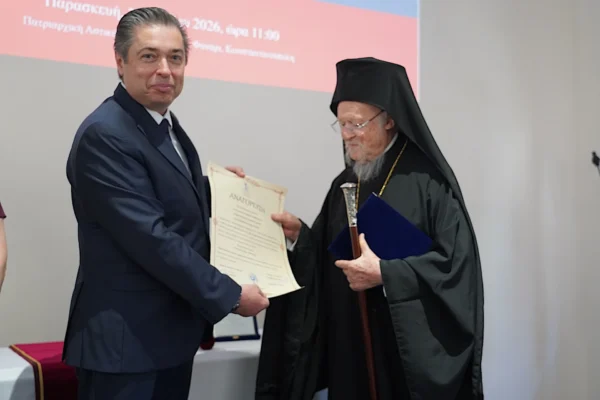
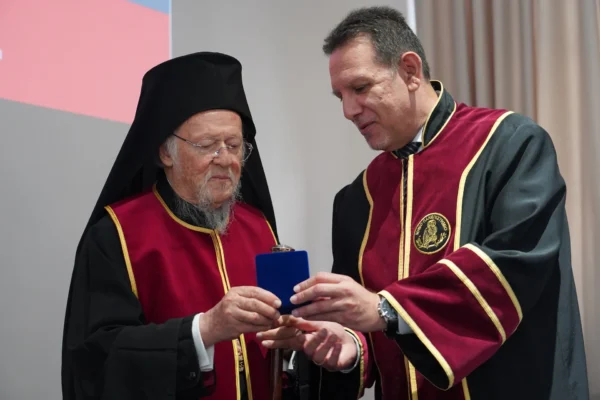
Addresses were delivered by the Deputy Ministers, after which the Mayor of Zakynthos, Georgios Stasinopoulos, presented the Ecumenical Patriarch with the Municipality’s special honorary distinction, in accordance with the unanimous decision of the Municipal Council.
The Mayor warmly welcomed the Ecumenical Patriarch, who, in his reply, stated, among other things:
“With gratitude, We accept the proclamation of Our Modesty as ‘High Protector of Zakynthian Letters and the Environment’ by your Municipality, and, through you, dear Mr. Mayor, We extend Our heartfelt thanks to the historic Municipality of Zakynthos for this exceptional honour bestowed upon Our humble person.
The supreme institution of our Nation, which We have had the privilege of serving for the past thirty-five years, has long stood as the guardian of education, both Christian and secular. Through the establishment of schools and academies, it preserved and cultivated the Greek language, our enduring spiritual and cultural heritage, and our traditions, extending its influence throughout the East and beyond. In recent decades, the Holy Great Church of Christ has also added to its noble mission a steadfast commitment to the protection of the natural environment, an undertaking that has achieved and continues to enjoy worldwide recognition.”
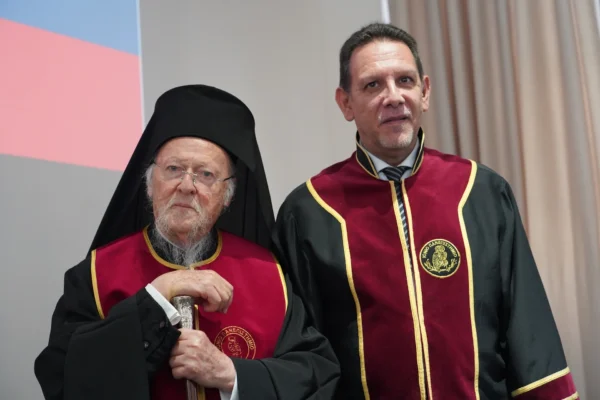
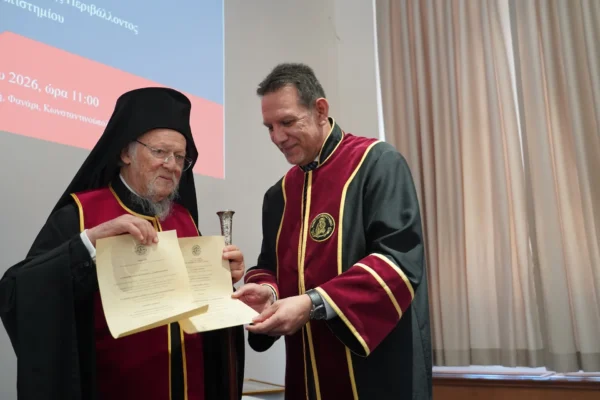
Following these remarks, the Ecumenical Patriarch was formally invested as Honorary Professor of the Department of Environment of the School of Environment at the Ionian University.
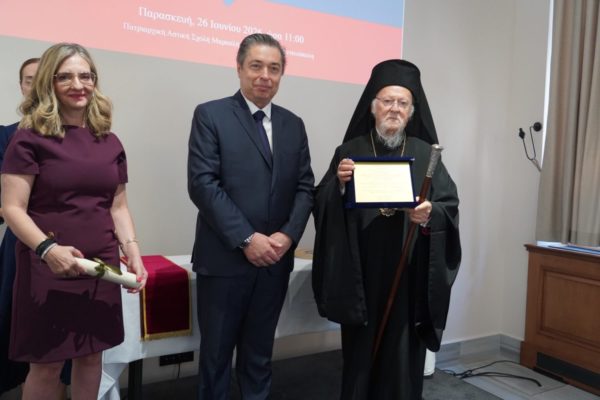

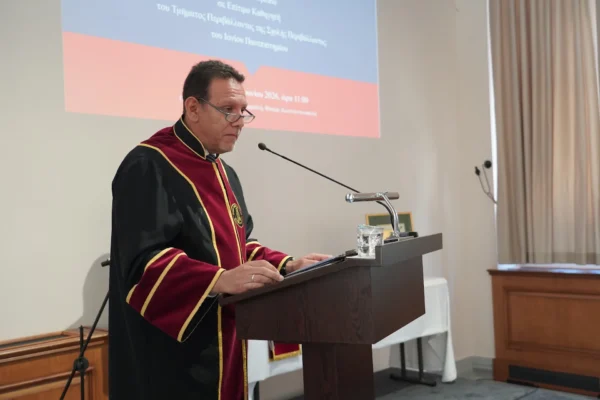
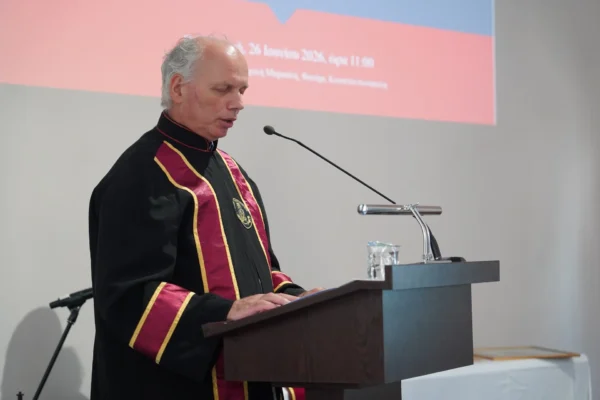
The Ecumenical Patriarch was formally addressed by the Rector of the Ionian University, Professor Andreas Floros [Read Professor Floros’ address HERE], while the Laudatio in honour of the recipient was delivered by the Chair of the Department of Environment, Professor Christos Karydis [Read Professor Karydis’ address HERE].
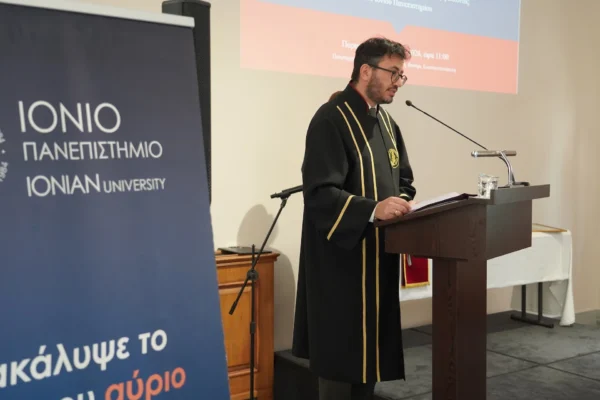
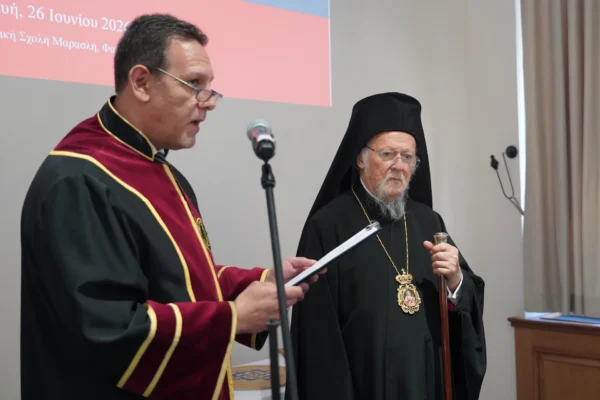
The Resolution of the Department was read by the Dean of the School of Environment, Professor Konstantinos Poirazidis, and was subsequently presented to the Ecumenical Patriarch by the Rector of the Ionian University.
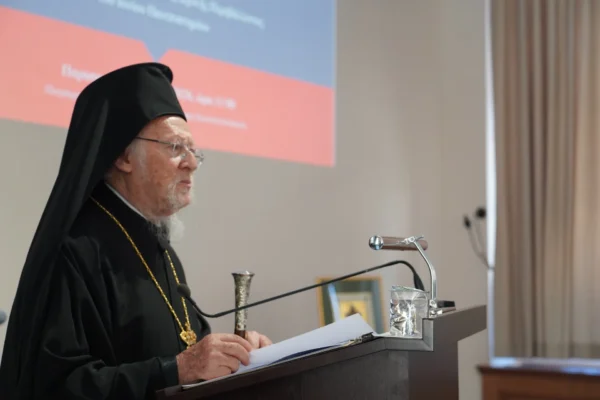
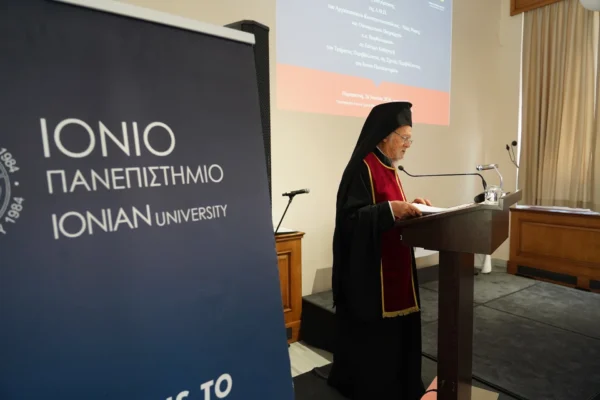
In his response, the Ecumenical Patriarch expressed his gratitude to the Senate of the Ionian University for the distinction bestowed upon him and, among other things, stated:
“There can be no doubt that the natural environment is more gravely threatened in our time than at any other period in history. Today, a ‘third world war against nature’ is being waged. The prevailing model of economic development, the ‘autonomy of the economy’ and the so-called ‘fundamentalism of the market,’ together with contemporary scientific and technological advances and the widespread pursuit of individual and collective material well-being, have further intensified ecological problems and foreshadow new crises.
The consequences of the ecological crisis recognise no national or cultural boundaries. They imperil the very conditions necessary for the survival not only of the human race but of life on our planet as a whole. The climate crisis is not a ‘future scenario’; it is a painful reality, manifested in the rapid loss of biodiversity, widespread deforestation, the pollution of the atmosphere and the seas, and increasingly devastating wildfires and floods.
Despite the reactions and resistance to this threat, the destruction of the Earth continues, while, at the same time, the misguided notion persists that nature possesses the inherent capacity to restore itself indefinitely. It is hardly encouraging that humanity fully recognises the gravity of the environmental crisis, yet continues to behave as though it were unaware of it.
The Ecumenical Patriarchate is widely known for its ecological initiatives, the beginning of which was marked by the Patriarchal and Synodal Encyclical of the Indiction in 1989, through which 1 September was established as a Day of Prayer for the Protection of the Natural Environment. Since then, the Church of Constantinople has taken a leading role in fostering ecological awareness, giving tangible expression to the ecological ethos inherent in the Eucharistic and ascetical tradition of Orthodoxy. During Our humble Patriarchate, this commitment has been advanced through a wide range of environmental initiatives, including nine international interdisciplinary and interfaith symposia held aboard ship, as well as seminars, lectures, book publications, environmental declarations, and numerous other activities. The Ecumenical Patriarchate’s ecological initiatives have inspired parliaments, universities, research institutions, the educational community, and environmental organizations, while also serving as a catalyst for the incorporation of ecological concerns into inter-Christian and interfaith dialogue.
We wish to emphasise that the Church’s concern for the protection of the natural environment did not arise merely as a reaction to the contemporary ecological crisis. The environmental challenges of our age indeed provided the occasion, but not the cause, for the Orthodox Church’s ecological engagement. Rather, they offered the opportunity to articulate more fully the Church’s teaching on the relationship between the human person and the natural world, and to proclaim the need to safeguard God’s creation, which Holy Scripture declares to be “very good” (Genesis 1:31). The unwavering concern of the Church for the ecological crisis is rooted in the very identity of Orthodoxy itself. Ecclesial life is ‘lived ecology’, a concrete expression of care for creation and a victory over all those forces that give rise to ecological destruction. The culture of Orthodoxy is, by its very nature, ecologically minded.”
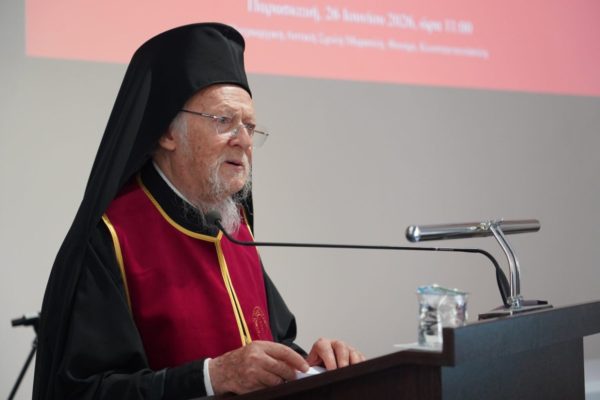
In conclusion, the Ecumenical Patriarch stated:
“Most esteemed Mr. Rector, Mr. President, and esteemed Professors,
You represent the University, the palladium of the sciences; you are ministers of science, which today constitutes a great power that is rapidly transforming our lives. The Holy and Great Council of Crete referred to the ‘capacity for scientific research’ as a ‘God-given gift to humanity’ (The Mission of the Orthodox Church in the Contemporary World, VI, 11). No reasonable person can dispute the manifold benefits of science and its applications in technology.
At the same time, however, it is undeniable that science cannot provide answers to the great existential and social problems that afflict humanity. Responses to these problems are offered by other forces, first and foremost, religious faith. Based on these data, we consider it both erroneous and unprofitable to approach faith and science as opposing forces. In essence, they are co-workers in the service of humanity.
It is certain that, together with science and technology, the contemporary ‘superpower’, the future of humanity is also linked to the spiritual ‘great power,’ namely religion. Without reference to religion, we cannot understand the past, analyse the present condition, envision the future, give meaning to our lives, or address the threshold situations of human existence.
Concerning the presence of religions, our era is characterised by the simultaneous emergence of two tendencies: their dynamic return to the forefront of history, and the appearance of distortions of the religious phenomenon, which not only alter the authentic expression of religious faith but also threaten peace and cooperation among peoples. One such phenomenon is religious fundamentalism, described in the Encyclical of the Holy and Great Council (§ 17) as an ‘expression of pathological religiosity,’ which bears no relation to the authentic experience of faith in God.
With these thoughts and sentiments, once again affirming our conviction that a theological approach to the contemporary ecological crisis reveals dimensions inaccessible to other interpretations and opens new possibilities for overcoming it, we extend our heartfelt thanks to all of you and to each one of you individually for your presence and your kind participation in today’s ceremony. We also express, through your person, Most Esteemed Mr. Rector, to the Senate of the Ionian University and to your entire academic community, our gratitude for the exceptional honour of conferring upon Our Modesty the title of Honorary Professor of the Department of Environment.
And, imparting to all of you the blessing of the Holy Great Church of Christ, We wish you steadfast health, spiritual joy, and every blessing from above.”
Photographs: Nikos Papachristou