Outside of Church services, an Orthodox Bishop is recognizable by his wearing a traditional necklace-chain and medallion depicting a small, circular icon of the Saviour or of the Theotokos (the Mother of our Lord). This necklace and medallion is called an Engolpion, worn over the Bishop’s heart as a reminder that the Bishop must always bear in his heart our Lord and His mother, and to keep his heart pure.
Inside our Church services, the Bishops are more easily recognizable because of distinctive signs that clearly distinguish them from the other clerics who take part in the service. Such recognition lies in the specific vestments of the Bishop.
The first distinguishing sign of a Bishop’s vestments is the omophorion, a long and wide piece of textile material that is wrapped around the Bishop’s neck and shoulders, making up a complete revolution—as opposed to the epitrachelion of the priest, which is wrapped only in half. The omophorion is much wider than the priest's epitrachelion or the deacon's orarion, is usually decorated with crosses, and symbolizes the lost sheep that the Good Shepherd carries on His shoulders. It is the symbol of the bishop's spiritual and ecclesial authority.
Also visible is the miter (the crown) that was taken over from the Byzantine emperors. It is, in fact, their crown, designed today in a stylized form because, after the fall of Constantinople (under the Turks), the Patriarch was forced to assume part of the Emperor’s responsibilities toward the Greek people. Usually, only the first bishop in the rank wears a miter when serving. Even if the miter is specific to the bishops, it can also (rarely and, more so, historically) be granted to archimandrites and archpriests. The miter symbolizes the crown of thorns on the head of our Lord Jesus Christ.
The sakkos is a relatively large-sleeved coat that ends slightly below the knee with a cross on the back. In the beginning, Bishops wore a phelonion like the priests, but adorned with many crosses, called polystavrion ("many crosses"). The sakkos was the official clothing of the Byzantine emperor and it was especially offered by the emperor to certain patriarchs as a sign of personal favor. In time, around the 13th century, the sakkos became worn by all the patriarchs and, after the fall of Constantinople, the sakkos became worn by all the bishops, regardless of rank. The sakkos represent the tunic of disgrace that Jesus wore during His mockery and judgment. Traditionally, on the sakkos are attached bells, following the Old Testament tradition according to the indications related to the High Priest (Exodus 28: 33-34; 39: 25-26).
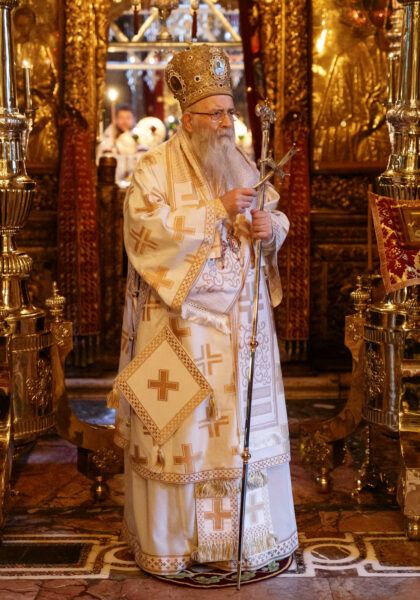
The Bishop’s Church staff is the sign of the pastoral service and is significantly longer than the more-plainly presented staff carried by the Bishop outside of Church services. At the end of the Church staff are two snakes, reminiscent of the bronze serpent raised in the desert by Moses, which now symbolizes the crucifixion of the Lord by which we are saved from sin.
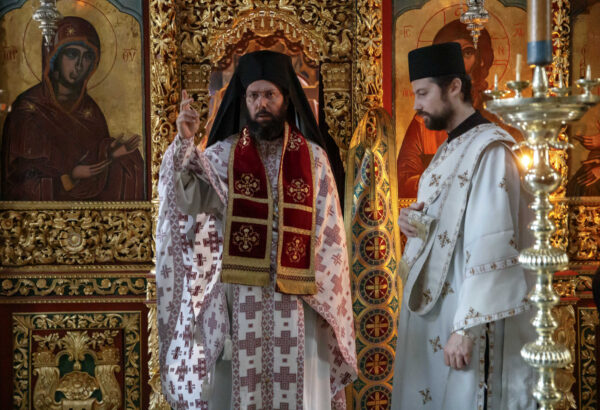
If the Bishop serves as a simple priest: from the above distinctive signs, the Bishop will have only the omophorion worn as an epitrachelion.
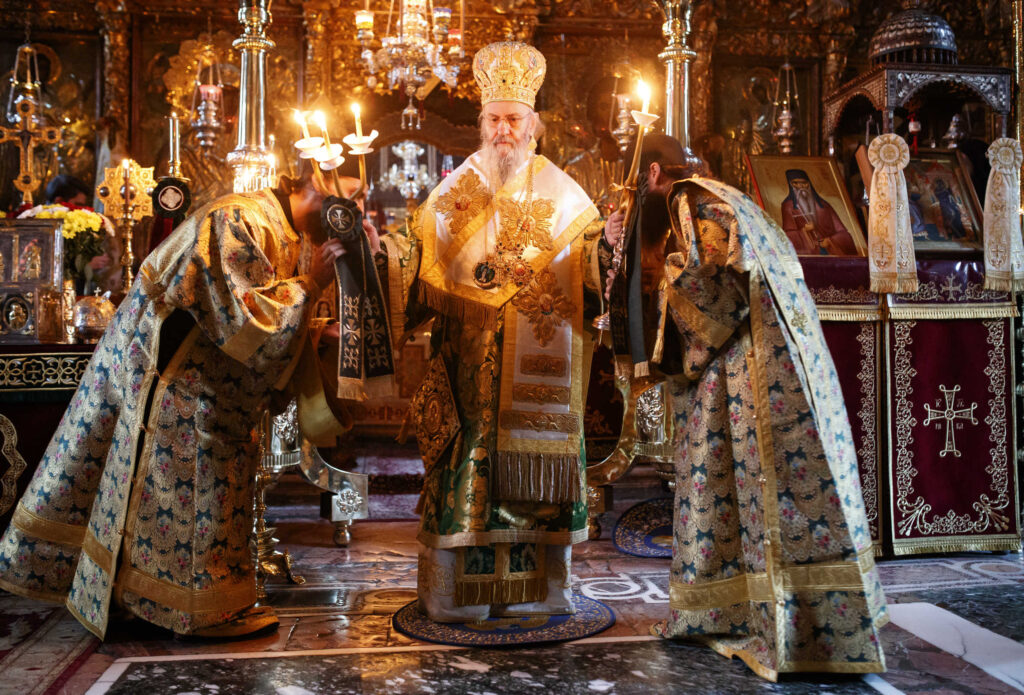
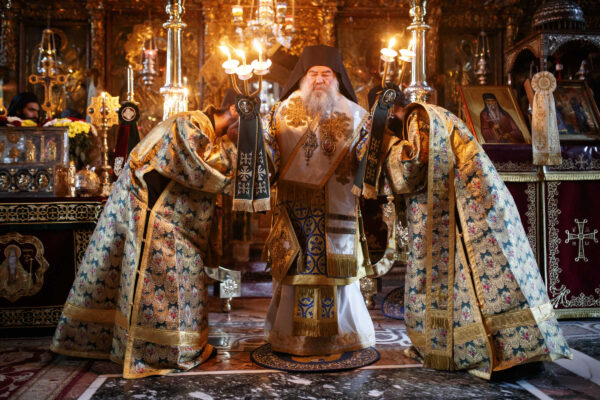
In the following photographs, you may see the following bishops serving: Metropolitan Ierotheos Vlachos of Nafpaktos, serving as a protos; Metropolitan Athanasios of Lemessos, serving the same liturgy as the second archbishop; Metropolitan Joseph of Prikonisou, with a sakkos with polystavrion and Church staff; and Metropolitan Arsenios of Austria, serving as a simple priest, having just the omophorion, a phelonion with polystavrion and koukoulion.
Dincolo de egolpioanele pe care le poartă și în afara slujbelor, episcopul ortodox este ușor de recunoscut în timpul slujbelor datorită unor semne distinctive care îl deosebesc clar de ceilalți clerici care iau parte la slujbă.
Omoforul
Semnul distinctiv este omoforul, o bucată lungă și lată de material textil care este înfășurată în jurul gâtului și pe umeri alcătuind o revoluție completă spre deosebire de epitrahilul preotului care este înfășurat doar pe jumătate. Omoforul este mult mai lat decât epitrahilul preotului sau orarul diaconului, este decorat cu cruci și simbolizează oaia pierdută pe care Bunul Păstor o duce pe umeri. Este simbolul autorității sale spirituale și ecleziale.
Mitra
Foarte vizibilă este de asemenea și mitra care a fost preluată de la împărații bizantini. Este de fapt, coroana acestora, astăzi într-o formă stilizată, pentru că în urma căderii Constantinopolului sub turci, Patriarhul a fost nevoit să preia asupra lui o parte din responsabilităţile faţă de poporul grec. De obicei, doar primul arhiereu în rang poartă mitră când slujește. Chiar dacă mitra este specifică arhiereilor, poate fi acordată și protopresviterilor și arhimandriților. Mitra simbolizează cununa de spini de pe capul Domnului nostru Iisus Hristos.
Sakkosul
Sakkosul este haina cu mâneci largi, relativ scurtă care se termină puțin mai jos de genunchi având o cruce pe spate. La început arhiereii purtau un felon ca și preoții însă împodobit cu multe cruci, numit polystavrion („multe-cruci”). Sakkosul era haina oficială a împăratului bizantin și era oferit în mod special de acesta anumitor patriarhi în semn de favoare personală. În timp, în jurul secolului al 13-lea, sakkosul a ajuns să fie purtat de toți patriarhii iar după căderea Constantinopolului, sakkosul este purtat de către toți arhiereii, indiferent de rang. Sakkosul reprezintă tunica defăimătoare pe care Iisus a purtat-o în timpul batjocurei și judecății Sale. În mod tradițional sunt atașați clopoței urmând indicațiile din Vechiul Testament legate de Arhiereul neamului (Ieșirea 28:33-34; 39:25-26).
Cârja
Cârja este semnul pastorației și este semnificativ mai lungă decât bastonul purtat în afara slujbelor. La capătul cârjei sunt doi șerpi, amintind de șarpele de aramă ridicat în pustie de către Moise care simboliza răstignirea Domnului prin care suntem scăpați de păcat.
Ca simplu preot
Dacă episcopul ortodox slujește ca simplu preot din cele de mai sus va avea doar omoforul purtat ca un epitrahil (omoforul mic).
În fotografii diverși arhierei slujind: Mitropolitul Ierotheos Vlahos de Nafpaktou slujind ca protos, Mitropolitul Atanasie de Lemessos slujind la aceeași liturghie ca al doilea arhiereu, Mitropolitul Iosif de Prikonisu cu sakkos cu polistavrion și cârjă, Mitropolitul Arsenie de Austria slujind ca și simplu preot, având doar omoforul, un felon cu polistavrion și camilafcă
Mitropolitul Athanasie de Limassol slujind Liturghia ca al doilea episcop
Mitropolitul Iosif de Prikonisou cu sakkosul având polistavrion și cârja
Mitropolitul Arsenie de Austria slujind ca simplu preot, având doar omoforul, un felon cu polistravion și camilafca