
For more than half of the 20th century, two men—equally dynamic yet distinctively gifted leaders—served as Archbishop of the Greek Orthodox Archdiocese of America. Among their many personal endeavors and accomplishments as clergymen, hierarchs, and stewards of Hellenic society and culture, Athenagoras (+1972) and Iakovos (+2005) shared an extensive interest and involvement in the ecumenical movement. Specifically, both men were directly responsible for orchestrating one of the most remarkable episodes in Church history: the first face-to-face meeting of a Pope and an Ecumenical Patriarch in over five-hundred years. [1]
While such an event may seem mundane to us today—perhaps even a formality for the leaders of two great, globe-spanning communions—this was not the case a mere seven decades ago. The pioneering efforts of Ecumenical Patriarch Athenagoras and Archbishop Iakovos opened a channel of communication between the Orthodox and Catholic Churches that soon blossomed into a genuine friendship, a “dialogue of love,” that fruitfully links today the historic centers of Western and Eastern Christianity: Rome and New Rome, the Vatican and the Phanar.
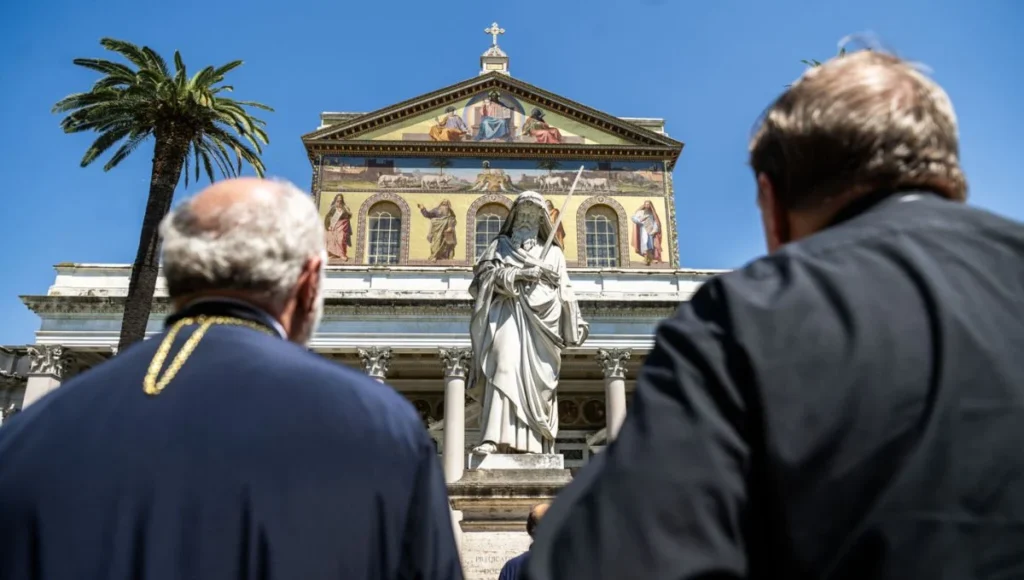
As His Eminence Archbishop Elpidophoros of America prepares to lead a joint pilgrimage, “From Rome to New Rome,” with His Eminence Cardinal Joseph Tobin, Roman Catholic Archbishop of Newark, it is worth revisiting the early contributions of his distinguished archepiscopal predecessors to establishing and advancing contemporary Orthodox-Catholic relations.
Bishop Iakovos and the World Council of Churches
In 1954, Ecumenical Patriarch Athenagoras, formerly the Archbishop of North and South America, appointed a promising young Archimandrite, Fr. Iakovos Coucouzes, to represent the Ecumenical Patriarchate at the World Council of Churches (WCC) in Geneva. Fr. Iakovos had distinguished himself in America over the course of fifteen years as a beloved pastor, able parish administrator, and forward-thinking religious educator. He was responsible for spearheading an incredibly successful Sunday School program as well as many other youth-oriented initiatives while serving as Dean of the Annunciation Cathedral in Boston. In this capacity, Fr. Iakovos introduced his Greek American flock to the ecumenical character of contemporary Christianity, emphasizing their duty as Orthodox Christians to engage both discerningly and charitably with the world around them.
Following his consecration as Bishop of Melita in the Patriarchal Cathedral of St. George in the spring of 1955, Iakovos assumed his new position in Geneva. Over the next four years, Bishop (and soon Metropolitan) Iakovos earned a reputation among the diverse gathering of delegates, observers, and students present at the WCC as a tireless advocate for Christian unity, eager to bring his Orthodox faith to bear on contemporary issues of war and peace, racial reconciliation, and human rights. In fact, it was during this time in Geneva that Metropolitan Iakovos became acquainted with a young Black pastor from Atlanta, Georgia, by the name of Rev. Dr. Martin Luther King, Jr.
Three Months in 1959
In the early months of 1959, two consequential events coincided. The unexpected death of Archbishop Michael (Constantinides) in July of the previous year had left the Archdiocese of North and South America without an archbishop. While arrangements were underway at the Phanar to elect his successor, an entirely unrelated but ultimately fortuitous announcement issued forth from the Vatican. On January 25th, 1959, the newly minted Pope John XXIII, declared his intent to convoke a universal council of the Catholic Church in Rome. The impact of this papal pronouncement was widely and immediately felt. Among those who expressed an early and keen interest in the imminent council was Ecumenical Patriarch Athenagoras.
Weeks later, on February 14th, Metropolitan Iakovos was elected the new Archbishop of North and South America by the Patriarchal Synod. Before travelling to New York for his enthronement, however, Metropolitan Iakovos was tasked with a final ecumenical mission. He was asked by Patriarch Athenagoras to visit the Vatican and speak with Pope John XXVIII. He was to discuss if and how the upcoming council might provide opportunities for pursuing Orthodox-Catholic rapprochement. Specifically, Patriarch Athenagoras was interested in the possibility of lifting the mutual anathemas that had formally split the Orthodox and Catholic Churches in 1054.
So, on March 17th, 1959, Metropolitan Iakovos met the Pope—the first Patriarchal representative to do so in over three-hundred years. He then proceeded on his way to America, where he was enthroned at the Archdiocesan Cathedral of the Holy Trinity on April 1st. Following this historic meeting, a series of back-and-forth exchanges involving various other representatives from the Vatican and the Phanar ensued. By the opening session of the Second Vatican Council (Vatican II) in the fall of 1962, a channel of communication had been established at the highest of levels, yet relations remained formally distant and rather impersonal.
Pilgrims Reunited
As Pope John XXVIII neared the end of his fatal battle with stomach cancer in May of 1963, he received an unexpected letter from Patriarch Athenagoras wishing him good health. This simple and well-meaning gesture sparked a cordial exchange of letters between Patriarch Athenagoras and Pope John’s successor, Paul VI. In a sign of warming relations, the Ecumenical Patriarchate sent its first official observer to the second session of Vatican II later that year. Then, in December, when Pope Paul VI announced he would shortly go on pilgrimage to Jerusalem, Patriarch Athenagoras openly expressed an ardent desire to meet him there. Within less than a month, having informed the other autocephalous Orthodox Churches of his impending trip and coordinated the necessary details with the Vatican, Ecumenical Patriarch Athenagoras set off for Jerusalem, in his words, “to say ‘good morning’ to my beloved brother, the Pope.”
It was thus on pilgrimage to Jerusalem in the opening days of 1964, that Pope Paul VI was joined in prayer and fellowship on the Mount of Olives by his brother hierarch, Ecumenical Patriarch Athenagoras. Present in the background on this historic occasion was Archbishop Iakovos, who could surely rejoice that his ecumenical mission nearly five years prior had not been in vain. This initial joy was likely surpassed only two years later when, on December 7th, 1965, a joint declaration read at the Vatican and the Phanar formally lifted the mutual anathemas of 1054. That same year, as head of the Standing Conference of the Canonical Orthodox Bishops of America (SCOBA), Archbishop Iakovos established in the U.S. the world’s first bilateral Orthodox-Catholic theological dialogue, which remains active to this day and is presently co-chaired by Cardinal Tobin and His Eminence Metropolitan Methodios of Boston.
This brief recounting of the early contributions of two former Archbishops of America to establishing and advancing Orthodox-Catholic relations leaves out many interesting details and passes over instrumental figures in an otherwise intricate and evolving story. For instance, no mention was made of a young deacon studying in Rome at the time who, some years later as a priest, would coedit the official publication documenting these early years of Orthodox-Catholic encounter, even lending it the title, Τομος Αγαπης (“Volume of Charity”). That person, of course, is His All-Holiness Ecumenical Patriarch Bartholomew, whose longstanding connection to Rome and the Catholic Church culminated in the extraordinary friendship he shared with the late Pope Francis. In the coming weeks, while on pilgrimage “From Rome to New Rome,” Archbishop Elpidophoros will have an opportunity, much like his predecessors, to pave the way for another historic meeting of a Pope—the newly enthroned Leo XIV—and the Ecumenical Patriarch this November in the ancient city of Nicaea.[CR1]
Conclusion
In his 2020 Economos lecture delivered at Fordham University, Archbishop Elpidophoros characterized the evolution of Orthodox-Catholic relations in the U.S. as “the transformation of the dialogue of charity [agape] into the dialogue of truth, that is to say, the shift from gestures of rediscovered fraternity to an exchange of theological programs, mark[ing] the fruitful maturation and growing confidence to tackle the heart of our divisions.” With this growing confidence in the common pursuit of truth in mind, he went on to state: “I am convinced that the future and mission of Roman Catholic and Orthodox relations here in the United States is to continue to bear witness to God’s presence in the world, faithful to the spirit of Jerusalem, that we receive as a legacy.”
It is precisely this “spirit of Jerusalem”—an ecumenical legacy inherited from his distinguished predecessors—that His Eminence Archbishop Elpidophoros seeks to affirm and extend as he travels alongside a brother hierarch on pilgrimage “From Rome to New Rome.”
[1] Much of the information presented here is adapted from an article composed by Fr. John Chryssavgis for the Apostolic Pilgrimage to Jerusalem of Ecumenical Patriarch Bartholomew and Pope Francis in 2014. See John Chryssavgis, “Pilgrimage Toward Unity: Ecumenical Patriarch Athenagoras and Pope Paul VI in Jerusalem (1964) Based on Correspondence and Archives,” https://www.apostolicpilgrimage.org/historicmeeting.html
Photos: Orthodox Observer/Brittainy Newman