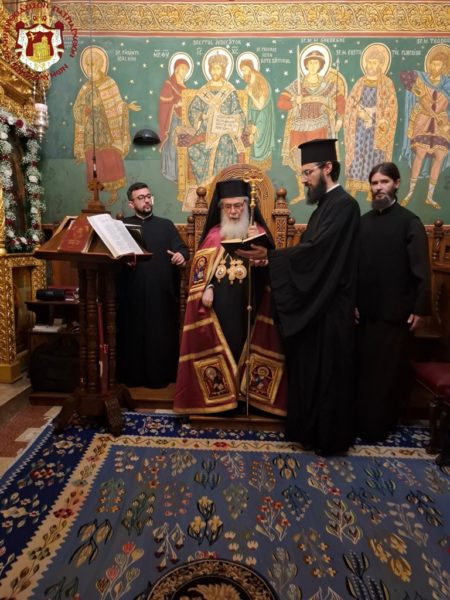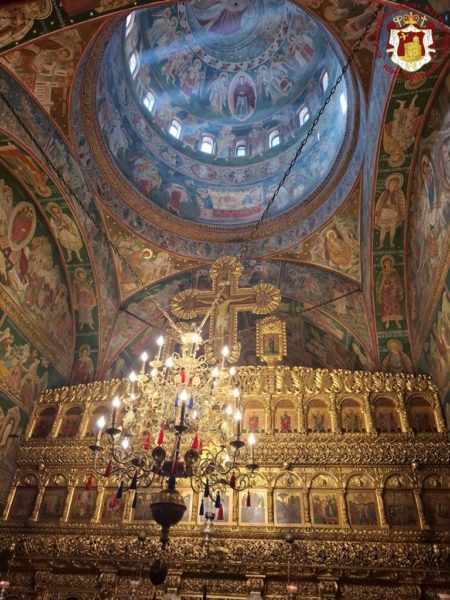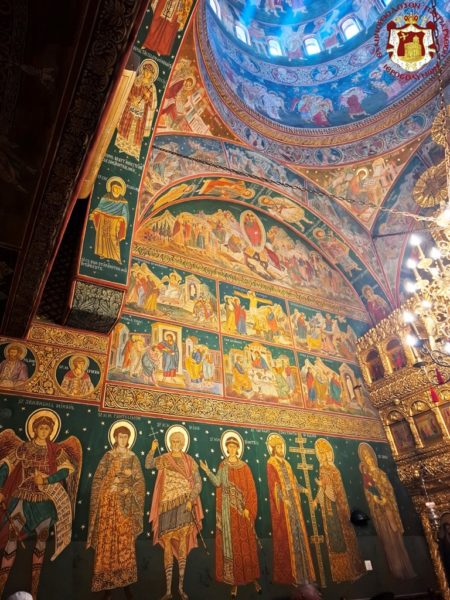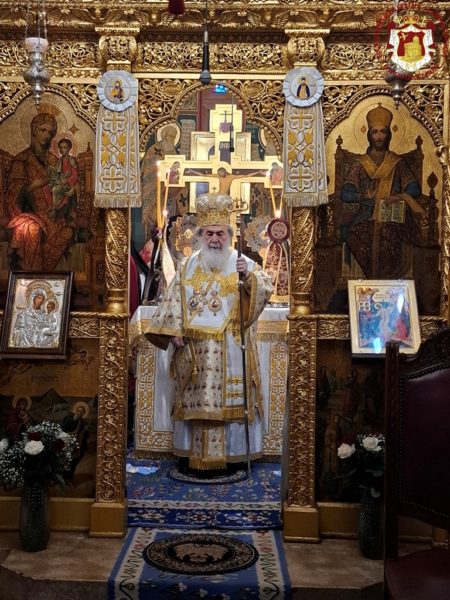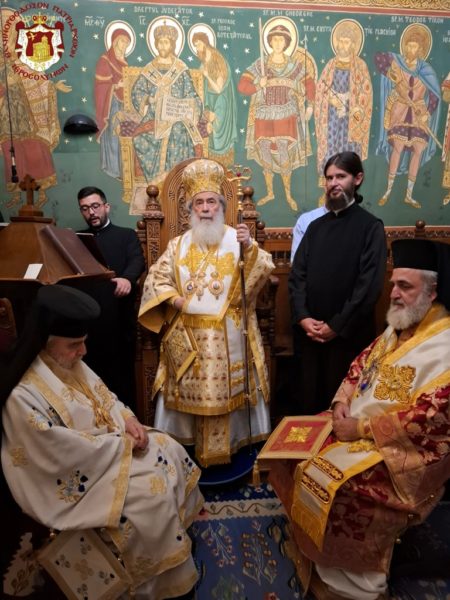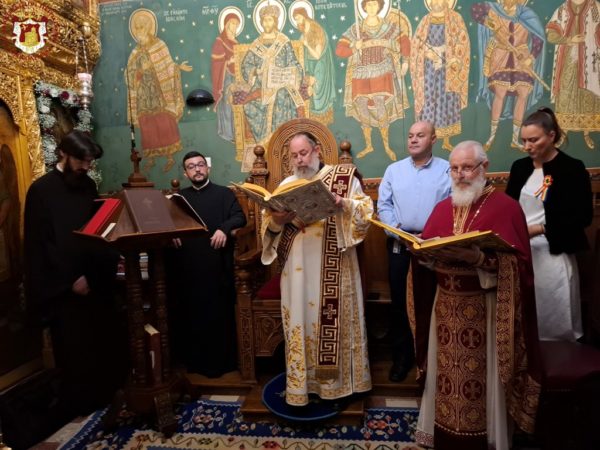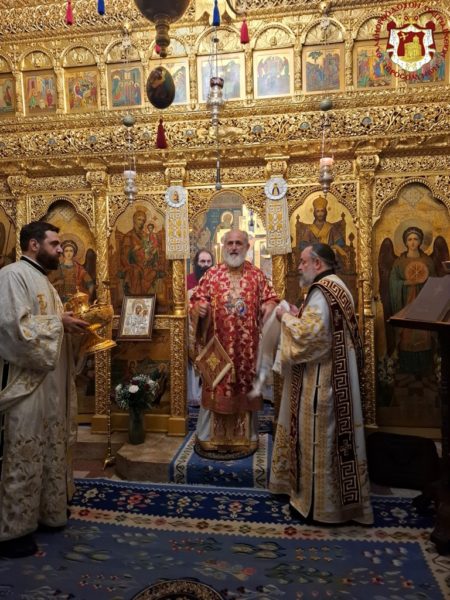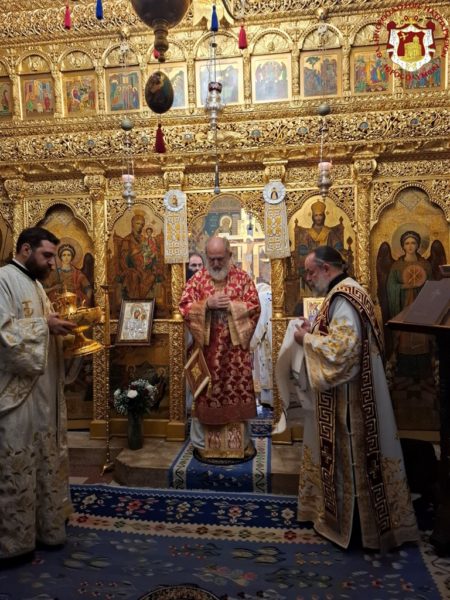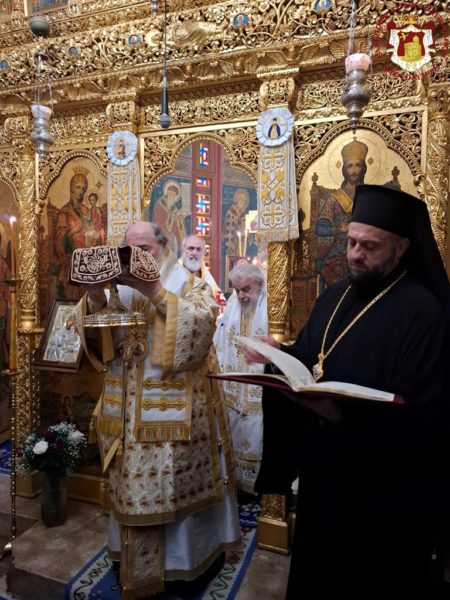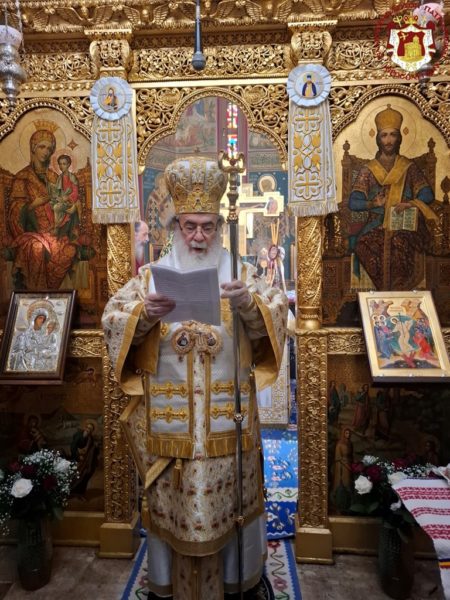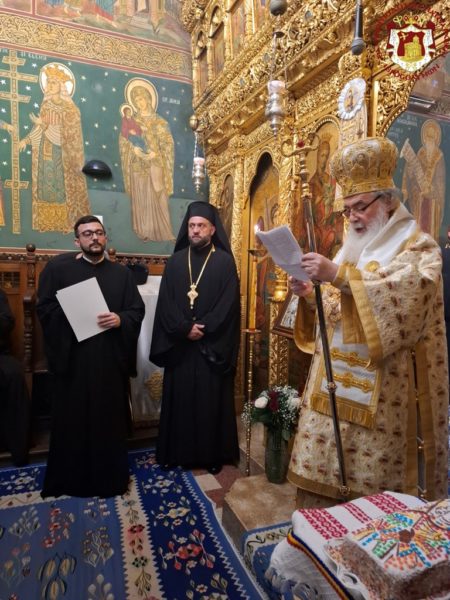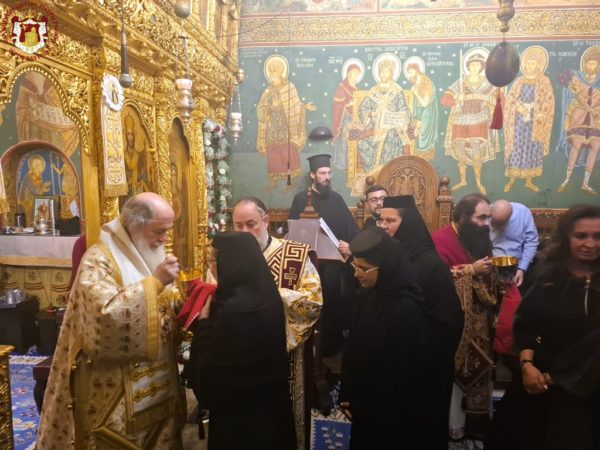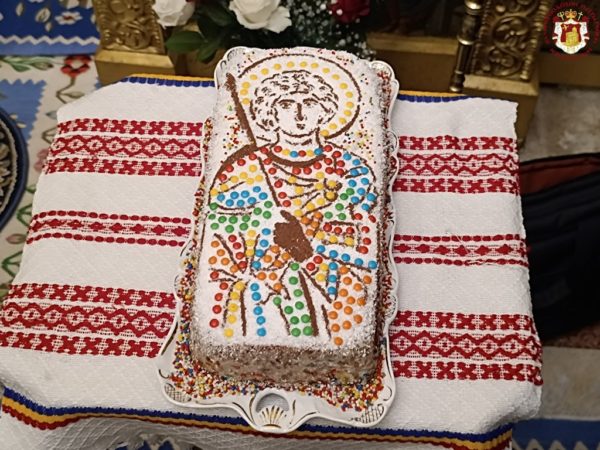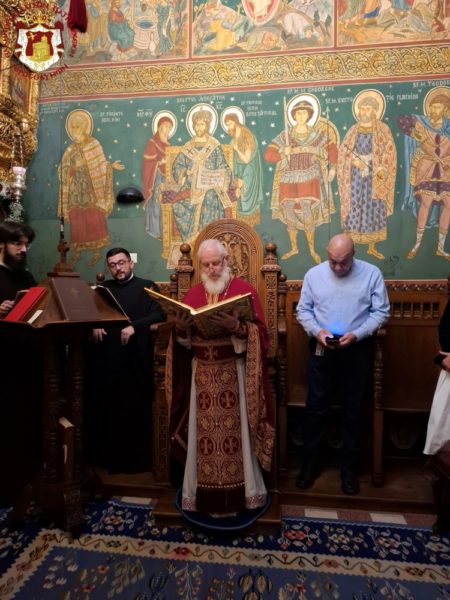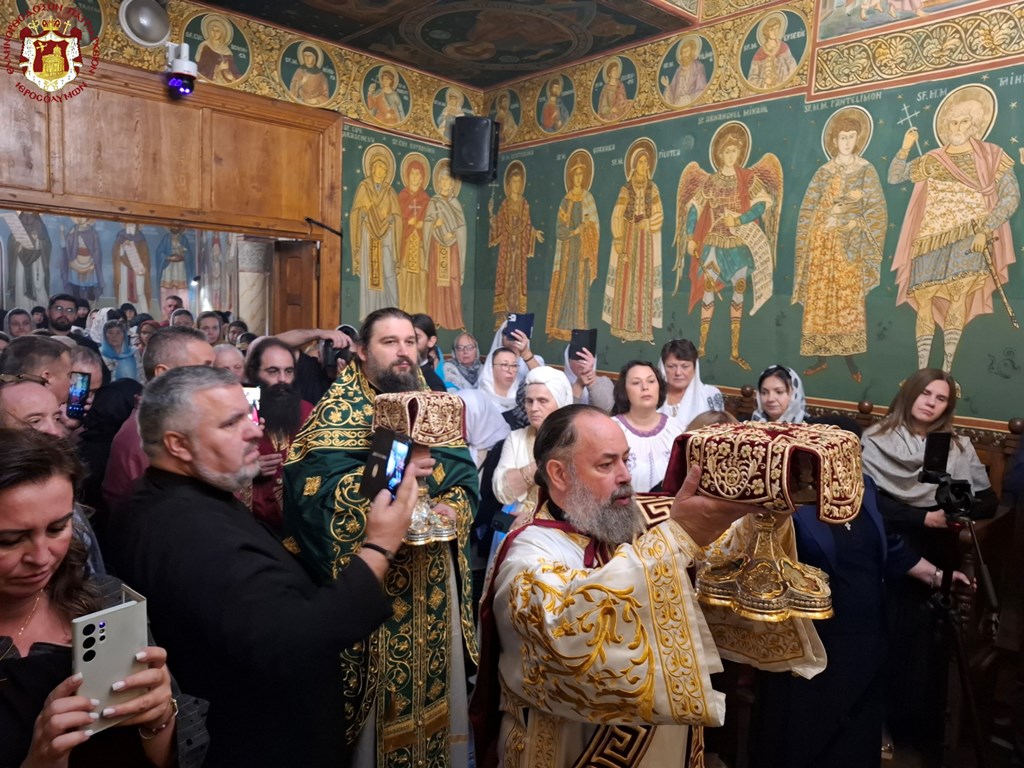
At the gracious invitation of the Representative of the Patriarchate of Romania in Jerusalem, Archimandrite Ioan, His Beatitude our Father and Patriarch of Jerusalem Theophilos, presided over the Divine Liturgy in the Holy Monastery of Saint George of the Romanian Representation in Jerusalem, in the quarter of the observant Jews, on Sunday, the 27th of October / 9th of November 2025. The Liturgy was celebrated for the feast of the translation of the relics of the Great Martyr Saint George, and was transferred for pastoral reasons a few days earlier.
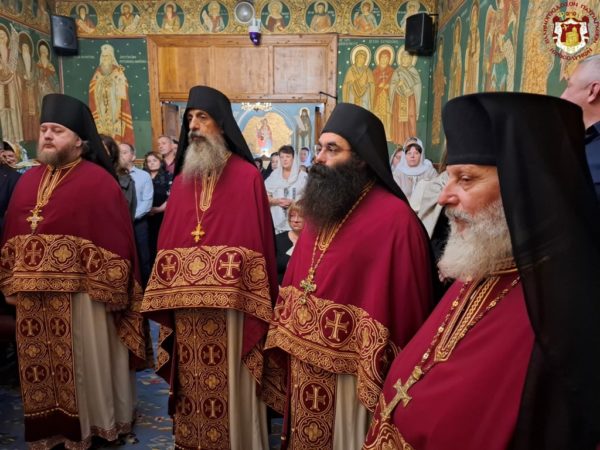
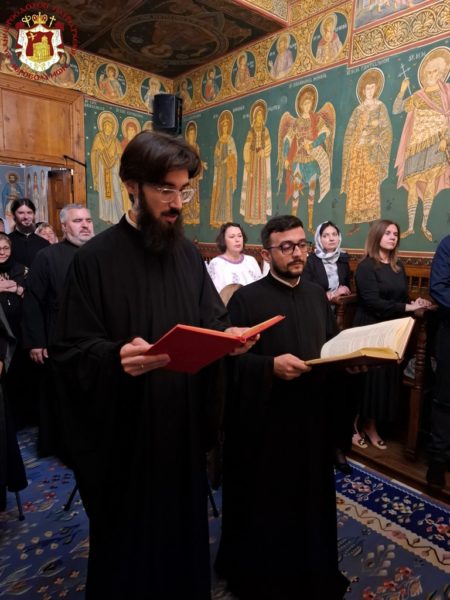
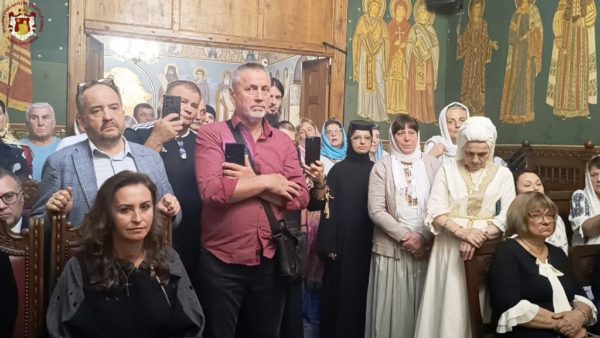
Concelebrating with His Beatitude were His Eminence Archbishop Aristarchos of Constantina and His Eminence Metropolitan Joachim of Helenoupolis, together with Holy Sepulchre Fathers, among whom first was the Elder Dragoman, Archimandrite Mattheos, the Archimandrites Christodoulos and Konstantinos, the Head of the Holy Church, other Priests from Romania, Archdeacon Mark and Hierodeacon Eulogios. The chanting was offered by the Church’s Romanian chanter and by the chief cantor of the Church of the Holy Sepulchre, Deacon Eustathios, with the participation of the nuns of the Representation and a devout congregation, chiefly Romanian-speaking faithful residing in Israel.
To the pious congregation, His Beatitude delivered the following Sermon in Greek, translated into Romanian:
“For love did conquer nature, persuading the lover through death to pass over unto the Beloved, Christ our God, the Saviour of our souls”, the hymnographer of the Church exclaims.
Your Grace Archimandrite Ioan,
Representative in Jerusalem of His Beatitude the Patriarch of Romania, Daniel,
Reverend Holy Fathers and Brethren,
Pious Christians and pilgrims,
The grace of the Holy Spirit hath gathered us today in the church named after the Holy Great Martyr George the Trophy-bearer, of the sister Orthodox Romanian Church in Jerusalem, that we may celebrate the deposition of his holy relics in the magnificent church at Lydda, which was built by the holy Emperor Constantine the Great.
The glorious Great Martyr of Christ, George, born of a noble and wealthy family, came from Cappadocia—Cappadocian by father and Palestinian by mother. He served as a senior officer in the Roman army under Emperor Diocletian (A.D. 284–305), before whom he declared himself a Christian, confessing Jesus Christ as God and the Son of God. For this, he was arrested and endured a martyr’s death. His sacred relics were transferred to Diospolis (Lydda), the biblical city where his eponymous church and cenotaph stand.
The honour of Saint George spread to the ends of the inhabited world, especially in the East, but also in the West, where he is venerated not only by Christians but also by adherents of other religions. This is owed to the many miracles wrought by him, which his hymnographer most vividly describes, saying: “Great and wondrous indeed is proclaimed, O glorious Martyr, the renown of thy ineffable witness; for as a radiant champion, thou traversest, all-admirable George, the whole creation, truly adorned with many miracles, healing diseases and curing the afflicted by thine intercessions. Wherefore we know thee to be a fervent protector and universal benefactor, delivering the captives. Do thou therefore entreat Christ, that to our souls may be granted the great mercy.”
The testimony and confession of the wondrous George, that Christ is God and the Son of the living God, made him great and distinguished in the midst of the “cloud of witnesses” (cf. Heb. 12:1) of the Church. He became a fellow-dweller and converser with the martyrs of Christ, for he proclaimed with boldness the truth in Christ, denouncing the idolatrous religion born of diabolical delusion, fearing not death, hearkening to the Evangelical word of the Lord, Who says: “Fear not them which kill the body, but are not able to kill the soul: but rather fear Him which can destroy both soul and body in hell” (Matt. 10:28).
The blessed George, illumined by the Holy Spirit, was moved by the irresistible desire to pass over unto Christ the God and Saviour of our souls, that is, “unto the city of the living God, the heavenly Jerusalem… and to the Church of the firstborn, which are written in heaven” (Heb. 12:23). And this, because he hearkened to the preaching of the divine Paul: “For here have we no continuing city, but we seek one to come” (Heb. 13:14). Interpreting this saying, Theophylactos writes: “We have no part in the things of this world, since nothing in it abides. We ought therefore to flee from it and to run towards the city to come, that is, heaven.”
The martyrs of Christ are those who proclaim His righteousness and His truth, not only through their spoken word, but also through the blood of their martyrdom. This precisely did the Great Martyr George, hearkening to the voice of the Psalmist, saying: “My mouth shall shew forth Thy righteousness and Thy salvation all the day; for I know not the learning of books” (Ps. 70:15).
In other words, the admirable George, being in active service as an officer of the Roman army, evangelised Christ the God and Son of God and Saviour of the world. For this cause “their sound went into all the earth, and their words unto the ends of the world” (cf. Rom. 10:18 / Ps. 18:5). Extolling the memory of the trophy-bearing George, his hymnographer says: “Let us extol the Husbandman of Christ, the valiant among Martyrs, the wise George, the herald of the truth, the ever-living branch of the vine of life, who blossomed forth the fruit and poured forth the wine of piety, gladdening those who in faith each year keep his memory.”
Most fittingly, the hymnographer calls the ever-memorable Martyr George “the herald of the truth and the ever-living branch of the vine of life.” The vine of life is none other than, according to the witness of the Evangelist John, Christ and the Church, which is His mystical Body: “I am the true vine, and My Father is the husbandman. Every branch in Me that beareth not fruit, He taketh away: and every branch that beareth fruit, He purgeth it, that it may bring forth more fruit” (John 15:1–2).
Interpreting this word, Saint Cyril of Alexandria says: “We must know, then, that if we be united to Him through faith, yet cultivate only the form of attachment with bare and empty confessions, and do not tighten the bond of union (with Christ) through deeds of love, then indeed we shall be branches, but dead and fruitless ones.”
This very unity in Christ of the brethren of the Orthodox Churches of Holy Jerusalem and of Romania is today made manifest through the supplications of the Great Martyr George, together with the intercessions of the all-blessed Theotokos, in the holy mystery of the mystical blessing of the common chalice, that is, the Divine Eucharist, of the Body and Blood of Christ our God and Saviour, of which we have been made communicants and partakers.
Together with the hymnographer, let us say: “Upon the mountain of martyrdom thou didst ascend, and from the hand of the Lord thou didst receive the crown, O prize-bearer; for this is the honour of the Martyrs; wherefore we all magnify thee worthily.”
Many happy returns, blessed and peaceful.”
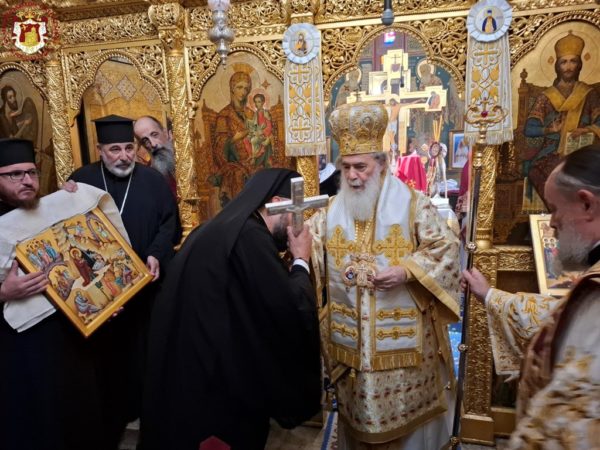
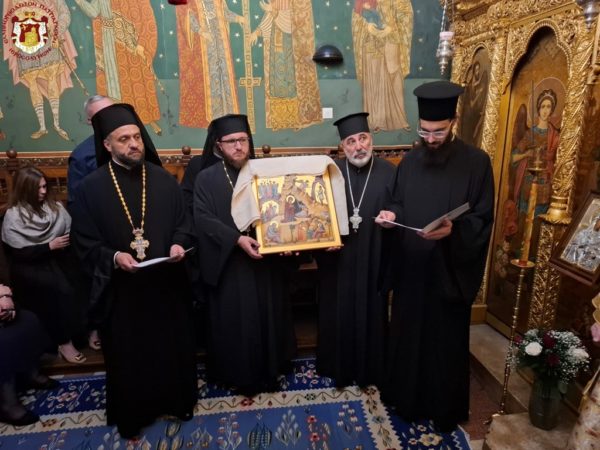
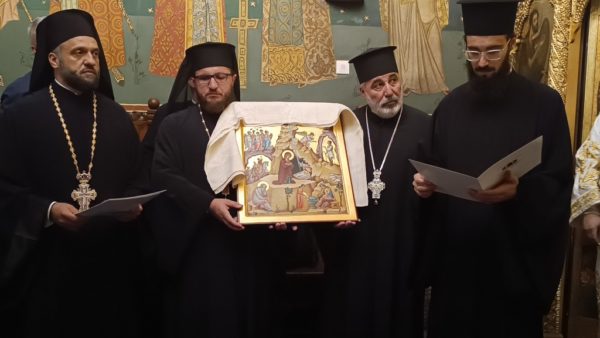
At the end of the Divine Liturgy, His Beatitude presented to Fr. John a pectoral cross and a blessing cross of mother-of-pearl; and Fr. John addressed His Beatitude honourably in Greek as follows:
“Your Beatitude Patriarch Theophilos III,
Madam Vice-President of the Chamber of Deputies of Romania, Honourable representatives of the Romanian–Israeli Diplomatic Corps,
Beloved brethren and friends in the Lord,
I extend to you a most heartfelt welcome to this exceptional and blessed celebration, dedicated to Saint George the Great Martyr.
In recent years, owing to the pandemic and the conflicts that have unsettled the whole world, we have not had the joy of meeting and celebrating together the Martyr of the Lord, our protector.
The essence of love and Eucharistic communion in the Church of Christ is the gathering itself, where the significance of the word ‘synagogue’.
Today, having assembled united around the most glorious and radiant martyr of Christ, we bring to remembrance the word of the Lord: ‘For where two or three are gathered together in My Name, there am I in the midst of them.’
Indeed, we rejoice that we are living peaceful days and that Christ is in our midst.
With the blessing of His Beatitude Patriarch Daniel, we celebrated today the Doxology and the Divine Liturgy, presided over by His Beatitude the Patriarch of Jerusalem and all Palestine. We rejoice from the depths of our souls that Your Beatitude is in our midst today, and I personally express my profound gratitude for all the support and the precious spiritual teachings which I have received from Your Beatitude.
For me, You are not only a Patriarch, but also a Father and a spiritual support.
I thank You from my heart for the love with which You surround all of us who live in Jerusalem, the holiest place in the world and the centre of the earth, where salvation came forth.
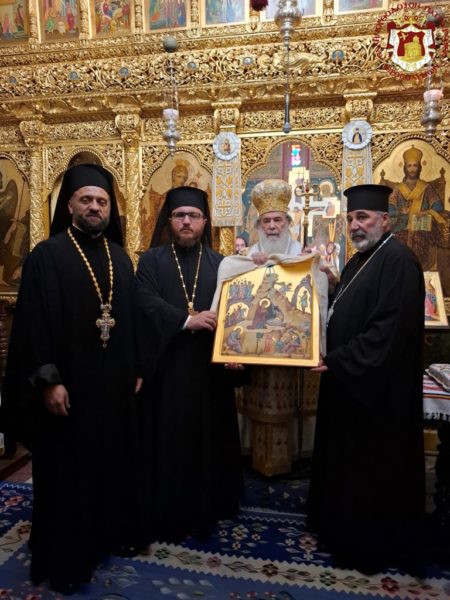
We desire to offer You as a gift an icon depicting the Nativity of the Lord, in remembrance of the fact that soon we shall rejoice together in Bethlehem at this great feast; an icon that will remind us that God descended into the world in order to raise man to heaven.
We wish You many happy returns, blessed, healthy, and full of light!
After the Divine Liturgy, refreshments followed in the hegoumen’s quarters and a meal for His Beatitude and His entourage.
From the Chief Secretariat