
My beloved Brother in Christ, Metropolitan Gerasimos of San Francisco,
Dear Fathers and brethren in the Lord,
Beloved sisters and brothers in Christ,
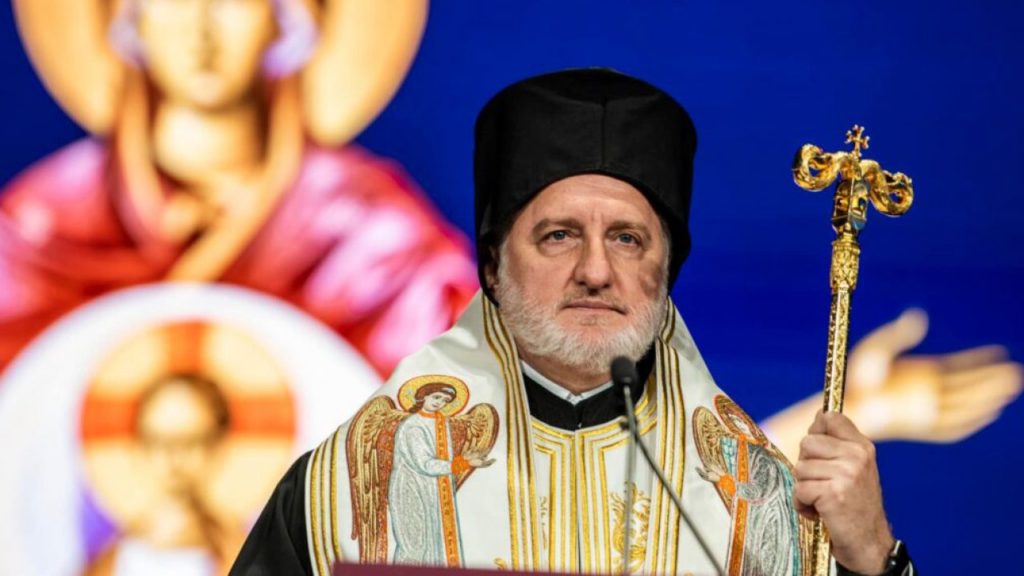
I am delighted to be here with all of you in Portland – my first visit – especially as I begin my fifth year of Archpastoral ministry as your Archbishop. I have always taken to heart the significance of the date of my enthronement, coming just after the Sommer Solstice, and right before the Feast of the Nativity of the Forerunner and Baptist John. This evening, as we celebrate the Birth of the son of Zacharias and Elizabeth – the cousin of our Lord Jesus Christ – let us reflect upon how and why the Church selected this day to remember the birth of Saint John the Baptist.
As all of you know, the Summer Solstice falls six months after its Winter counterpart in December. We know it as the longest day of the year – meaning, the hours of sunlight are the longest. But in truth, it marks the climax of the lengthening of daylight, which actually commences with the Winter Solstice, which we call the shortest day of the year.
There is often a false impression with each of these. We feel like the days are longer after June 21, but in fact, they are getting shorter. And we feel like the days are shorter after December 21, but in reality, they are progressively longer.
The Church understands that the “heavens declare the glory of God,”[1] so there is a marvelous arrangement of the Births of both the Baptist and the Lord in our liturgical year. If you remember the story of the Annunciation of the Theotokos, which we celebrate with such joy and magnificence on March 25, you know that the first words of the Gospel narrative are:
᾿Εν δὲ τῷ μηνὶ τῷ ἕκτῳ – in the sixth month…[2]
In the sixth month of what? Of Elizabeth’s pregnancy! Which concludes three months later on the 24th of June with the Birth of the Baptist. So, John was conceived in his mother’s womb six months before the Lord was conceived by the Holy Spirit in the womb of the Holy Theotokos. And six months after the Forerunner’s Birth, we celebrate our Lord’s Nativity in the Flesh on December 25 – Christmas!
It all makes sense when you put the dates together, but this is much more than a chronological arrangement. There is a deep truth here, which relates to the sun – the brilliant star without which no life could ever exist on our beloved planet, and which is reflection of the Sun of Righteousness.
You see, my friends, when John was convincing his disciples to follow the new Rabbi, the One he had baptized in the river Jordan, his cousin, Jesus of Nazareth, he said to them:
Ἐκεῖνον δεῖ αὐξάνειν, ἐμὲ δὲ ἐλαττοῦσθαι.
He must increase, and I must decrease. [3]
John came to realize that his cousin was, in fact, “the True Light Who enlightens every person who comes into this world.”[4] Just as the light seems greatest after the Summer Solstice, in truth, it begins to decrease. And John the Baptist, who was in many ways more famous than the Lord in the popular culture of the day, understood that it was his time to fade, just as the moon fades when a bright sun arises. There is a deep lesson here for all of us. No matter how bright and important we think that we are, it is the light of Christ that we reflect in our lives that manifests our faith. He is the Light of the world, and we receive our brightness from Him.
Therefore, as we celebrate this Feast of the Baptist, whose mission it was to prepare the People of Israel for the Advent of the Lord, let us all pause and reflect on our missions and purpose within the Church. Let us ask ourselves: Who is increasing? And who is decreasing? The answers might surprise us, but year after year, the circuit of the earth around the sun reminds us that we must decrease, as the Lord increases – day by glorious day. It may seem dark at first, but the morning always comes.
May you always be blessed to realize this truth in your lives, and thereby give all praise and glory to the Holy Trinity, Whom you honor in this parish, Father, Son and Holy Spirit, Who is worshipped in spirit and truth, now and ever, and unto the ages of ages. Amen.
[1] Psalm 18:1 (LXX).
[2] Luke 1:26.
[3] John 3:30.
[4] John 1:9.