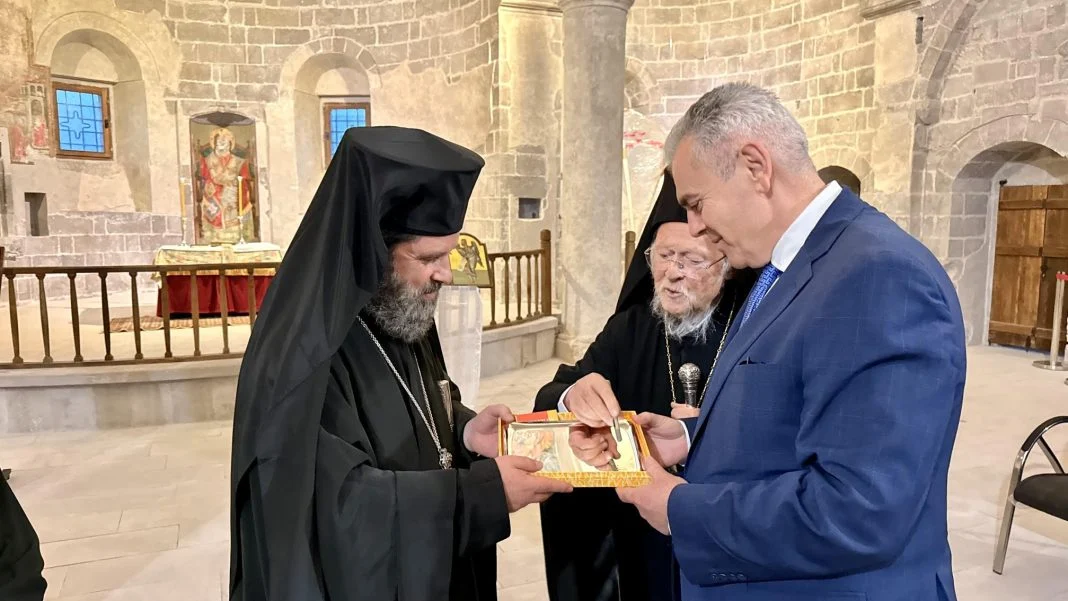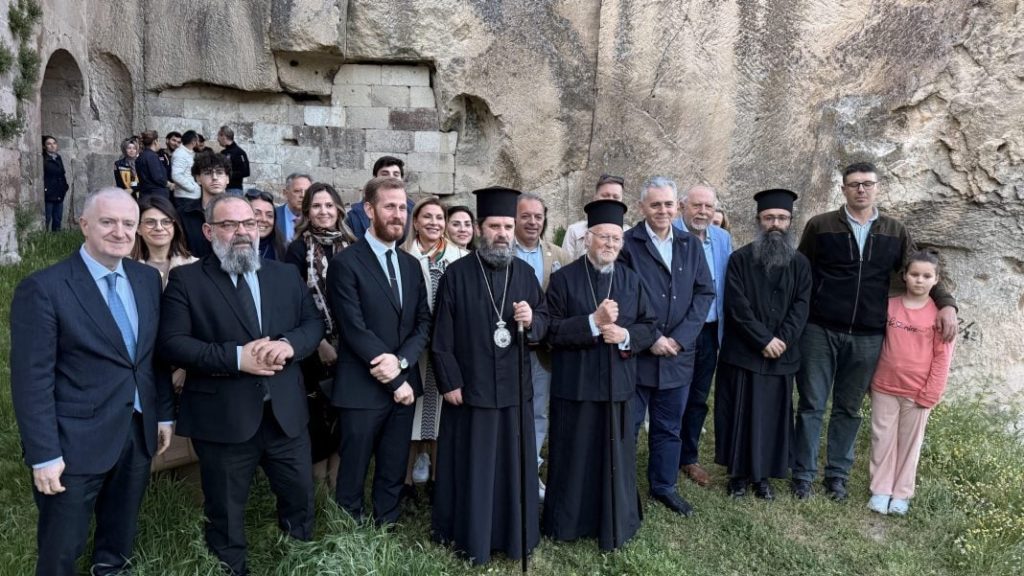
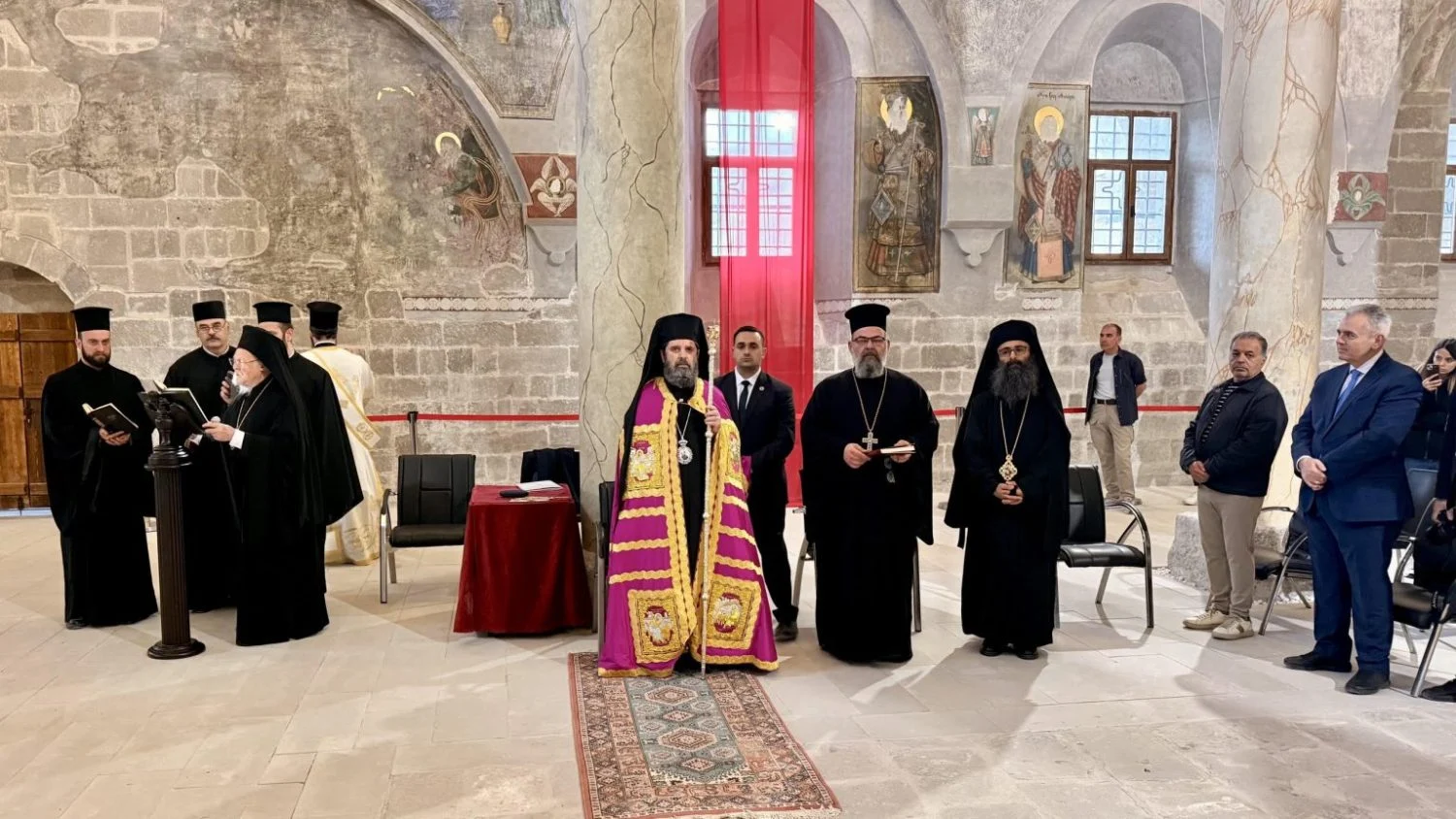
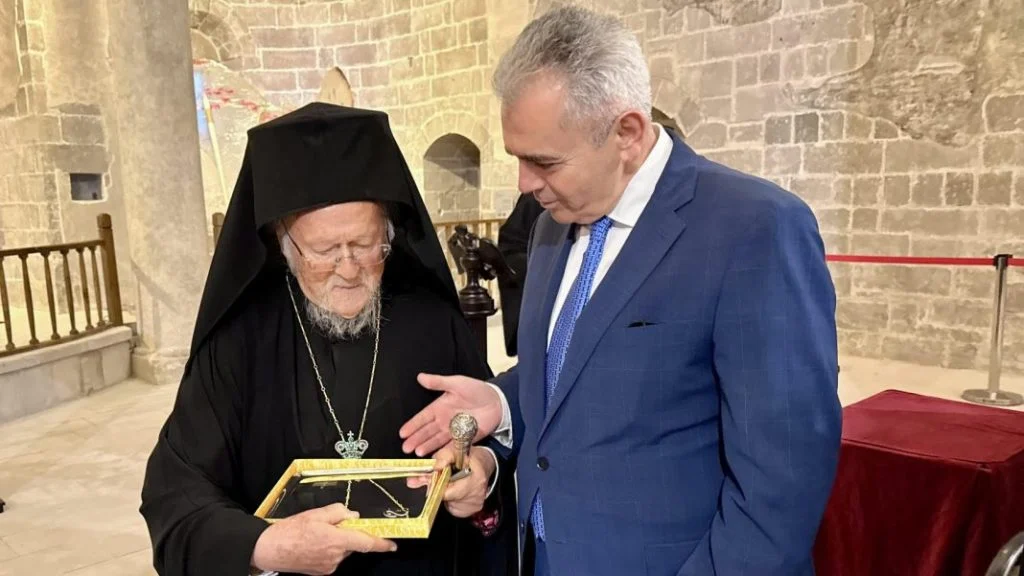
Referring to the piety of the Cappadocians, who preserved their Greek identity deep within the East thanks to the Ecumenical Patriarchate and Orthodoxy, especially those among them who lost the Greek language, as well as to the Christian values that “can fill the souls of modern people who have lost their sense of direction,” the Secretary General of the Interparliamentary Assembly on Orthodoxy (IAO), Member of the Hellenic Parliament, Dr Maximos Charakopoulos, spoke during his address to His All-Holiness Ecumenical Patriarch Bartholomew following the Divine Liturgy at the Church of Saints Theodore in Malakopi of Cappadocia, where the Ecumenical Patriarch concelebrated with Archbishop Ioannis of Albania.
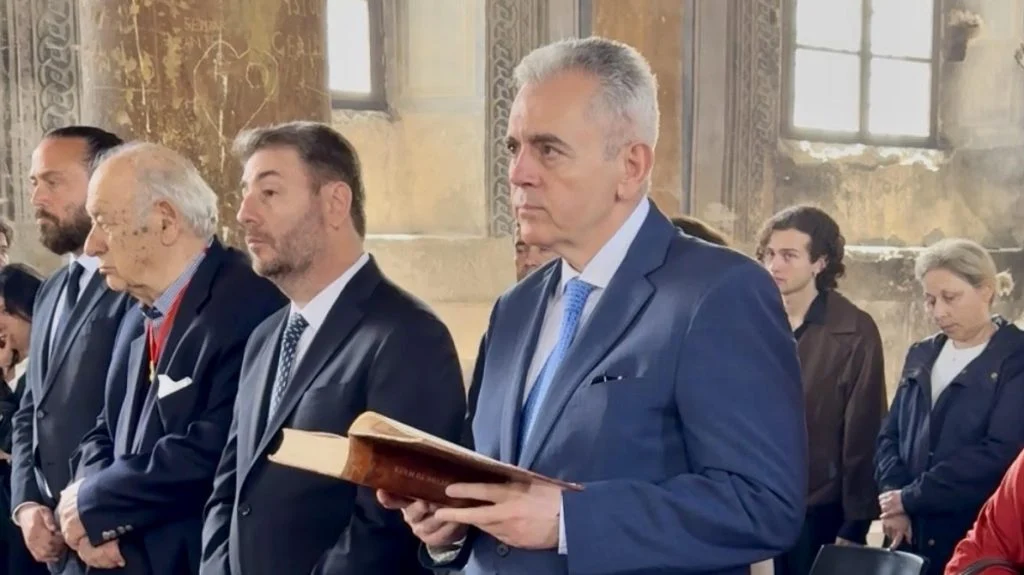
Also participating in the Divine Liturgy were the Leader of the Official Opposition, Mr Nikos Androulakis, the Deputy Regional Governor of Attica, Mrs Alexandra Palli-Yannakopoulou, the President of the Panhellenic Union of Cappadocian Associations, Mrs Vasiliki Papadopoulou, and the Honorary President of the Union, Mr Fanis Isakidis.
The head of the IAO, who traces his own origins to the unforgettable homelands of the East, recalling a reference by “the saint of Greek letters, Alexandros Papadiamantis,” concerning the piety of the Romioi (Greeks) of Cappadocia who had lost the Greek tongue, stated in his address that “those unfortunate in regard to language preserved their Romioi national consciousness thanks to the Ecumenical Patriarchate, which always remained the beacon of Orthodoxy and the ark of hope for every Orthodox Christian. With this two-thousand-year-old vessel the Cappadocians migrated to Greece because of the compulsory exchange of populations mandated by the Treaty of Lausanne. And with this as the moral core of their lives, they took root and prospered in their new homes, while even today they preserve vivid memories of their ancestry.”
Below follows the address of Mr Maximos Charakopoulos.
Address of the Secretary General of the Interparliamentary Assembly on Orthodoxy, Member of the Hellenic Parliament, Dr Maximos Charakopoulos, to His All-Holiness Ecumenical Patriarch Bartholomew following the Divine Liturgy at the Church of Saints Theodore in Malakopi of Cappadocia
Your All-Holiness Ecumenical Patriarch,
Your Beatitude Archbishop of Albania,
Deep emotion overwhelms us each time Divine Grace grants us the honour of following, as humble pilgrims, your footsteps upon the sacred soil of Cappadocia.
Unforgettable remain the pilgrimages under your spiritual guidance in this Saint-bearing land, which constituted the homeland of our ancestors, who for generations were born here, created here, and departed this life from here.
Adverse circumstances and various obstacles interrupted that luminous opening which you created in the decades-long silence imposed upon the sacred shrines of Cappadocia.
Thanks to the wisdom, prudence, and diligence that seal your enlightened ministry, “Christ is Risen” was once again heard in the churches of Cappadocia, reminding us of the timeless spiritual mission of these sacred places, regardless of worldly vicissitudes.
For a time it seemed to us that a new era had dawned for all Asia Minor, one century after those tragic events that silenced the Christian presence in this Saint-bearing land.
Every great effort, however, and every lofty vision inevitably encounters reactions born of suspicion, insecurity, and ignorance. Yet you were not discouraged, and despite the multitude of concerns you are called to address daily, you did not forget this significant goal of your long ministry. Thus, we stand here once more, glorifying God for this blessing.


Your All-Holiness,
Cappadocia is a unique place, not only geologically but above all culturally. Its contribution to the spread and consolidation of the teaching of the Gospel is unparalleled.
The Cappadocian Fathers of the Church, through their unwavering faith and incomparable knowledge, made a decisive contribution to the establishment of the foundations of Orthodoxy. They were those who harmoniously incorporated the finest elements of the ancient Greek spirit into Christian faith and worship.
From Cappadocia also came countless missionaries who carried the message of the Gospel to lands previously considered barbarous and laid the foundations for their Christianisation.
Recently we were in Georgia, where Saint Nina, who originated from Cappadocia and who Christianised the Georgians 1,700 years ago, is honoured. Likewise, the first bishop of Larissa, our patron Saint Achillios, the melodious trumpet of Larissa, was also a Cappadocian.
Orthodoxy constituted an essential element of the consciousness of the Cappadocians, and it was this that enabled them to preserve their identity under the most adverse conditions. Even when they lost their language, their faith was not lost.
Regarding the deep faith of the Cappadocians, the saint of Greek letters, Alexandros Papadiamantis, wrote at Christmas in 1887 about the joy experienced by the Romioi who had lost the Greek tongue upon hearing the festal exapostilarion:
“‘Our Saviour from on high has visited us, the Dayspring from the East.’ This final phrase, which I have written in spaced letters, possesses, as I have heard, the privilege of inspiring great enthusiasm among our brethren from Caesarea and Cappadocia, unfortunate in regard to language but Greek in heart and spirit, who rightly boast and say that ‘from the East comes the light.’”
Your All-Holiness,
Those unfortunate in regard to language preserved their Romioi national consciousness thanks to the Ecumenical Patriarchate, which always remained the beacon of Orthodoxy and the ark of hope for every Orthodox Christian.
With this two-thousand-year-old vessel the Cappadocians migrated to Greece because of the compulsory exchange of populations mandated by the Treaty of Lausanne. And with this as the moral core of their lives, they took root and prospered in their new homes, while even today they preserve vivid memories of their ancestry.
Your All-Holiness,
Here in Cappadocia, situated amid the two major military conflicts presently shaking humanity, we realise even more intensely that the world appears to have forgotten the devastation caused in the past by global wars, and today, possessing even more technologically advanced weaponry, it balances literally on the edge of the abyss.
In this environment, Ecumenical Orthodoxy, which you serve from the highest position in the Orthodox world, the Ecumenical Throne, can contribute substantially toward calming passions, fostering mutual understanding, and choosing the path of peaceful cooperation.
Furthermore, Orthodox values, as inseparable elements of European civilisation and universal ideals, can fill the souls of modern people who have lost their orientation due to the materialistic models of contemporary life.
What greater testimony do we require regarding the strength of Orthodoxy, for which the late Sir Steven Runciman predicted that the twenty-first century would belong to it, than the presence here among us of His Beatitude Archbishop Ioannis of Albania?
In a country where the prohibition of religion was violently imposed in the name of a totalitarian ideology, Orthodoxy, through the decisive contribution of the late Archbishop Anastasios, rose again from the ashes and today stands as a flourishing Church.
Your All-Holiness,
Through your words and deeds, and above all through your personal example, you render precious service not only to Orthodox Christians but to the entire Christian world.
May God preserve you healthy and strong, so that for many years you may continue to hold firmly the helm of the First-Throned Church of Constantinople.
And may we celebrate again next year!