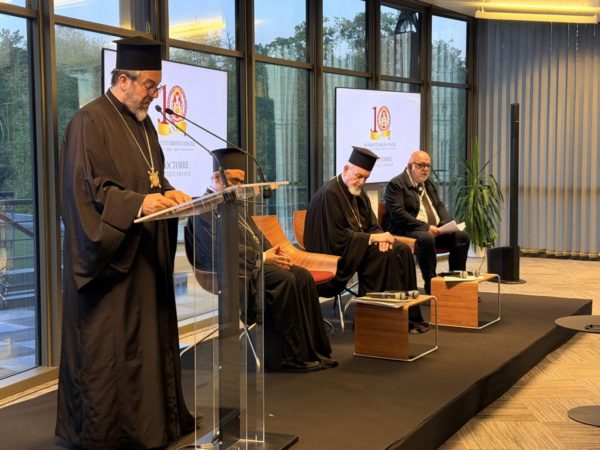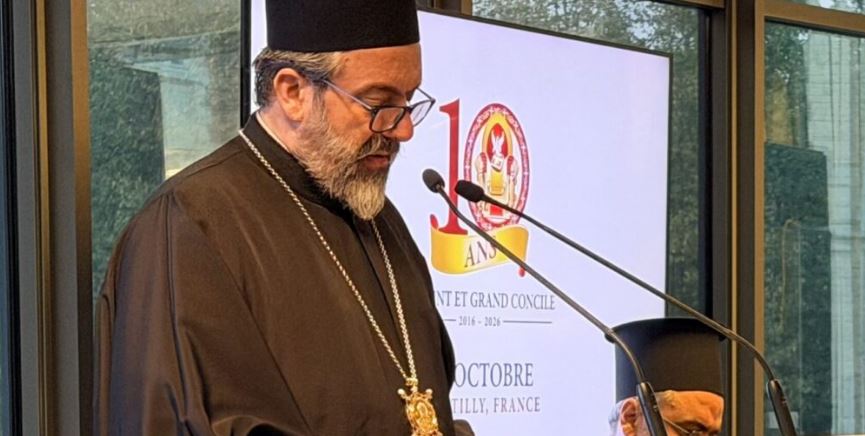
At a conference in Chantilly, France (5-8 October 2026), His Eminence Metropolitan Gregorios of Cameroon offered a candid, self-critical reflection on Orthodox mission in Africa, a decade after the Holy and Great Council of Crete (2016).
The Metropolitan began by calling the Council’s six documents prophetic and far-sighted. In his view, they anticipated issues that surfaced soon afterward: the condemnation of war, including so-called “holy war”; the rejection of ethnophyletism; the granting of autocephaly; respect for ecclesiastical jurisdictions; and the danger of Churches becoming instruments of geopolitical interests. He also pointed to the Council’s fear for Christian populations leaving their ancestral homelands, especially in the Middle East, and for the persecution of Christians. As an African example, he said that some 7,000 Christians have been killed in Nigeria since the start of the year, with similar incidents on a smaller scale in the Democratic Republic of the Congo.
On mission specifically, he noted that the Council addressed it for the first time in an Orthodox conciliar text, and that it calls on all Local Churches to contribute. The Council stresses that mission must be carried out not aggressively or through proselytism, but “in love, humility and respect towards the identity of each person,” and concerning the distinct culture of each people.
He argued, however, that the texts have been poorly received. He attributed this to the demands of serious study in an age of information overload, and to the suspicion and indifference of some monastic and clerical circles toward initiatives of the Ecumenical Patriarchate. He also lamented that many Local Churches seem unaware that mission is still needed today, while many urban centres have an excess of unassigned clergy.
The Metropolitan then turned to history. He explained that the Patriarchate of Alexandria’s mission was long constrained by geography, Arab rule and Ottoman rule, and was largely devoted to sustaining enslaved Christian communities. Western missions, by contrast, became entangled with colonialism. He observed that missionary approaches differed by era: earlier missionaries showed adaptability toward local customs, while those of the 18th and 19th centuries were marked by rigidity and by the destruction and plundering of African religious and cultural treasures, many of which remain in European museums.
Turning to the Patriarchate of Alexandria’s own record, he acknowledged both achievements and mistakes. He criticised a defensive style of catechesis, in which missionaries spend their energy proving to rival denominations that they are the right Christians, rather than becoming the Gospel through sacrifice and example. He also criticised the transplanting of Greek national symbols, holidays and customs onto African communities, a practice that some African clergy have adopted. He recalled the late Metropolitan Alexandros of Nigeria, who taught that an African bishop’s ministry draws its meaning from his ecclesial identity, with other identities relativised rather than abolished. Metropolitan Alexandros also insisted that Africa should be seen not as a perpetual recipient but as a source of theology, ideas and experience from which others can draw.
In his epilogue, the Metropolitan proposed a criterion for judging past mistakes: did missionaries bring Christ to Africa, or Christ together with their own national and cultural baggage? Did they let the Gospel take flesh within each people, or ask peoples to become something else before becoming Orthodox? He concluded that the Council’s legacy for 21st-century mission is to rediscover the Church’s apostolic character as witness to Christ rather than the export of culture, as service rather than conquest, and as self-emptying (kenosis) rather than imposition. Only then, he said, will Africa cease to be merely a field to which missionaries are sent and become a living Church with its own voice, theology, and witness to offer the whole of Orthodoxy.