
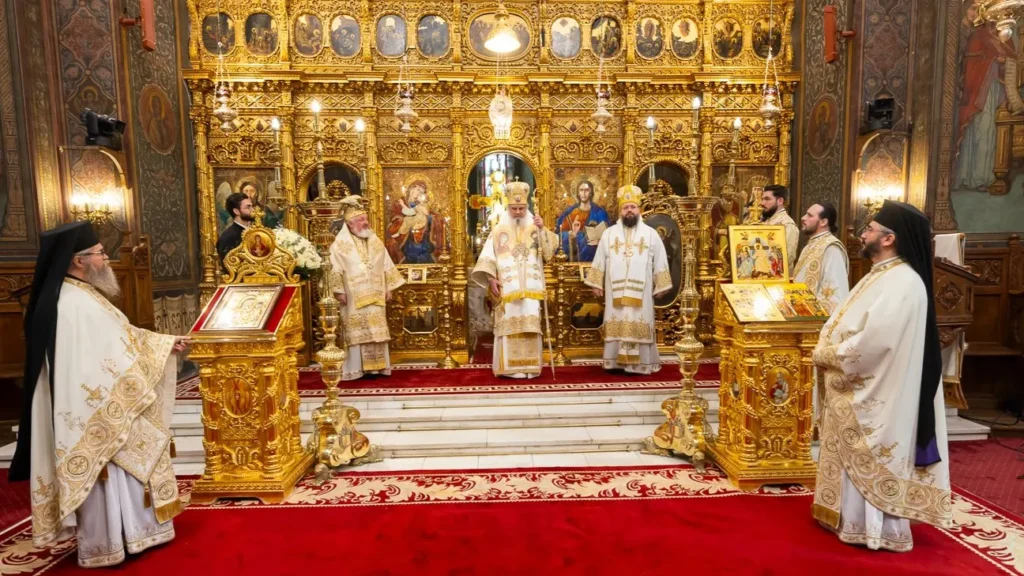
On Sunday, following the Divine Liturgy at the Patriarchal Cathedral, His Beatitude Patriarch Daniel was honored on the occasion of his 35th anniversary of episcopal ministry.
Before delivering the congratulatory message, Patriarchal Auxiliary Bishop Varlaam of Ploiești presented the volume “The Church’s Work in Society in 2024,” authored by Patriarch Daniel.
A Life of Episcopal Ministry
In his speech, Bishop Varlaam of Ploiești highlighted Patriarch Daniel’s achievements over the past 35 years of hierarchical ministry.
“All these achievements are merely means through which the Primate of our Church strives, day and night—and this is not a metaphor—to fulfil, to the highest degree possible, the threefold episcopal ministry: the responsibility of teaching, the sanctifying service, and the pastoral guidance of the faithful on the path to salvation.”
“From the perspective of the teaching ministry, Patriarch Daniel is recognized as the most profound, explicit, systematic, and well-documented preacher of the Gospel. He never delegates the moment of preaching and never tires of delivering homilies in every liturgical setting.”
Patriarch Daniel’s Role in Religious Education
Bishop Varlaam also recalled Patriarch Daniel’s involvement in reinstating religious education in schools after the fall of the communist regime.
“He worked to introduce the subject of Religion into primary, secondary, and high school education in our country, ensuring that this discipline, so essential for the spiritual and moral formation of young generations, retained its status through every legislative change. He also oversaw that theologians and specialists in educational sciences designed curricula and textbooks suited to the needs of today’s students.”
As a token of appreciation, Patriarchal Auxiliary Bishop Varlaam of Ploiești, along with Patriarchal Auxiliary Bishop Paisie of Sinaia and the clergy of the Patriarchal Cathedral, presented His Beatitude with a floral arrangement.
A Collective Effort
In response, Patriarch Daniel expressed gratitude for the presentation of the volume and the words of appreciation.
“We consider that this work has always been carried out together with the members of the Holy Synod, the staff at the Diocesan Centers in Timișoara, Iași, and Bucharest, all the clergy of the Romanian Orthodox Church, as well as the various organizations and associations within the Church.”
Reflecting on the significance of religious education, the Patriarch recalled the persecution of Christian catechesis during communism, mentioning Saint Liviu Galaction of Cluj, who was imprisoned for organizing religious instruction for children after the communist government removed religion from schools in 1948.
Defending Religious Education
His Beatitude also shared how he convinced the Minister of Education in the 1990s to reintroduce religious studies in schools:
“I presented two books I had brought from Germany, documenting the agreements between the state and the two major churches—the Roman Catholic Church and the Evangelical Church in Germany—on the necessity of religious education as a cultural requirement for understanding the history and identity of the German people.”
Despite multiple attempts to remove religious symbols and icons from schools, faith prevailed over temporary ideologies, the Patriarch emphasized:
“This is why we believe we have a duty to pass on the treasure, the precious gift of Christian faith, which is none other than the presence of Christ Himself in the souls of the people.”
For more pictures, please visit our Photo Gallery section.
Photo: Basilica.ro / Mircea Florescu