
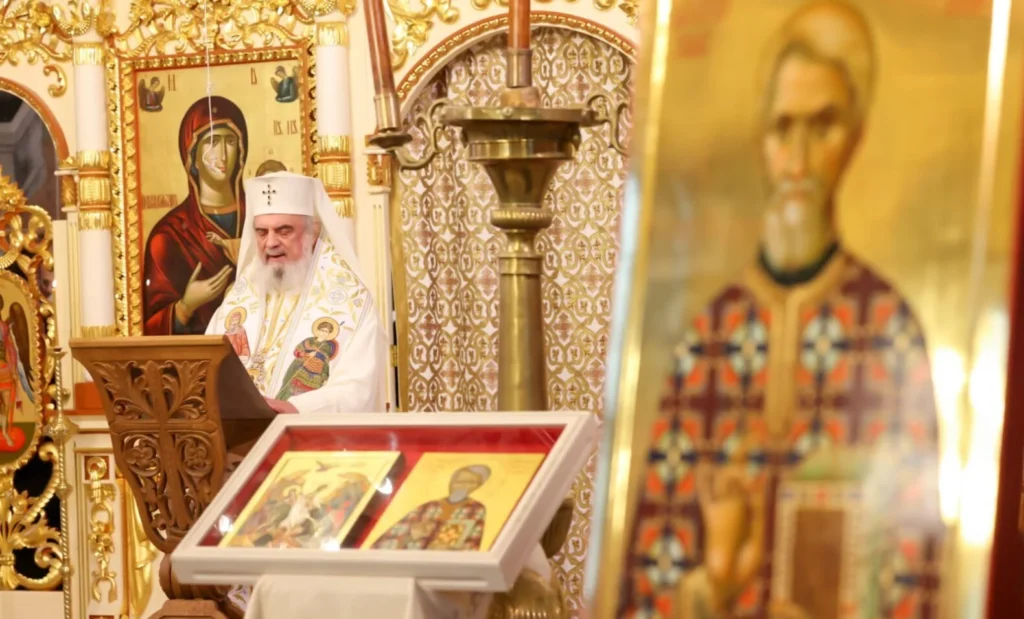
Patriarch Daniel of the Romanian Orthodox Church said on Saturday at Cernica Monastery that the Confessor Priest Saint Dumitru Stăniloae exemplified three defining traits of his spiritual personality: steadfast confession of faith, profound theology, and a unique gift for interpreting the Philokalia.
“In his holy life, we can see three main features that define his spiritual personality,” the Patriarch said during the local proclamation of the saint’s canonisation at Cernica Monastery.
Theologian of the Holy Trinity’s love
“He was an enlightened confessor of the Orthodox faith during the communist regime, a profound theologian of the love of the Holy Trinity, and a gifted translator and interpreter of the Philokalia into Romanian, offering our Church a rich theological and spiritual legacy.”
Patriarch Daniel noted that Saint Dumitru Stăniloae became a true teacher and comforter for those imprisoned under communism, who were thirsty for the word of God.
“Amid the terrifying walls of those camps of death, his voice—though weakened by hunger and suffering—became balm for souls thirsting for the word of God,” the Patriarch said.
“His fellow prisoners testified to the spiritual warmth of his words, which melted hunger and cold, dispelled despair, and strengthened the faith of those who doubted. When he spoke about Christ and the teachings of the Holy Fathers, silence descended around him, and the souls of those present were filled with joy and holy peace.”
Describing the saint’s transformation in prison as “born of suffering and sealed by the grace of the Holy Spirit,” the Patriarch compared him to “a burning candle shining in the darkness of communist atheism.”
The charisma of theology
On Saint Dumitru Stăniloae’s theological charisma, the Patriarch said he was “a theologian enlightened by God, whose words often flowed not merely from academic study but from the living experience of communion with God through prayer.”
He emphasised that the saint rejected Western scholasticism and urged Orthodox theologians to draw instead from the spiritual experience and inspired teachings of the Church Fathers.
Unique interpretation of the Philokalia
Regarding the saint’s decades-long work of translating and commenting on the Philokalia, Patriarch Daniel explained that it was “not a simple linguistic translation from Greek into Romanian, but a deep work of interpretation of the writings of the great hesychast fathers who taught how spiritual life must be lived—grounded in Scripture, the Church Fathers, and their own ascetic experience.”
“His detailed commentaries and rich notes reveal his theology steeped in the Philokalic spirit,” the Patriarch continued. “He succeeded in conveying the meanings of the Holy Fathers of the Philokalia to his contemporaries in accessible 20th-century language, without diminishing the essence or depth of the patristic texts. His translation of the Philokalia extended over several decades and became the central work of his life.”
Concluding, Patriarch Daniel said that the canonisation of Saint Dumitru Stăniloae—together with 15 other 20th-century confessor priests—during the Centennial of the Romanian Orthodox Church’s elevation to Patriarchate “reveals the blessed work of God among the Romanian people, from whom have arisen great spiritual fathers who guided the faithful toward Christ during the hardships of the communist era.”
Photo: Mircea Florescu / Basilica.ro