
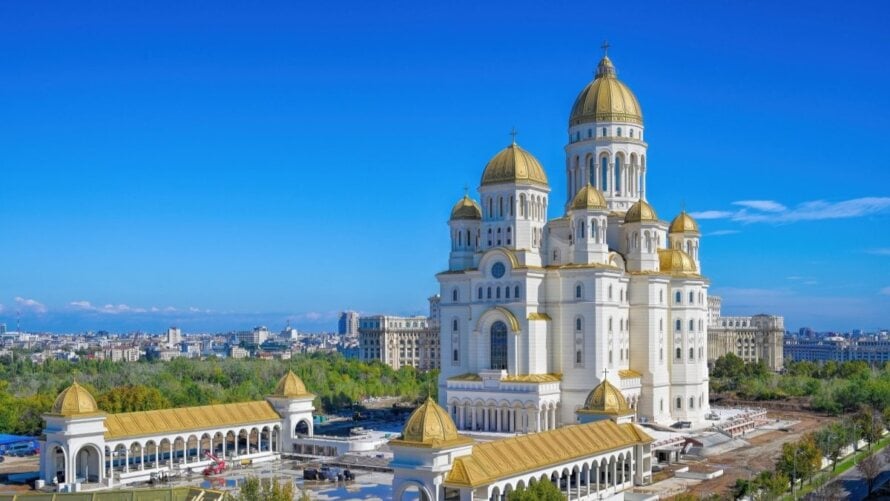
“Through all its component elements, the National Cathedral can be considered an open book of Orthodox theology, written in stone, colour, and light, which calls to prayer and holy communion,” emphasised His Beatitude Patriarch Daniel in an article published in the Sunday edition of Lumina newspaper.
In the article published on October 26 on the occasion of the consecration of the mosaic iconography of the National Cathedral, His Beatitude addressed several themes, such as: the public and liturgical necessity of the place of worship, its symbolism, its spiritual, liturgical, and missionary significance, and the symbolic value of a fulfilled ideal.
“The architecture of the National Cathedral offers us a cruciform liturgical space, with a floor plan in the shape of a Latin cross, its main arm longer than the others and thus representing the pilgrimage of the faithful toward the Kingdom of God, symbolised by the iconostasis,” explained Patriarch Daniel.
The Patriarch of the Romanian Orthodox Church underlined that the place of worship is the spiritual heart of a unified ecclesiastical complex raised for the glory of the Most Holy Trinity.
“Our Cathedral concentrates in its form three fundamental symbols of Orthodox architecture: the image of the ship, inspired by Holy Scripture of the Old Testament and the Gospels; the cruciform space in which is the presence of Christ Who is crucified, risen, and ascended into Heaven; and the mystery of the Church as the House of the Most Holy Trinity.”
Symbol of unity of faith and nation
Patriarch Daniel noted that the Romanian Orthodox Church now has in Bucharest a cathedral that represents the faith of the majority of the Romanian people and their dignity.
“The new Cathedral in Bucharest is called the National Cathedral because it is located in Romania’s capital, and ceremonies of national symbolic value take place here.”
The Patriarch of Romania stated that the National Cathedral complex was built not only with public funds but also with substantial donations from Romanian Orthodox clergy and faithful, both in Romania and abroad.
“Through its traditional Byzantine and Romanian architectural style, it is an expressive synthesis of the faith of the majority of the Romanian people. The mosaics of the National Cathedral include saints of universal Orthodoxy and from all Romanian provinces, including saints canonised in 2024 and 2025.”
Photo: Lumina Newspaper
basilica.ro