Many wonder why Great Lent holds forty days. To be very accurate, Great Lent does not last forty days but thirty-six days. However, people generally think it holds 40.
This year—2020—is a good year in which to explain this: because Great Lent begins on March 2nd, when it is “Clean Monday,” the first day of fasting,. The 12th of April is Palm Sunday and, on the 19th of April, we celebrate Easter (Pascha).
First of all, it is fascinating to note that Holy Week is not part of Great Lent—because Lent is not distinguished by what we eat but for what we mourn, for what we struggle toward.
The Great Fast is, by excellence, a period of mourning in which we should more intensely live our separation from God, a time by excellence dedicated to God.
So, even though we refrain from non-fasting food until Easter, the mourning period only lasts until the Friday before the Saturday of Lazarus and, until there, are exactly forty days.
With Lazarus Saturday, the atmosphere changes and the certainty of the resurrection of the Lord, beyond the immensity of the pain of the cross, rises in our hearts. This change is evident in the services and, because of this, people generally count Great Lent as a period of forty days, even if the period in which we eat only fasting food extends through to Easter.
However, some of the holy Fathers say that the 36-day period was chosen for Great Lent as a tithe of the Old Testament law, transfigured in the New Testament.
If, in the Old Testament, the law was “bodily” (material) and, therefore, each one had to give the tenth part of what is most valuable of his material wealth to God, yet in the law of the New Testament, being a spiritual law, we must give God the tenth part of our most precious wealth, seen from the spiritual point of view, that is the mind, the heart, in the tenth part of our time. The year, having 365 days, the Fathers decided that Great Lent would hold 35-36 days.
Being easier to calculate in whole weeks, the Fathers said six weeks of seven days equaled forty-two days—from which they removed Saturday of Lazarus and Palm Sunday; and so, from here, it is said that Great Lent holds 40 days—from which, the Fathers removed also the five Sundays that remained, making each of these Sundays a feast day: leading us to have thirty-five days. To this, some consider Great Friday to be a day of mourning by excellence: thus, we may conclude to having thirty-six days, the spiritual tithe of the New Testament of our Lord Jesus Christ.
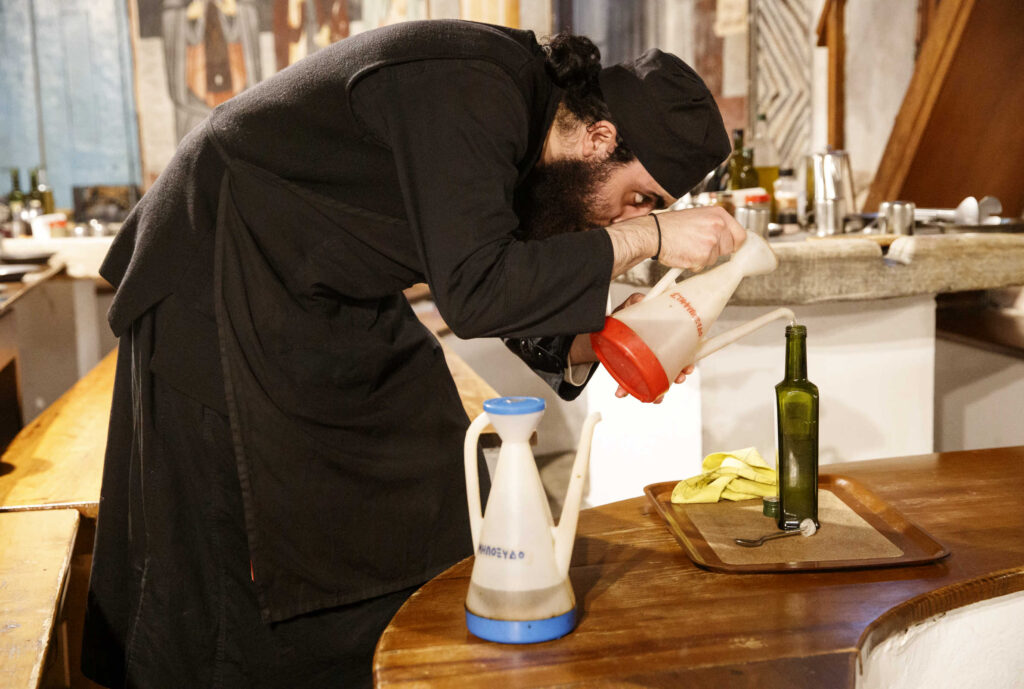
In the photo, a parent fills a bottle with vinegar. Vatopedi Monastery, Mount Athos.
Mulți se întreabă de ce Postul Mare ține 40 de zile. Ca să fim foarte exacți Postul Mare nu ține 40 de zile ci 36 de zile. Cu toate acestea oamenii, în general, cred că ține 40.
Anul acesta: 2020
Anul acesta – 2020 – este un an potrivit pentru a explica acest lucru pentru că Postul Mare începe pe data de 2/3 când este Lunea Curată, prima zi de post, 12/4 este Duminica Floriilor iar pe 19/4 sunt Sfintele Paști.
Scopul Postului Mare
Întâi de toate Săptămâna Mare nu face parte din Postul Mare pentru că Postul Mare nu se distinge prin ceea ce mâncăm ci pentru ceea ce plângem, pentru ce ne nevoim.
Postul Mare este o perioadă prin excelență jelitoare în care ar trebui să trăim mai intens despărțirea de Dumnezeu, o perioadă afierosită prin excelență lui Dumnezeu.
Postul Mare: 40 de zile?
Deci cu toate că ne abținem de la mâncărurile de dulce până Paște, perioada jelitoare ține doar până la vinerea de dinainte de Sâmbăta lui Lazăr până la care sunt exact 40 de zile. Odată cu Sâmbăta lui Lazăr atmosfera se schimbă și certitudinea Învierii Domnului, dincolo de imensitatea durerii crucii, răsare în inimile noastre. Această schimbare este evidentă în slujbe și din cauza aceasta în general oamenii socotesc Postul Mare ca o perioadă de 40 de zile, chiar dacă perioada în care mâncăm doar de post se întinde până la Paște.
Cu toate acestea, spun unii din sfinții părinți că s-a ales perioada de 36 de zile pentru Postul Mare ca fiind zeciuiala Legii Vechiului Testament transfigurată duhovnicește în Noul Testament.
Vechiul Testament – Noul Testament
Dacă în Vechiul Testament legea era trupească și deci fiecare trebuia să dea a zecea parte din ce avea mai valoros din averea sa trupească lui Dumnezeu, în legea Noului Testament, fiind lege duhovnicească, trebuie să dăm lui Dumnezeu a zecea parte din cea mai prețioasă avere a noastră din punct de vedere duhovnicesc adică mintea, inima în a zecea parte din timpul nostru. Anul având 365 de zile, părinții au hotărât ca Postul Mare să țină 35-36 de zile.
Fiind mai ușor de calculat în săptămâni întregi, au spus 6 săptămâni a câte 7 zile, 42 de zile din care au scos Sâmbăta lui Lazăr și Duminica Floriilor și deci de aici se spune Postul Mare ține 40 de zile. Din care au scos și cele 5 Duminici care au mai rămas, făcând fiecare din aceste Duminici sărbătoare și, deci, avem 35 de zile. La aceasta unii socotesc Vinerea Mare ca zi prin excelență de tânguire și avem 36 de zile, zeciuiala cea duhovnicească a Noului Testament a Domnului nostru Iisus Hristos.
Un moment din trapeza mănăstirii Vatoped, Muntele Athos