
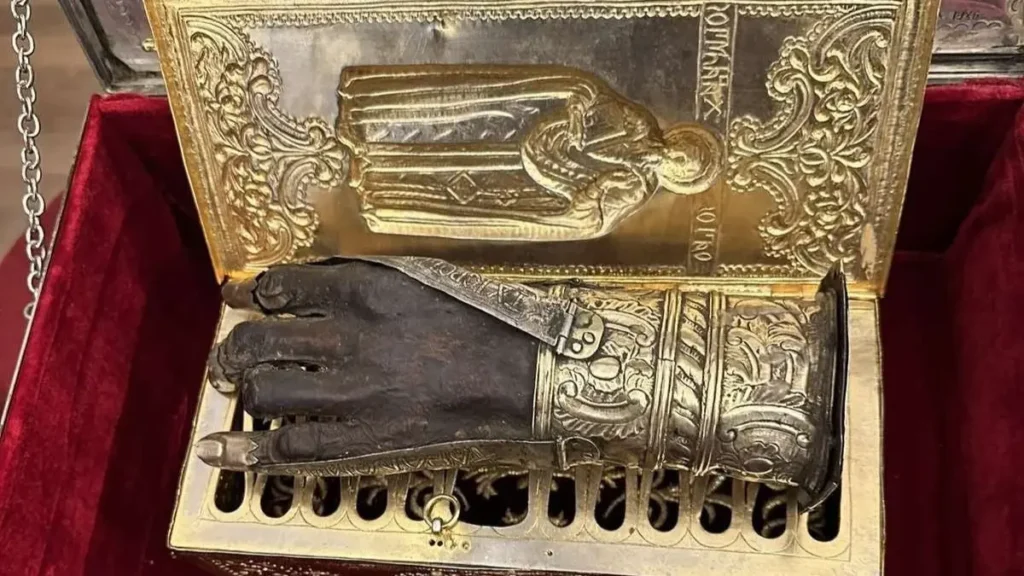
The left hand of Saint Haralambos, a treasured relic from the Mega Spileo Monastery in Greece, will be brought to Romania for veneration at the Diocesan Cathedral in Alexandria between August 29 and September 1, in conjunction with the patronal feast of St. Alexander Monastery.
The event’s program includes hierarchical liturgies, religious processions, and all-night vigils held at both the Cathedral and Pantocrator Monastery, where the relic will be transferred on August 30 and remain until 10:00 p.m. on September 1.
The final day of the pilgrimage coincides with two significant dates in the Orthodox calendar: the beginning of the liturgical new year and the anniversary of the enthronement of His Grace Bishop Galaction of Alexandria and Teleorman.
Liturgical Schedule
Friday, August 29 – Alexandria (Diocesan Cathedral)
08:00 – Reception of the delegation from the Metropolis of Kalavryta, Greece, with the relic of Saint Haralambos
09:00 – Hierarchical Divine Liturgy
18:00 – Vespers with Lity
20:00 – Religious procession through the streets of Alexandria
21:00 – All-night Vigil at the Episcopal Cathedral
Saturday, August 30
08:30 – Paraklesis (Supplicatory Canon) to Saint Alexander
09:00 – Divine Liturgy in the Cathedral Park
16:00 – Transfer of the relic to Pantocrator Monastery
Sunday, August 31 – Pantocrator Monastery
08:30 – Akathist to the Savior
09:00 – Outdoor Hierarchical Divine Liturgy
16:00 – Procession with the relic of Saint Haralambos
The relic will remain available for veneration at Pantocrator Monastery until 22:00 on September 1
Monday, September 1 – Pantocrator Monastery
08:30 – Akathist to Saint Haralambos
09:00 – Hierarchical Divine Liturgy
18:00 – Vespers
Saint Haralambos: A Martyr of Unshakable Faith
Saint Haralambos (also spelled Haralambos or Charalambos) was a third-century Christian bishop and martyr renowned for his unwavering faith during one of the Roman Empire’s most brutal waves of persecution. Born in Magnesia, Asia Minor (modern-day Turkey), he served as bishop of the city and was known for his pastoral care, spiritual wisdom, and fearless preaching of the Gospel.
At the age of 113, during the reign of Emperor Septimius Severus, Saint Haralambos was arrested and subjected to extreme tortures for refusing to renounce Christ. His enduring patience and serenity in suffering astonished even his persecutors—many of whom converted to Christianity, including Roman soldiers and even the daughter of the emperor. According to tradition, when Emperor Severus ordered the saint’s execution, Saint Haralambos peacefully gave up his spirit before the sword could strike him, sparing his executioners the burden of martyring him directly.
Saint Haralambos is venerated across the Orthodox world as a powerful intercessor and protector against plagues and infectious diseases, due to his miraculous healings both during life and after death. His relics, including his incorrupt hand, are considered to be wonderworking and are housed in several locations, notably the historic Mega Spileo Monastery in Greece. His feast day is celebrated on February 10.
Photo: crestinortodox.ro