
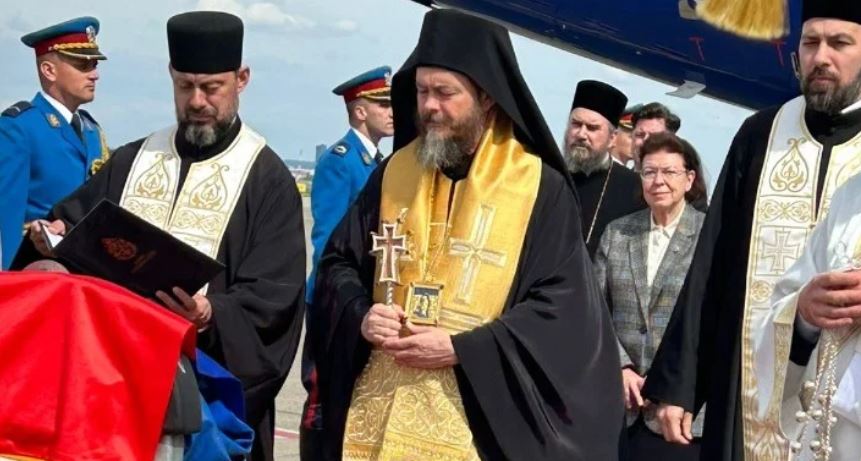
Greek Minister of Culture Lina Mendoni and her Serbian counterpart Nikola Selaković attended a ceremony at the airport of Belgrade to formally welcome seven outstanding relics from the Mount Athos’ Hilandar Monastery on Wednesday, 13 May 2026.
The artifacts were transported to the Serbian capital to serve at the central feature of a large exhibition commemorating the 850th anniversary of the birth of Saint Sava (Savvas), founder of the Serbian Monastery of Hilandar on Mt Athos and venerated figure of Serbia.
According to a statement by the Greek ministry, the seven artifacts include the following: a rare mosaic icon of the Virgin Mary holding Jesus (12th century); icons of Christ Pantocrator and of the Virgin Mary with Jesus (both 13th c); icon of Saints Sava and Simeon (17th c); a handwritten scroll (1199) including The Typikon of Karyes of Saint Sava; a copy of Byzantine Emperor Alexios II Angelos’ scepter; and a copy of Saint Sava’s staff.
Ministers’ statements
“I feel a special honour and blessing that I am present today in the welcoming of these priceless artifacts in Belgrade,” Mendoni said. “Greece and Serbia’s relations are timelessly friendly, forged with strong historical and cultural ties, with a common foundation in Orthodoxy. The image of Saint Sava is decisive for the Church of Serbia and important for all Orthodox in the world. The Ministry of Culture of the Republic of Greece are very happy to provide permission to lend these treasures of the Hilandar Monastery, recognising that this exhibition is a leading cultural event that relates to all Orthodox countries of our region.”
On his side, Selaković noted the historic day for the Serbian people, and said the relics “reflect the golden era of medieval Serbia and the founding of our state and spiritual entity. Saint Stephen and Saint Sava established the foundation of the Serbian government and way of life, bequeathing to us values that remain alive to the present day. We warmly thank the Greek side for this gesture of brotherhood, which allows the Serbian people to get in touch with the sources of their national identity and Orthodox faith.”
Mendoni was accompanies by Greek Ambassador to Serbia, Maria Levanti, European Centre for Byzantine and Postbyzantine Monuments Director Flora Karagianni (also General Director of the Museum of Byzantine Culture in Thessaloniki), and officials of the Ministry of Culture.
‘Saint Sava’ exhibition in Belgrade
The ministry’s statement also noted the exhbition ‘Saint Sava’ at the Gallery of the Serbian Academy of Arts and Sciences in Belgrade is a multifaceted exploration of the iconic figure of the founder of the Autocephalous Serbian Church, who laid the ground for the cultural and national identity of the Serbian people as teacher, lawmaker, diplomat, and benefactor.
The event highlights the deep historical links between Greece and Serbia, focusing on Mt Athos’ Hilandar Monastery. The seven artifacts from Greece will be accompanied by many artifacts from museums and ecclesiastical foundations of Serbia, Russia, Croatia, Czechia, and Bosnia-Herzegovina. The participation of so many agencies highlights the ecumenical influence of Saint Sava and transforms the exhibition into a bridge of cultural diplomacy and trust, the ministry said.