
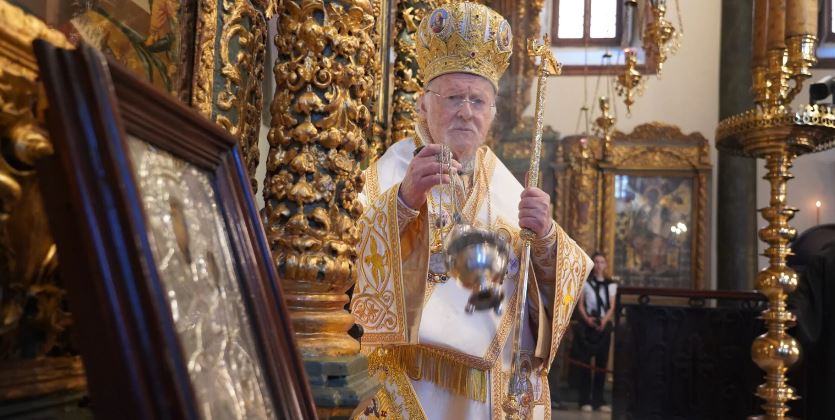
Emphasising contemporary global challenges, particularly the dangers arising from the war in Ukraine and its implications for nuclear facilities, His All-Holiness Ecumenical Patriarch Bartholomew spoke on the occasion of the 40th anniversary of the Chernobyl disaster (26 April 1986).
In his address at the Patriarchal Church of Saint George, following the Divine Liturgy of the Sunday of the Myrrh-Bearing Women, and in light of the presence of His Beatitude Pope and Patriarch Tawadros II, Patriarch of the Coptic Orthodox Church, who was on an official visit to the Ecumenical Patriarchate, His All-Holiness reflected extensively on the anniversary of the nuclear catastrophe of Chernobyl, linking it with present-day geopolitical realities.
As he characteristically noted: “Today marks forty years since the tragedy of Chernobyl, a wound in the memory of humanity and a stern reminder that creation, entrusted to us by God, must never be subjected to reckless neglect nor transformed into an instrument of destruction.”
Observing that the consequences of the disaster persist to this day, he underlined that “forty years later, this wound has not fully healed.”
The Ecumenical Patriarch connected this historic tragedy with the war in Ukraine, warning of renewed dangers:
“The ongoing war of Russia against Ukraine has introduced new risks in regions already marked by suffering. Attacks on nuclear facilities and related infrastructure, including areas connected with Chernobyl, have rekindled concerns about nuclear safety, inflicted immeasurable pain upon the Ukrainian people, and threatened consequences that would not be confined to Ukraine alone, but would endanger Europe and the entire world.”
Concluding his remarks, he issued a clear appeal: “We raise our voice with a sincere call for a just and lasting peace: for the cessation of hostilities, for the protection of civilian life, and for the safeguarding of creation from every form of arbitrary destruction,” he stated, adding that “the integrity of creation and the dignity of the human person are not secondary matters, but sacred responsibilities before God and among ourselves.”
