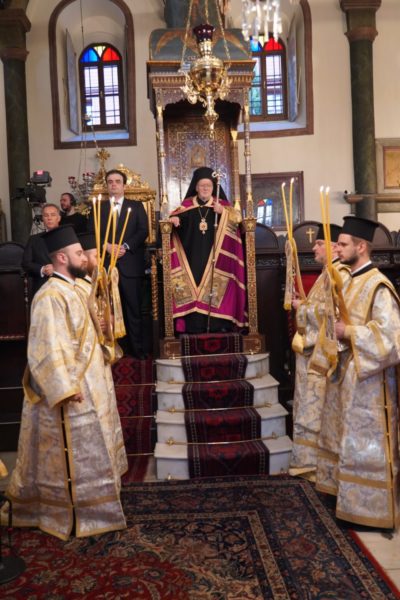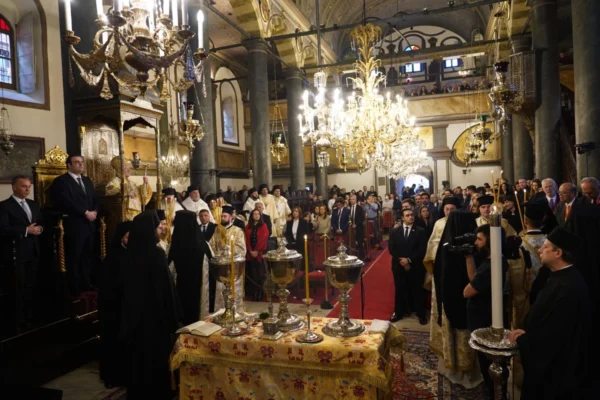
With great splendour and in the presence of thousands of pilgrims, the Holy Feast of Theophany was celebrated at the Ecumenical Patriarchate on Tuesday, 6 January 2026.
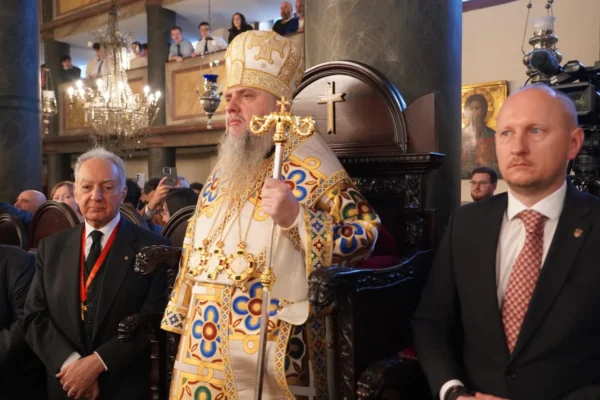
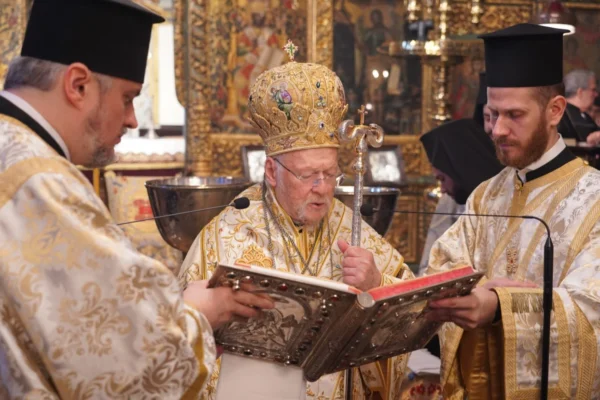
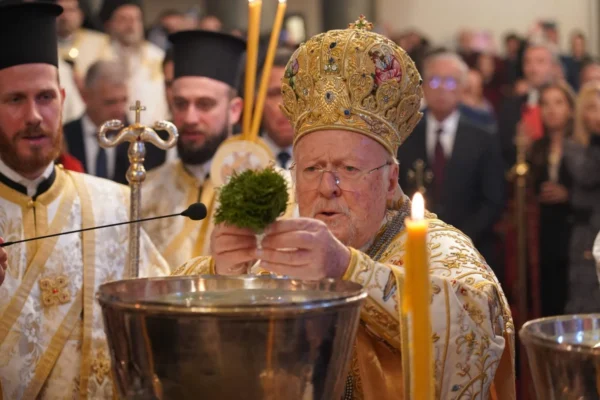
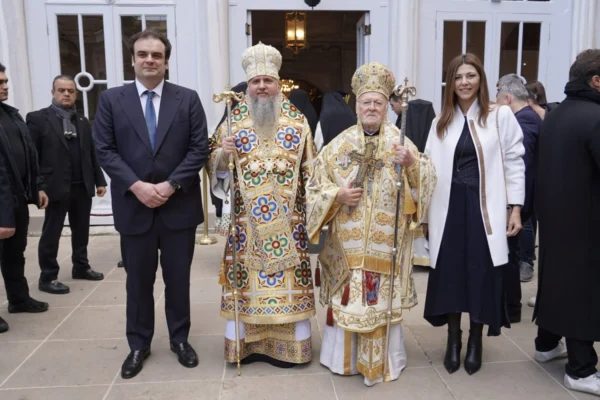
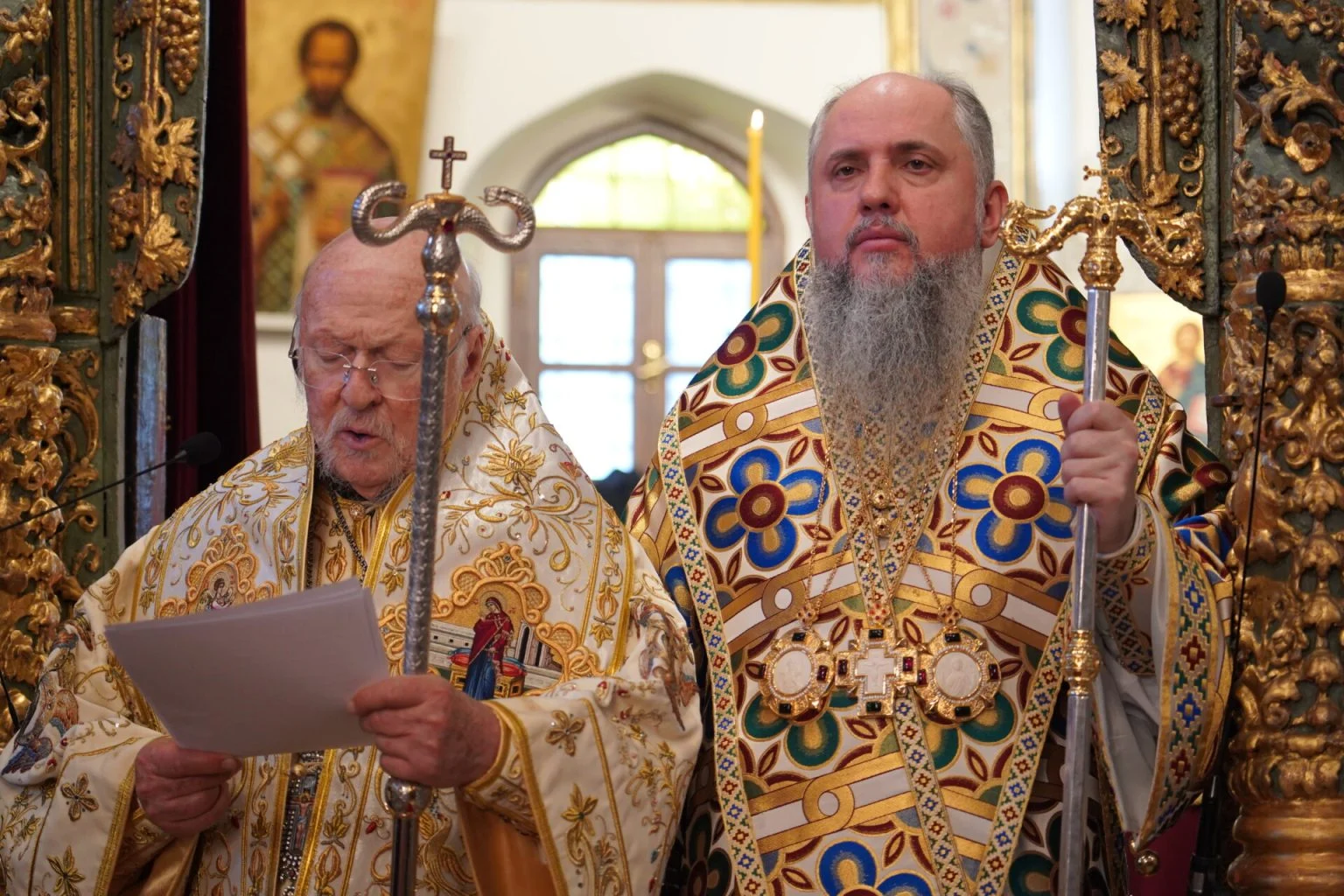
His All-Holiness Ecumenical Patriarch Bartholomew, after Matins, during which he presided, led the Service of the Great Blessing of the Waters, assisted by His Beatitude Metropolitan Epiphaniy of Kyiv and All Ukraine. Thereafter, they celebrated the Divine Liturgy together, concelebrated by Their Eminences the Metropolitans: Metropolitan Joseph of Proikonnisos; Metropolitan Symeon of Vinnytsia and Bar; Metropolitan Eirinaios of Myriophyton and Peristasis; Metropolitan Chrysostomos of Myra; Metropolitan Theoliptos of Iconium; Metropolitan Hilarion of Rivne and Ostroh; Metropolitan Kyrillos of Krini; and Metropolitan Theodoros of Seleuceia.
Among those attending the service were the Minister of National Economy and Finance of Greece and newly elected President of the Eurogroup, Kyriakos Pierrakakis, representing the Greek Government; the Minister of Education and Religious Affairs, Sofia Zacharaki; the Leader of the Official Opposition and President of PASOK–Movement for Change, Nikos Androulakis; the Ambassador Konstantinos Koutras, Consul General of Greece in Constantinople; the Consul General of Ukraine, Roman Nedilskyi; and a multitude of faithful from Constantinople and pilgrims from abroad.
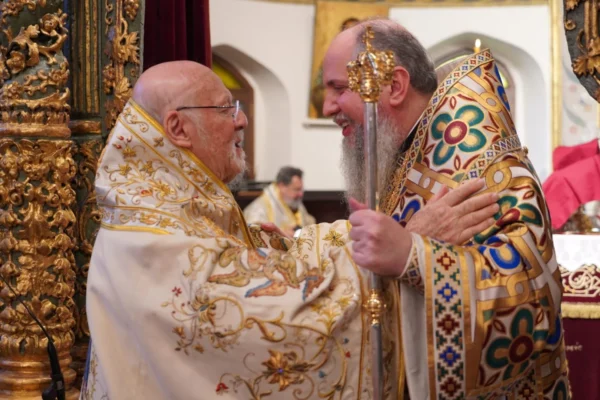
At the conclusion of the Divine Liturgy, His All-Holiness warmly welcomed His Beatitude Metropolitan Epiphaniy, once again expressing his support for the Ukrainian people who are enduring severe trials due to the Russian invasion. On the occasion of the seventh anniversary of the granting of the Tomos of Autocephaly to the Church of Ukraine, he also referred to the reasons that led the Mother Church of Constantinople to this decision, stating, among other things:
“Our motives, we repeat with clarity and a resonant voice, were purely ecclesiological. We did not yield to expediencies, nor did we proceed to a hasty and superficial consideration of this long-standing issue, as some, who are ill-informed, wrongly allege. As was our duty, we received the appeals repeatedly submitted to us, in a spirit of repentance and acknowledgment of errors, by those under censure who sought refuge with us. Prior to accepting them, and exhausting the principle of oikonomia and even going beyond the responsibility deriving from the appellate process, we undertook initiatives of mediation for the reconciliation of the divided parties.
Reconciliation presupposes that those involved emerge from the obsessive certainty that each side alone has inherited absolute truth. In such cases, as the experience of the Church teaches us, sacrifices are required in order to find a balanced solution. In ecclesiastical life, justice is always in favour of the lost. ‘Those who are well have no need of a physician, but those who are sick… for I did not come to call the righteous, but sinners to repentance’ (Mt 9:12–13). The Church’s understanding of justice differs from that of worldly systems. In our faith, the strong one is the weak, the one who acknowledges his fault with contrition of heart and sincere disposition toward return: ‘A bruised reed He will not break, and a smoking flax He will not quench, but will bring forth justice in truth… and in His name the nations will hope’ (Is 42:3–4). Thus, in awareness of what had occurred, we pardoned those who had acted irregularly and restored the ecclesiastical order in Ukraine as it had been defined by the Great Church of Christ prior to its violation.”
Elsewhere in his address, the Patriarch emphasised: “Developments are known and painful. We do not wish today to underscore or delve into the full complexity of the matter in connection with the ongoing state of war. For this, we pray to the Lord of Peace to incline the hearts of the powerful of this world toward thoughts and actions that will overturn and bring to an end the brutal and inhumane condition of war. Once again, as on many occasions, we call upon the remaining venerable hierarchy in Ukraine under Metropolitan Onuphry to reconsider its stance. We urge ourselves and one another to earnest prayer, first and foremost for ecclesiastical reconciliation. We unequivocally condemn extremisms from wherever they may arise. We recommend that state authorities refrain from interference in the internal affairs of the Church. We once again offer an opportunity and invite those who have remained apart to unity, and finally we courageously ask forgiveness if, through our humble silence, we may have given some the impression that our approach to this issue was human-centered rather than ecclesial.”
In his response, His Beatitude Metropolitan Epiphaniy of Kyiv and All Ukraine expressed his warm thanks to His All-Holiness and to the Mother Church of Constantinople for granting autocephalous status to the daughter Church of Ukraine, stating:

“Your All-Holiness, you and the Holy and Sacred Synod heard these requests of the Church and the people of Ukraine, and seven years ago you gave a written response here, sealing it with unity in prayer and the Divine Eucharist. Today, on a symbolic and historic day for us all, we have come from Ukraine to express once again, in person, our gratitude to the Mother Church and to Your All-Holiness for all that you have done, and continue to do, for Ukraine and for our good.
Four years ago, the Russian government, which until then had waged a hybrid war against Ukraine, attacked us openly. We are also compelled to observe that this crime of unjust aggression was not only not condemned by the Church of Russia, but, on the contrary, through its Patriarch and many others, began to be endorsed as a ‘holy war.’ Over these four years, we have seen the impious doctrine of the ‘Russian world,’ which contradicts the Gospel and the Tradition of the Church, penetrate deeply into the environment of the Church of Russia and even beyond its borders. This doctrine and its adherents introduce ethno-racial division into the Church of Christ, something we see not only in Ukraine, but also in countries of Africa, Europe, and throughout the world.”
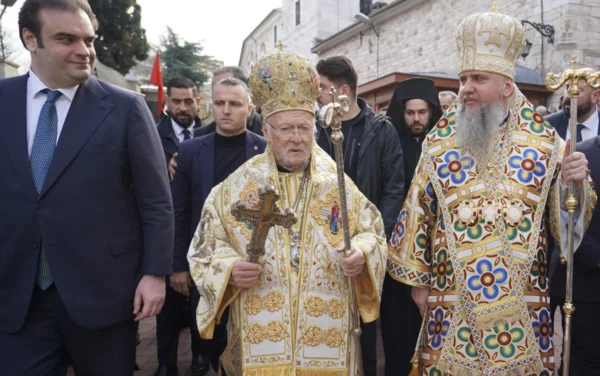
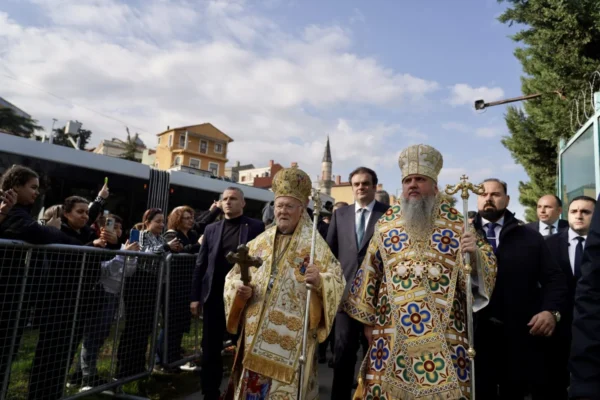
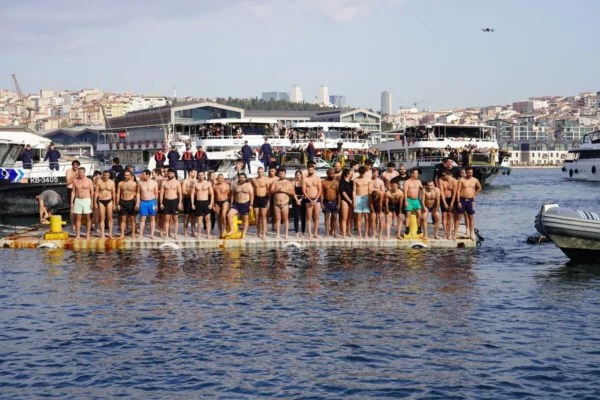
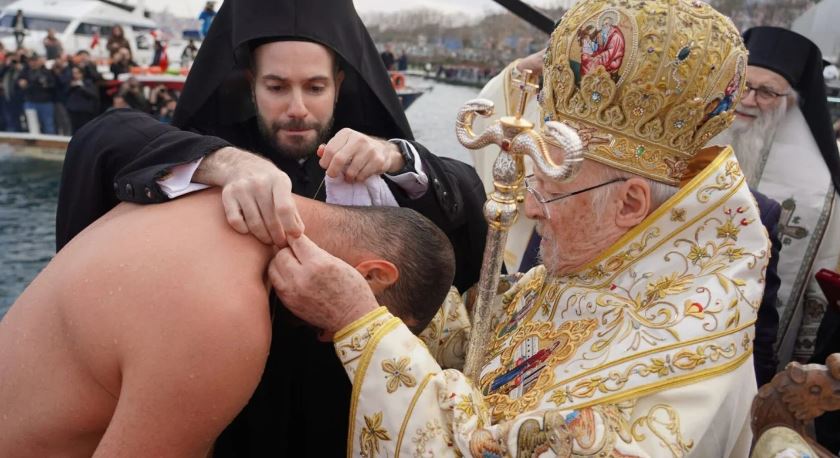
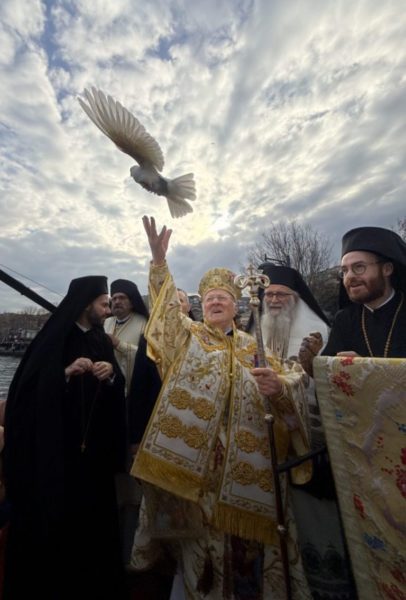
After the conclusion of the Divine Liturgy, the two Primates, the hierarchs, the Archons of the Great Church of Christ, the officials, and the faithful people processed to the Phanar waterfront, where His All-Holiness presided over the ceremony of the immersion of the Holy Cross into the waters of the Golden Horn.
More than fifty participants from Constantinople and Imbros, from Greece and other countries, dove into the blue waters of the Golden Horn. To Mr Vasileios Konstantinidis from Drama, who retrieved the Cross for the second consecutive year, the Ecumenical Patriarch offered, as a blessing, a gold pectoral cross, and he also blessed all the other swimmers, presenting them with small commemorative tokens.
Photographs: Nikos Papachristou