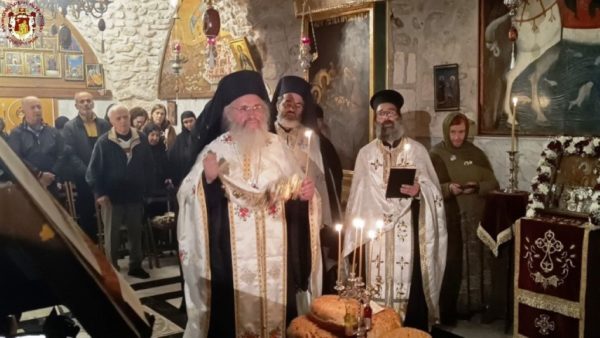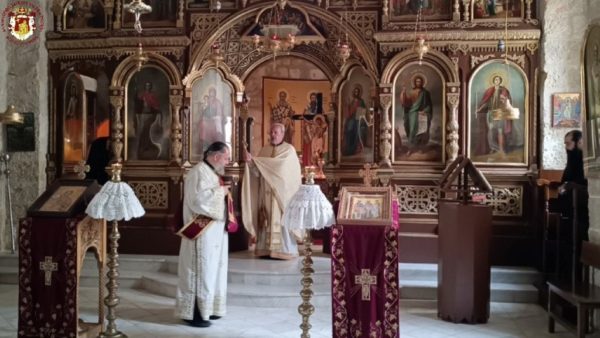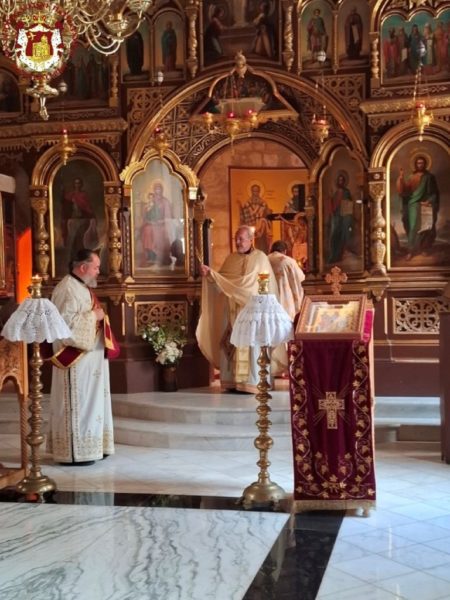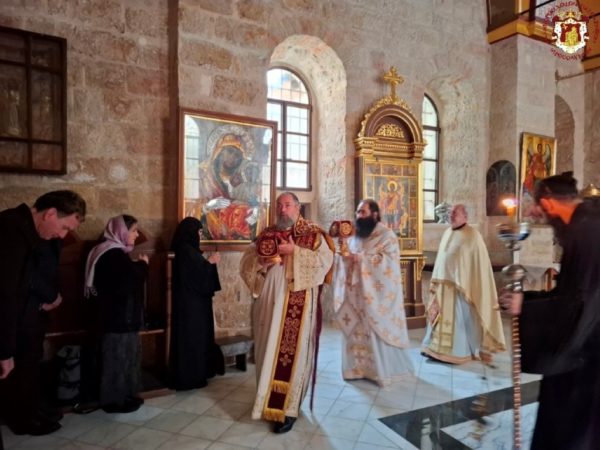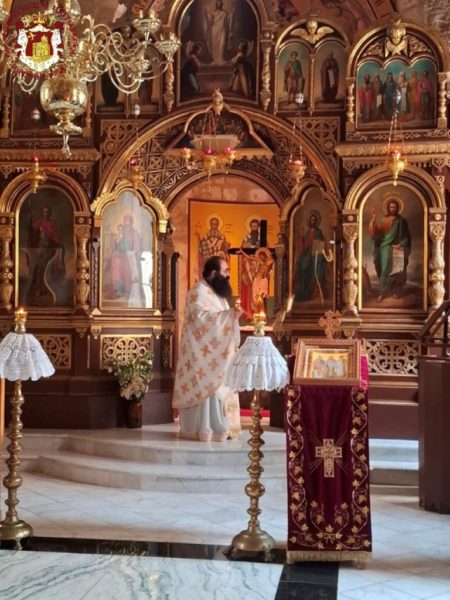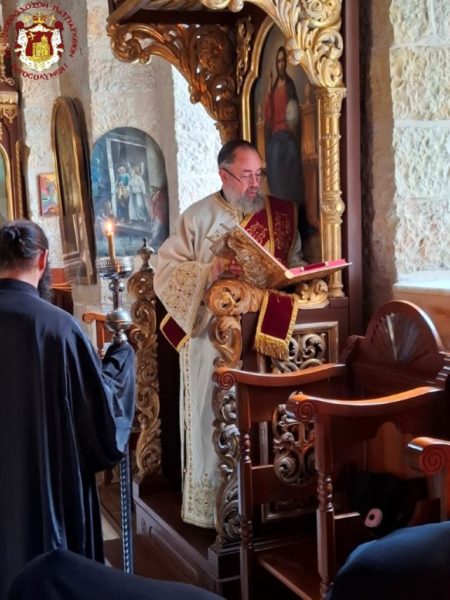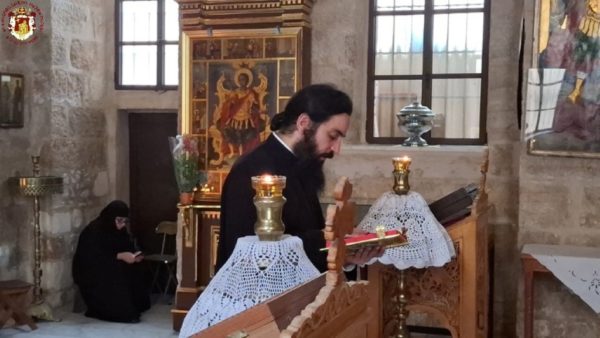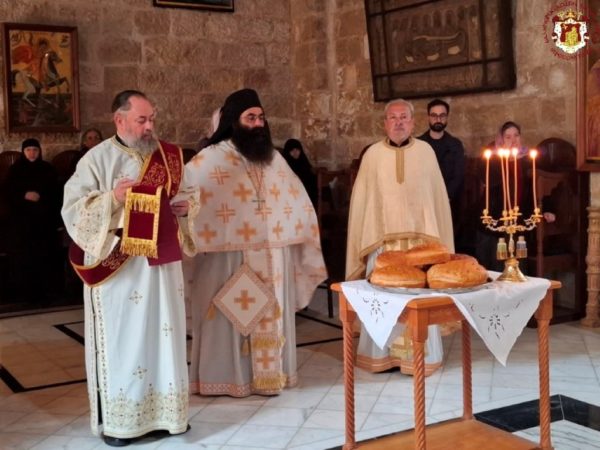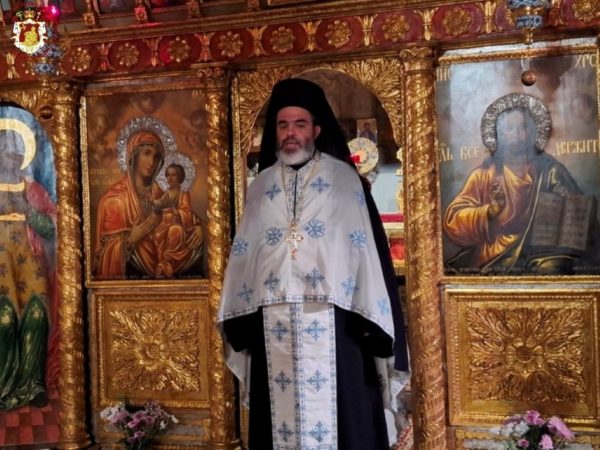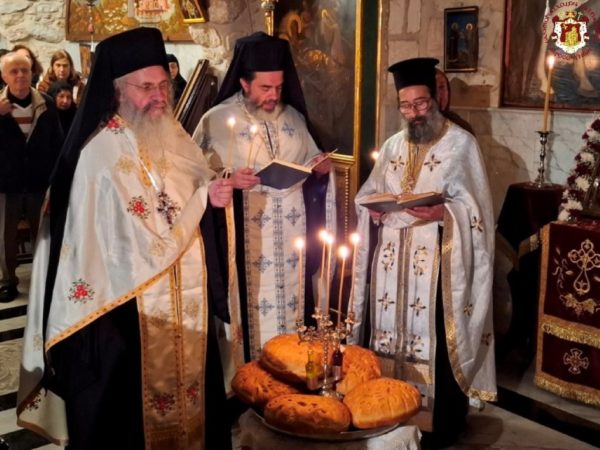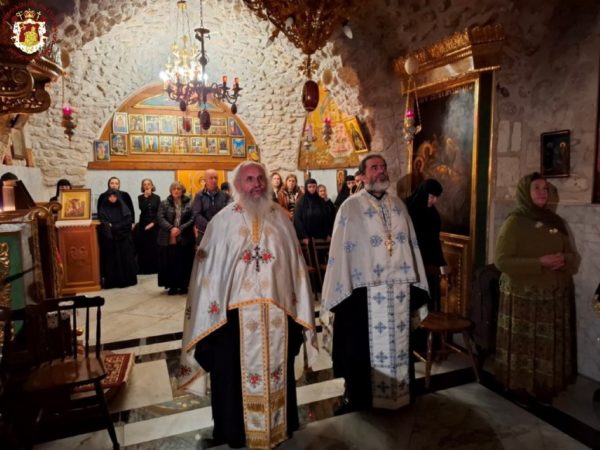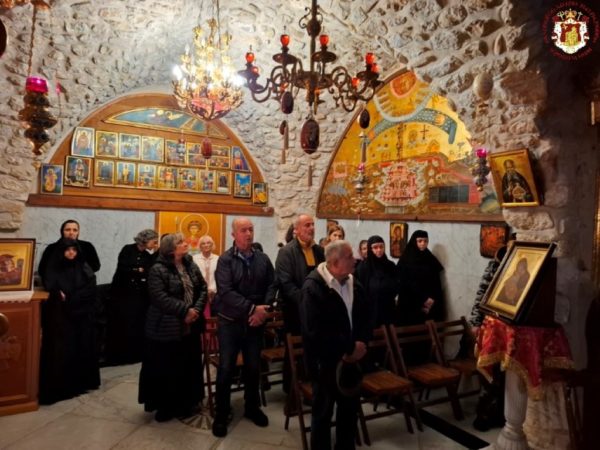
On Sunday, the 3rd/16th of November 2025, the Patriarchate celebrated the commemoration of the translation of the relic of the Holy Great-Martyr George the Trophy-bearer, together with the consecration anniversary of the Church dedicated to his name in Lydda, wherein his tomb is preserved in its crypt.
This feast is observed in memory of the translation of his precious relic from Rome—the city of his martyrdom—in the 4th century, during the reign of Diocletian, when it was brought by his servant to the native city of his mother, namely Lydda of Palestine (modern Lod). There he was laid to rest, and in his honour, Saint Helen erected a magnificent Church.
For the celebration of this event, His Beatitude, our Father and Patriarch of Jerusalem, Theophilos III, travelled from Jerusalem to Lydda, where He was warmly received by the Hegoumen of the Monastery, Archimandrite Marcellus, by the Priests of the region, and by the Scouts, as He entered the Church of Saint George, festively celebrating the anniversary of its consecration.
Thereafter, His Beatitude presided over the festal Divine Liturgy, with concelebrants their Eminences the Archbishops Damaskinos of Yaffo, Aristarchos of Constantina, and His Eminence Metropolitan Joachim of Helenoupolis, together with the Holy Sepulchre Hieromonks, first among whom was the Elder Kamarasis, Archimandrite Nektarios, the Archimandrites Niphon and Christodoulos, Archdeacon Mark, Hierodeacon Eulogios, and other deacons. The chief cantor of the Church of the Holy Sepulchre, Deacon Eustathios, chanted in Greek, and the choir of the Church chanted in Arabic. A great congregation participated, including the representative of the Greek Embassy in Tel Aviv, Mr Mavroeidis, the Ambassador of Cyprus Mr Kornelios other diplomatic attachés, the Ambassador of Cyprus, Mr Kornelios, and representatives of the Embassies of Russia, Bulgaria, Serbia, and Romania, as well as the Deputy Mayor of the city of Lydda.
Before the Holy Communion, His Beatitude delivered the following Sermon:
“For love overcame nature, persuading the lover through death to pass over unto Him Whom he loved—Christ God and the Saviour of our souls,” the hymnographer of the Church exclaims.
Reverend Holy Fathers and Brethren,
Pious Christians and pilgrims,
The grace of the Holy Spirit has gathered us today in the Church bearing the name of the holy Great-Martyr George the Trophy-bearer, that we may celebrate the translation of his sacred relic in the magnificent Church of Lydda, erected by the holy Emperor Constantine the Great.
The glorious Great-Martyr of Christ, George, born of a wealthy and noble family, was of Cappadocian descent on his father’s side and Palestinian on his mother’s side. He served as a high-ranking officer in the Roman army during the reign of Emperor Diocletian (AD 284–305), before whom he declared himself to be a Christian, confessing Jesus Christ to be God and the Son of God. For this reason, he was arrested and endured a martyr’s death. His relics were then transferred to Diospolis (Lydda), the biblical city where his eponymous Church and cenotaph stand.
The veneration of Saint George spread to the ends of the world, especially throughout the East but also throughout the West, where he is honoured not only by Christians but also by those of other religions. This is due to the manifold miracles wrought through him, as his hymnographer vividly proclaims, saying: “Truly great and wondrous is proclaimed the glory of thine ineffable martyrdom, O glorious Martyr; for as a radiant champion, thou runnest through all creation, all-admired George, adorned indeed with many miracles, healing diseases and curing all who suffer by thy supplications; wherefore we acknowledge thee as a fervent helper and all-blessed benefactor, delivering the captives. Do thou, therefore, entreat Christ to grant unto our souls His great mercy.”
The testimony and confession of the God-inspired George, that Christ is God and the Son of the living God, made him great and distinguished among the “cloud of witnesses” (cf. Heb. 12:1) of the Church. He became a fellow-dweller and converser with the martyrs of Christ, for he preached with boldness the truth in Christ, proclaiming the religion of idols, born of diabolic delusion, and fearing not death, heeding the Gospel word of the Lord which saith: “Fear not them which kill the body, but are not able to kill the soul: but rather fear Him Who is able to destroy both soul and body in Gehenna” (Matt. 10:28).
The blessed George, illumined by the Holy Spirit, was moved by an invincible longing to pass over unto Christ, the God and Saviour of our souls, that is, “unto the city of the living God, the heavenly Jerusalem… and to the Church of the firstborn, which are written in heaven” (Heb. 12:23). For he hearkened unto the preaching of the divine Paul: “For here have we no continuing city, but we seek one to come” (Heb. 13:14). Expounding this word, Theophylactos says: “We have no share in the things of this present world, for nothing remaineth. We ought therefore to flee from this and run toward the city which is to come—that is, heaven.”
The martyrs of Christ are they who proclaim His righteousness and truth not only by their spoken word but also by the blood of their martyrdom. This precisely did the Great-Martyr George, listening to the voice of the Psalmist who saith: “My mouth shall shew forth Thy righteousness and Thy salvation all the day; for I know not the learning of men” (Ps. 70:15).
In other words, the all-admirable George, being an officer of the Roman army, preached in deed that Christ is God, the Son of God, and the Saviour of the world. Wherefore “their sound went into all the earth, and their words unto the ends of the world” (cf. Rom. 10:18 / Ps. 19:4). Extolling the memory of the trophy-bearer George, his hymnographer says: “Let us extol George, the husbandman of Christ, the noble one among the Martyrs, the wise George, the herald of truth, the ever-living branch of the vine of life, who blossomed and poured forth the wine of piety, making glad those who in faith each year keep his memory.”
Most aptly, the hymnographer calls the ever-memorable Martyr George “the herald of truth and the ever-living branch of the vine of life.” The vine of life is none other, according to the testimony of the Evangelist John, than Christ and His Church, which is His mystical Body: “I am the true vine, and My Father is the husbandman. Every branch in Me that beareth not fruit He taketh away; and every branch that beareth fruit He purgeth it, that it may bring forth more fruit” (John 15:1–2).
Interpreting this saying, Saint Cyril of Alexandria states: “Know then that if we are united unto Him by faith, and practise only the form of union through bare confessions, yet do not strengthen the bond of our union with deeds of love, then shall we indeed be branches, but dead and fruitless.”
This very unity in Christ of the reverent pilgrims and all our Orthodox brethren is proclaimed today by the intercessions of the Great-Martyr George and of all who have partaken in this holy feast, together with the supplications of the all-blessed Theotokos, in the holy mystery of the mystical blessing of the common chalice, the Divine Eucharist of the Body and Blood of our God and Saviour Jesus Christ, of Which we have been made partakers and sharers.
Together with the hymnographer, let us say: “Thou didst ascend the mount of martyrdom, and didst receive the crown, O Trophy-bearer, from the hand of the Lord; for this is the reward of the Martyrs; wherefore we all worthily magnify thee.”
Many happy returns, blessed and peaceful.”
The Hegumen of the shrine, Archimandrite Marcellus, offered a treat to the Patriarchal entourage and the congregation, while at midday of the feast, the Community Council and the Scouts’ Association hosted a festal meal. At this meal, representatives of the Scouts addressed those present, together with many residents of Lydda and local officials, such as the Deputy Mayor of Lydda. His Beatitude responded to them as follows:
“Most Honourable President of the Ecclesiastical Committee, Mr Yousef Khan Khan,
Your Excellencies, the Ambassadors,
Beloved Christians and devout Pilgrims,
Your most ancient and scripturally renowned city of Lydda rejoices today on the feast of its holy martyr and protector, George the Trophy-bearer. The Christian flock dwelling here rejoices also in particular, which may be small in number, yet great in spiritual stature.
Today’s feast of Saint George is an indisputable testimony that the God of George is the God of light and of truth. He is God the Father, Who enlightens and frees from the fear of death and corruption. Ye shall know the truth, and the truth shall make you free (John 8:32), the Lord says.
This truth was proclaimed with boldness by George, being inspired and strengthened by the love of God, as well as by his love for his fellow human beings. For this reason, his fame spread unto the ends of the world. Their sound is gone out into all lands, and their words unto the ends of the world (Ps. 18:5), the Psalmist exclaims. A proof of this is the fact that the wondrous George has been revealed as the Protector of many peoples and nations.
Here precisely lies the invaluable contribution of the Rum Orthodox Patriarchate of Jerusalem, which has preserved and continues to preserve the Christian faith and culture alive through the centuries.
For this reason, we also confess and proclaim that the Rum Orthodox Patriarchate of Jerusalem, that is, the Church of the Horrendous Golgotha and of the empty Tomb of the All-holy Sepulchre, constitutes the guarantee of the identity and continuity of the Christians in the land and soil of their forefathers throughout the centuries.
In the midst of the prevailing confusion in the world of the so-called “New Order,” the victorious athlete George appears as a lamp set upon a hill, enlightening those who sit in darkness and in the shadow of death (Matt. 4:16), on the one hand, and guiding them towards paths of righteousness and havens of peace on the other.
Let us therefore entreat the martyr of the love, peace, and righteousness of Christ—George the Trophy-bearer—that he may guard the people of the beloved city of Lydda to dwell in peace, love, and mutual respect.
Let us, in thanksgiving, offer ourselves, according to the divine Paul, unto the God of love, mercy, and peace.
Many happy returns, blessed and peaceful. Amen.”
His Beatitude bestowed upon the representative of the Scouts’ Association a commemorative plaque.
2. In Jerusalem
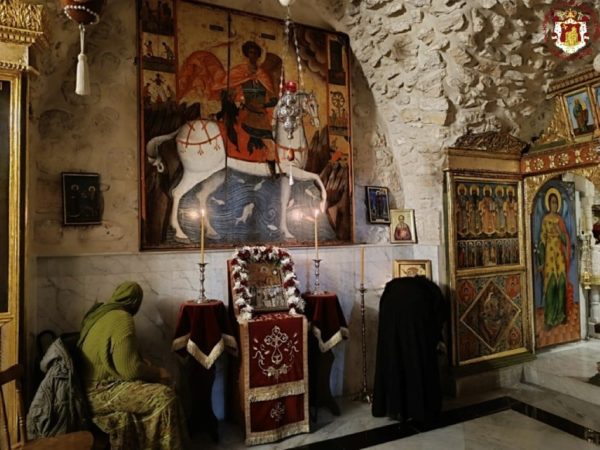
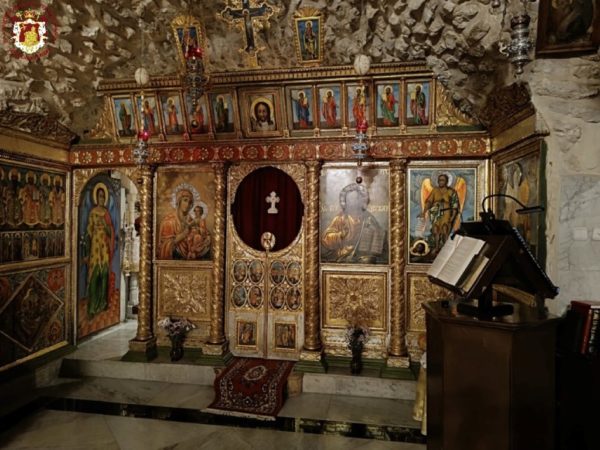
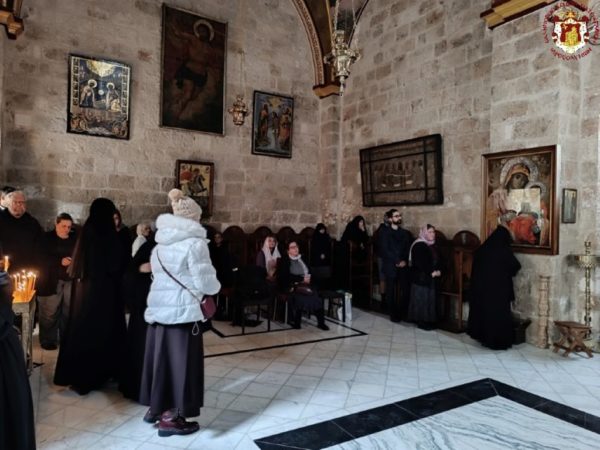
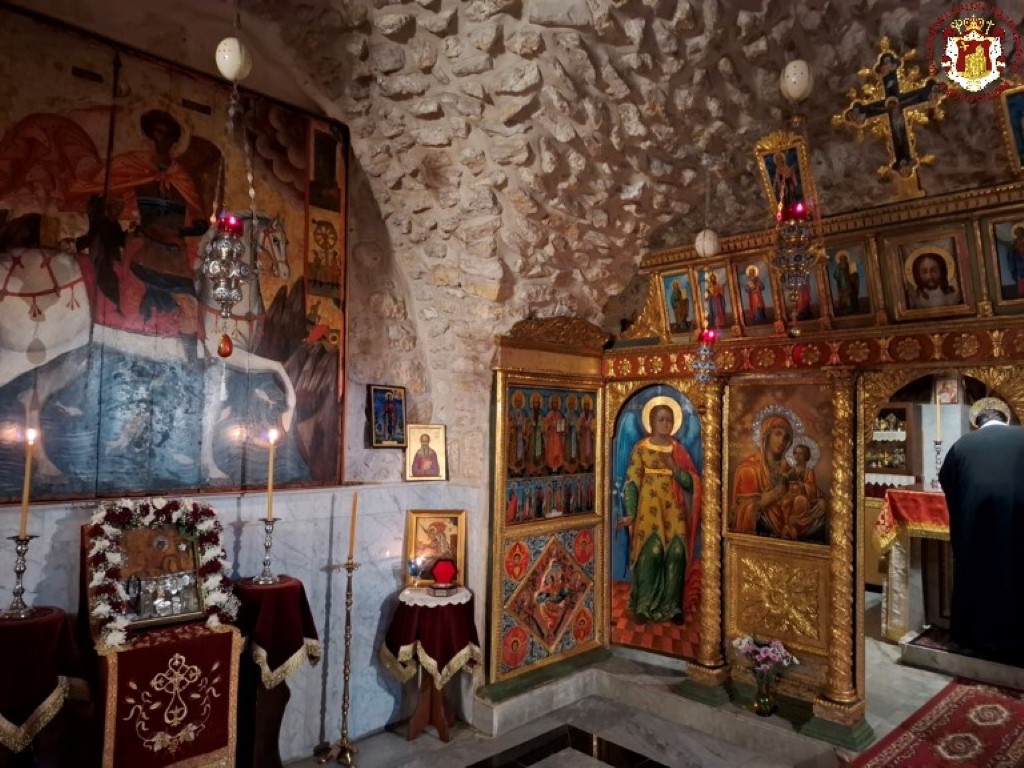
On Saturday, the 2nd/15th of November 2025, the commemoration of the translation of the relic of the Holy Great-Martyr George the Trophy-bearer was celebrated by transference at his Holy Monastery in the Jewish Quarter. The Divine Liturgy was presided over by the Hegumen of the Monastery of the Precious Cross, Archimandrite Christodoulos, with Archimandrite Klaudios and Archdeacon Mark concelebrating. The chanting was rendered by Hieromonk Dositheos and Hierodeacon Prodromos, while the Liturgy was attended by faithful from Jerusalem and by nuns of the Patriarchate. After the Liturgy, the Fathers and the congregation were graciously received by the Hegumen of the Monastery, Hierodeacon Prodromos.
This feast was likewise celebrated at the Holy Monastery of Saint George of the Hospital, situated within the Old City of Jerusalem and near the Monastery of the Holy Archangels, with Vespers on the eve and with the Divine Liturgy on the morning of Sunday, the 3rd/16th of November 2025. The services were presided over by Archimandrite Amphilochios, with Archimandrite Philoumenos and Priest Nektarios concelebrating. The chanting was offered by nuns of the Patriarchate, as a devout congregation of nuns, faithful from Jerusalem, and reverent pilgrims participated in the services.
After the Divine Liturgy, the Abbess, Nun Pansemni—who diligently oversees the affairs of the Monastery and has renovated the Holy Church—offered hospitality to the clergy and the congregation.
From the Chief-Secretariat