
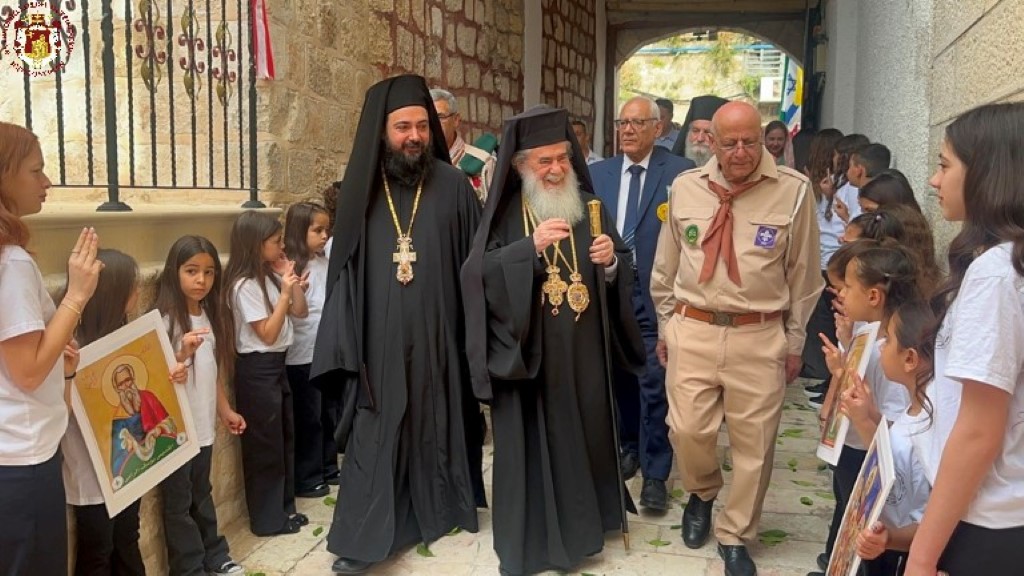
On Sunday, the 13th/26th of April 2026, the Patriarchate celebrated the feast of Joseph of Arimathaea and the Myrrh-bearing women.
On this Sunday, the Church commemorates Joseph of Arimathaea, present-day Ramleh, as a “counsellor of honourable estate,” who dared to go in unto Pilate and asked for the Body of Jesus (cf. Mark 15:42). And when Pilate was informed by the centurion that Jesus was dead (cf. Mark 15:45), he granted the Body to Joseph; and he, having taken It, wrapped It in linen and laid It in the tomb, wherein “the Myrrh-bearing women beheld where the Master was laid” (Mark 15:46–47).
Joseph of Arimathaea and the Myrrh-bearing women became witnesses of the Crucifixion, the Burial, and the Resurrection of Christ. The Myrrh-bearing women, “very early in the morning,” came unto the tomb of the Lord to anoint His Body with myrrh, and “they said among themselves, Who shall roll us away the stone from the door of the sepulchre?” And when they arrived, they found the stone rolled away from the door of the tomb, and a radiant angel spoke unto them, saying: “Be not affrighted: Ye seek Jesus of Nazareth, which was crucified: he is risen; he is not here: behold the place where they laid him. But go your way, tell his disciples and Peter that he goeth before you into Galilee: there shall ye see him, as he said unto you” (Mark 16:6–7).
The memory of Joseph of Arimathaea and of the Myrrh-bearing women was celebrated in Ramleh by a Patriarchal Divine Liturgy, presided over by His Beatitude our Father and Patriarch of Jerusalem, Theophilos III. This Divine Liturgy was preceded by a warm reception by the Hegumen of Ramleh, Archimandrite Niphon, the priests of the neighbouring regions of Ramleh, the Scout corps, the Churchwardens, and the Director and teachers of the Patriarchal School situated near the Holy Monastery.
Concelebrants to His Beatitude at the Divine Liturgy were their Eminences, Metropolitan Hesychios of Capitolias, the Archbishops Damaskinos of Yaffo and Aristarchos of Constantina; the choir of the church delivered the chanting, and the Orthodox faithful of Ramleh participated in devout prayer.
To this congregation, His Beatitude delivered the following sermon:
“Joseph of Arimathaea, being a disciple of Jesus, but secretly for fear of the Jews, besought Pilate that he might take away the body of Jesus: and Pilate gave him leave. He came therefore, and took the body of Jesus. And there came also Nicodemus, which at the first came to Jesus by night, and brought a mixture of myrrh and aloes, about an hundred pound weight” (John 19:38–39). “And when the sabbath was past, Mary Magdalene, and Mary the mother of James, and Salome, had bought sweet spices, that they might come and anoint him” (Mark 16:1).
Beloved brethren in Christ,
Pious Christians and pilgrims,
The grace of the Holy Spirit has gathered us together on this Paschal day, that we may festively honour the memory of the hidden disciples of Christ, Joseph and Nicodemus, in their own homeland, the Scriptural city of Arimathaea (namely, in your present-day city of Ramleh), on the one hand; and, on the other, the memory of the brave women, faithfully devoted to the Lord, who are called the Myrrh-bearers.
The Holy Church of Christ honours and venerates the precious persons of the Myrrh-bearing women, as also those of the hidden disciples of Christ, Joseph of Arimathaea and Nicodemus, for they became true eyewitnesses of the Crucifixion, as also of the Resurrection of our God and Saviour Jesus Christ in the Holy City of Jerusalem.
Both the hidden disciples, Joseph and Nicodemus, and likewise the Myrrh-bearing women, were distinguished for their faith and their love toward Christ, as well as for their boldness. “Joseph of Arimathaea… went in boldly unto Pilate, and craved the body of Jesus” (Mark 15:43), as the Evangelist Mark relates. And, “The first day of the week cometh Mary Magdalene early, when it was yet dark, unto the sepulchre, and seeth the stone taken away from the sepulchre” (John 20:1), as the Evangelist John points out.
This event most clearly bears witness that the true love of the hidden disciples, as also of the Myrrh-bearing women, toward Jesus overcame fear and every intervening difficulty. “There is no fear in love; but perfect love casteth out fear: because fear hath torment” (1 John 4:18), proclaims Saint John the Theologian.
Let us also hear the hymnographer, saying: “The women, bearing the ointments of Thy burial, came secretly unto the tomb at early dawn, fearing the boldness of the Jews and foreseeing the watch of the soldiers; yet weak nature overcame manly courage, for their compassionate resolve was well-pleasing unto God. Wherefore they cried aloud: Arise, O Lord, help us, and deliver us for Thy Name’s sake.”
Our Holy Church celebrates the feast of the holy Myrrh-bearing women, and also commemorates Joseph of Arimathaea, as well as of the nocturnal disciple Nicodemus; for the Myrrh-bearing women were shown to be true witnesses and the first Evangelists of the Resurrection. And Joseph and Nicodemus became witnesses of the Crucifixion and of the Burial of Christ in a new tomb. “And he bought fine linen, and took him down, and wrapped him in the linen, and laid him in a sepulchre which was hewn out of a rock, and rolled a stone unto the door of the sepulchre” (Mark 15:45–46). And the Myrrh-bearing women, “entering into the sepulchre, saw a young man sitting on the right side, clothed in a long white garment; and they were affrighted. And he saith unto them, Be not affrighted: Ye seek Jesus of Nazareth, which was crucified: he is risen; he is not here: behold the place where they laid him” (Mark 16:5–6).
And we enquire: why do all four Evangelists and disciples of Christ, in recounting the events of the Crucifixion, the Burial, and the Resurrection of Jesus Christ, invoke their true testimony? Because the Resurrection constitutes the fulfilment of the mystery of the Divine Providence, that is to say, the salvation of man from the corruption of sin; as Saint Gregory Palamas says: “The Resurrection of the Lord is the renewal of human nature; it is the revivification, the re-creation, and the return to the immortal life of the first Adam, who was swallowed up by death through sin, and through death returned again to the earth, from which he was formed.”
Worthy of note also is the observation of our holy Father Gregory, who says: “For He alone [Christ], having raised Himself on the third day, returned not again unto the earth, but ascended into heaven, making our nature co-enthroned and consubstantial with the Father… The last enemy that shall be destroyed is death, at the general resurrection, at the last trumpet. For this corruptible [body] must put on incorruption, and this mortal must put on immortality.”
It is therefore made manifest that the Resurrection of Christ pertains to the deification of our human nature, as the hymnographer most fully declares, saying: “Having utterly destroyed the dominion of death, thy Son, O Virgin, in His Resurrection, as a mighty God, has raised us up together with Himself and deified us; wherefore we hymn Him unto the ages.”
In this very truth consists the mystery of the Resurrection of our Saviour Christ, namely, in the deification of our human nature, as Saint Maximus the Confessor says: “For this cause did God create us, that we might become partakers of the divine nature, and sharers of His eternity, and be made like unto Him by grace.” And the deification of man, that is to say, the union of the divine with the human nature, is also proclaimed by the hymnographer, who says: “Thou, as the Lover of mankind, willing to save all whom Thou hast created from error, didst endure to be nailed upon the Cross, that Thou mightest renew, O Saviour, in Thy flesh, the image that had been obscured by the passions; and having overthrown Hades, Thou didst raise up together with Thyself those who had died.”
The manner and significance of deification are set forth most clearly by Saint Cyril of Alexandria, who, speaking of the human nature assumed by God the Word, says: “For as fire, being wholly united to iron, thoroughly inflames it, yet does not cause it to depart from the nature of iron (for it remains iron even after being inflamed); even so the Son and Word of God, being united with the mortal nature, deified it, yet did not cause it to cease from being mortal in nature. For it remains a mortal nature even after deification, and is both said and is a deified mortal nature: deified flesh with a rational soul, endowed with mind, will, and operation.”
The Holy Church of Christ honours today the memory of the hidden disciples of Christ, Joseph and Nicodemus, and especially of the Myrrh-bearing women, for they are not only true witnesses of the Resurrection, but also its heralds, according to the command of the young man sitting within the tomb, that is to say, the Angel, who said unto them: “But go your way, tell his disciples… that he goeth before you into Galilee: there shall ye see him, as he said unto you” (cf. Mark 16:7).
Wherefore, we also, my beloved brethren, together with the hymnographer, let us say: “Joseph the wondrous let us praise, O ye faithful, together with Nicodemus and the faithful Myrrh-bearers, crying aloud in truth: The Lord is risen!”
Christ is Risen!”
At midday, a meal was offered by the Hegumen and the Community at a restaurant in the city. There, His Beatitude addressed those present as follows:
“Joseph, the honourable counsellor, let him be praised with the Myrrh-bearers and the divine disciples, for he also was a herald of the Resurrection of Christ,” the hymnographer of the Church exclaims.
Honourable President and esteemed members of the Community Council,
Your Excellency, Ambassador of Greece, Mrs Maria Solomou,
Holy Fathers and devout Christians,
We offer glory and thanksgiving to the Holy Triune God, who has granted us, in the midst of the ongoing crisis of war in our blessed region, this present time of refreshment, that is to say, the season of the redeeming feast of the Pascha of the Lord. Wherefore, with the Apostle Peter we also say: “Blessed be the God and Father of our Lord Jesus Christ, which according to his abundant mercy hath begotten us again unto a lively hope by the resurrection of Jesus Christ from the dead, to an inheritance incorruptible, and undefiled, and that fadeth not away, reserved in heaven…” (1 Peter 1:3–4). Interpreting this word of the Apostle Peter, Oecumenius says: “By reason of His surpassing riches and mercy, God the Father has begotten us anew in His risen Son and Word, our Lord Jesus Christ.”
Of this event, our regeneration unto a living hope through the Resurrection of Jesus Christ from the dead (cf. 1 Peter 1:3, the holy Myrrh-bearing women on the one hand, and the hidden disciples of Christ, Nicodemus and the honourable counsellor Joseph of Arimathaea on the other, became eyewitnesses, hearers, and true witnesses.
This promise (cf. Matthew 28:10) of the Resurrection of Christ, that is to say, of the Word of God, the holy Apostles proclaimed with boldness, having been filled with the Holy Spirit (cf. Acts 4:31). This divine word continues to be proclaimed with boldness both by the Holy Church of Jerusalem and by her Christ-named flock, unceasingly throughout the ages.
We say this because the local Church of Ramleh, the ancient Scriptural Arimathaea, the city of Joseph, the disciple of Christ (Matthew 27:57), constitutes a visible and living example of the ancient presence of Christians in general, and of the Rum Orthodox in particular, in the Holy Land. “And there were dwelling at Jerusalem Jews, devout men, out of every nation under heaven… and strangers of Rome, Jews and proselytes, Cretans and Arabians” (Acts 2:5, 10), according to the Evangelist Luke. And, “And there were certain Greeks among them that came up to worship at the feast: the same came therefore to Philip… and desired him, saying, Sir, we would see Jesus” (John 12:20–21), according to the Evangelist John. “As Galileans, that is to say, non-Jews, the Greeks approached Philip, since he also was of Galilee,” comments the eminent Father of the Church, Cyril of Alexandria.
The Rum Orthodox Patriarchate of Jerusalem, which embodies the Christian presence in the Holy Land (and not only there), is “the faithful witness” (Revelation 1:5), “a witness of the sufferings of Christ” (1 Peter 5:1), and of the Resurrection of Christ from the dead. This is the witness to whom the Risen Christ gave command, saying: “Go ye therefore, and teach all nations… teaching them to observe all things whatsoever I have commanded you: and, lo, I am with you alway, even unto the end of the world. Amen.” (cf. Matthew 28:19–20).
Christ is Risen.”
Finally, refreshments were offered at the Hegumen’s residence by the Hegumen, Archimandrite iphon, who for many years has carried out a most significant spiritual ministry within the Community of Ramleh.
From the Chief Secretariat


