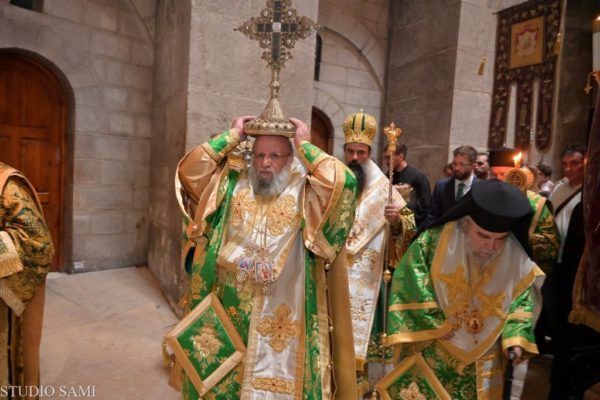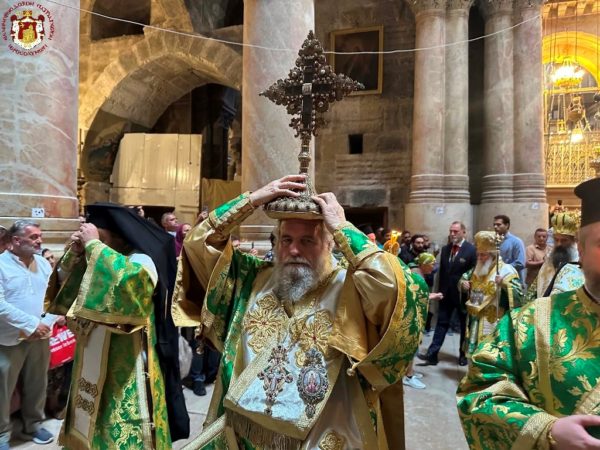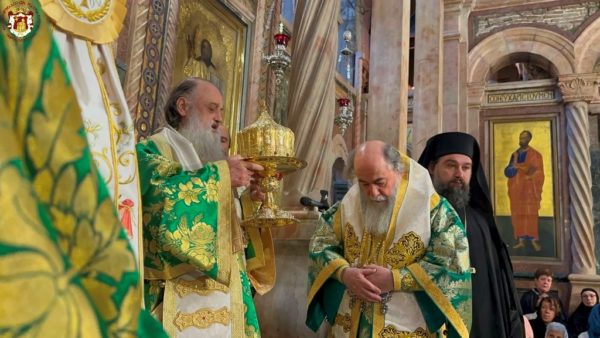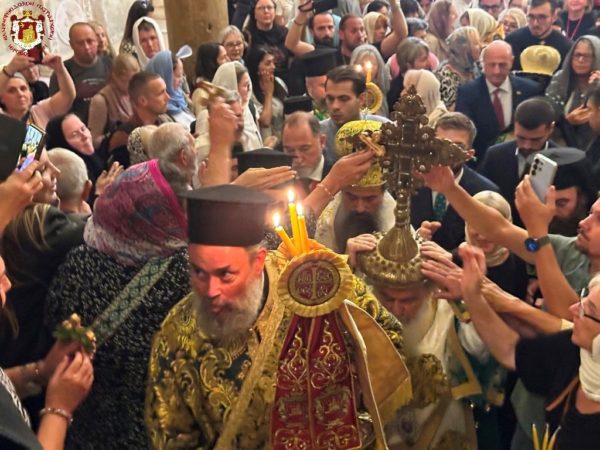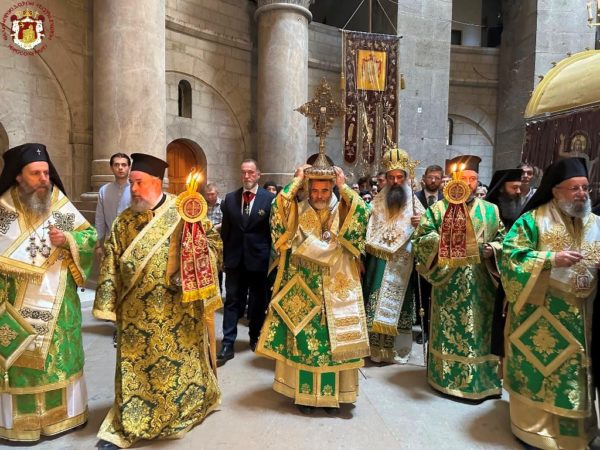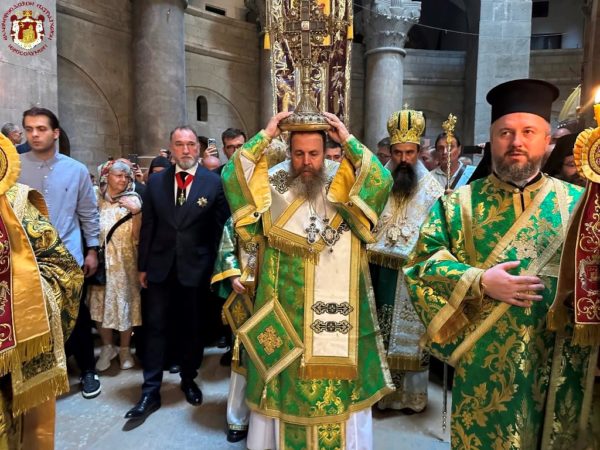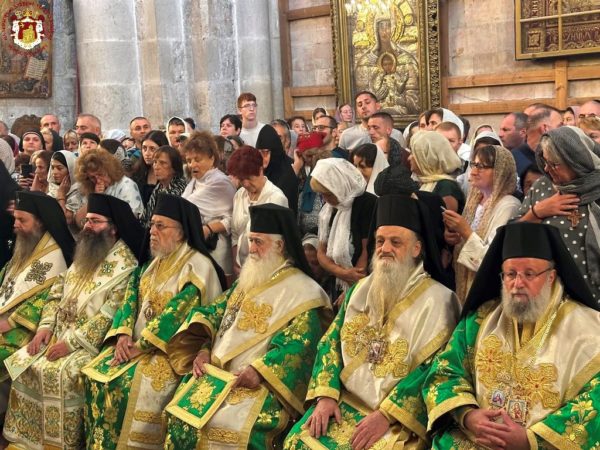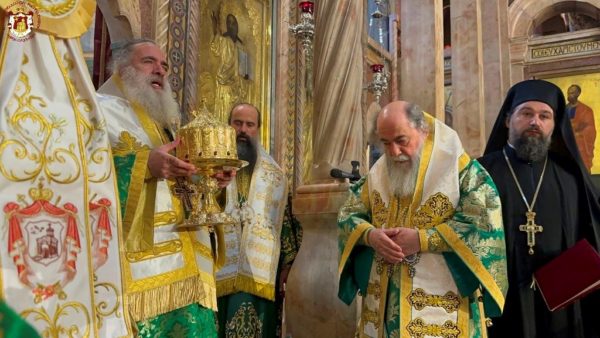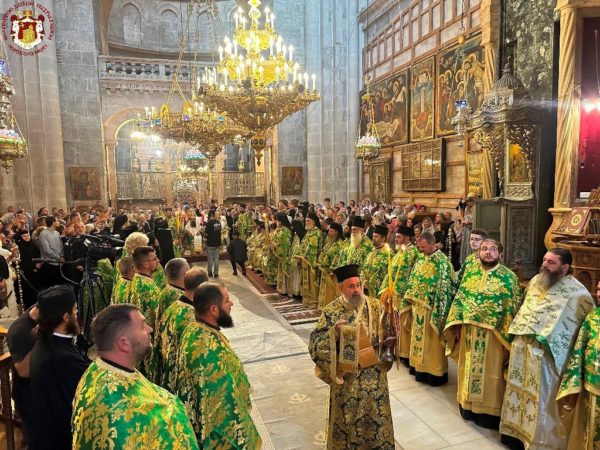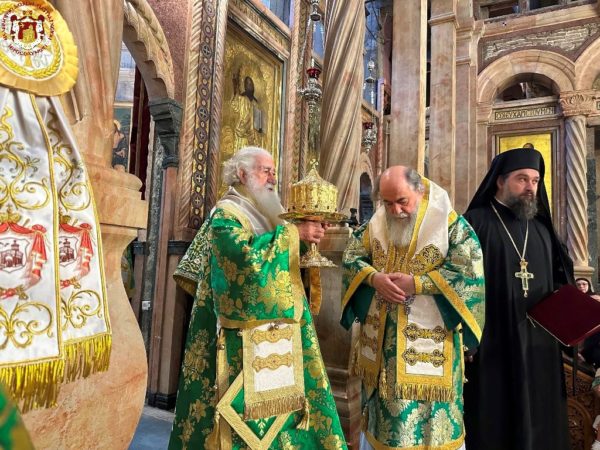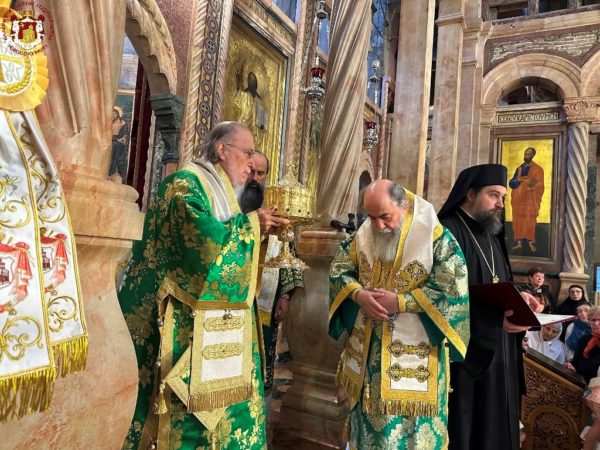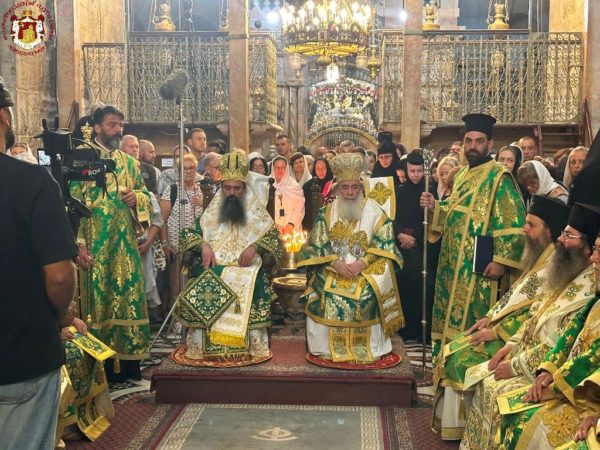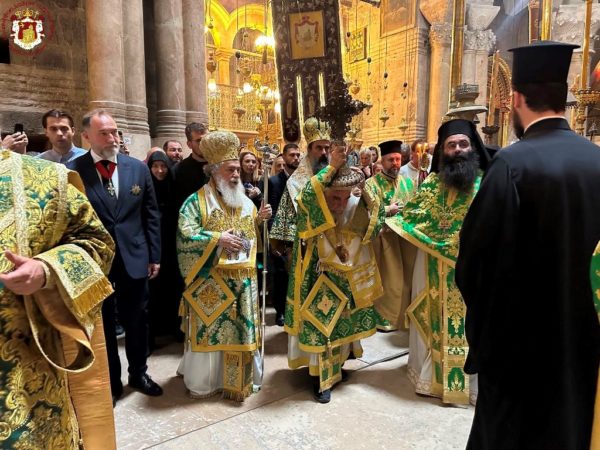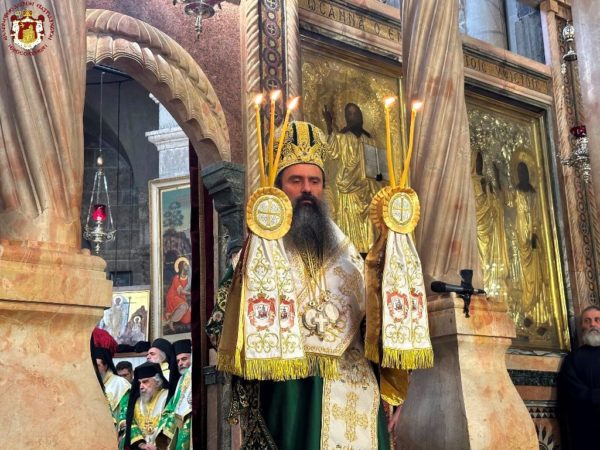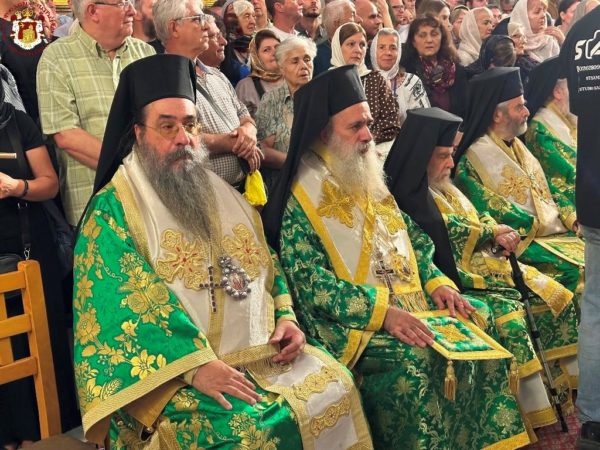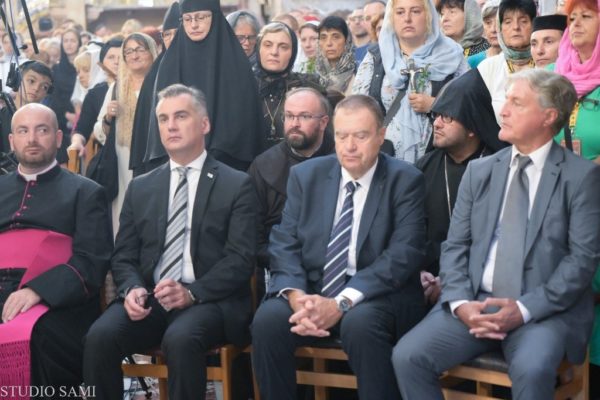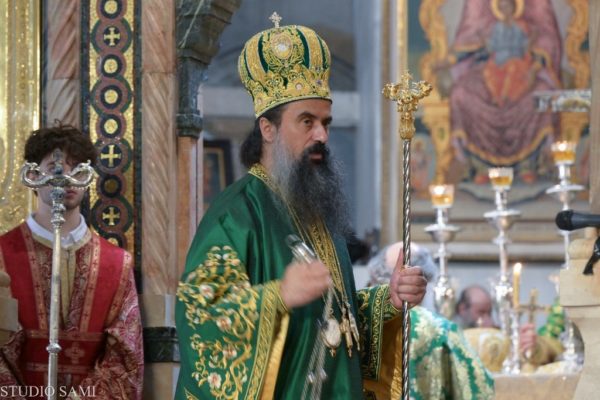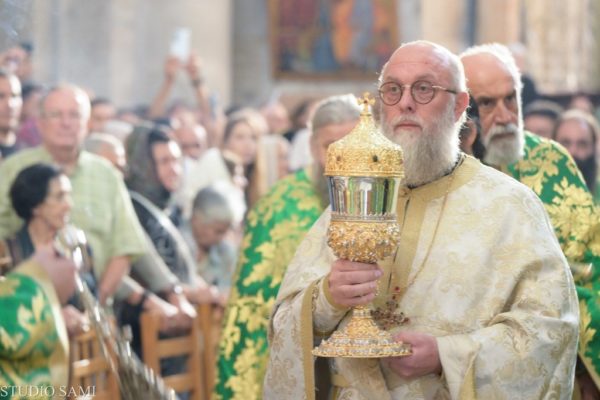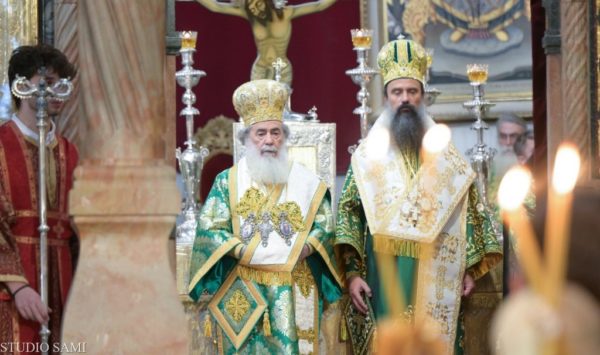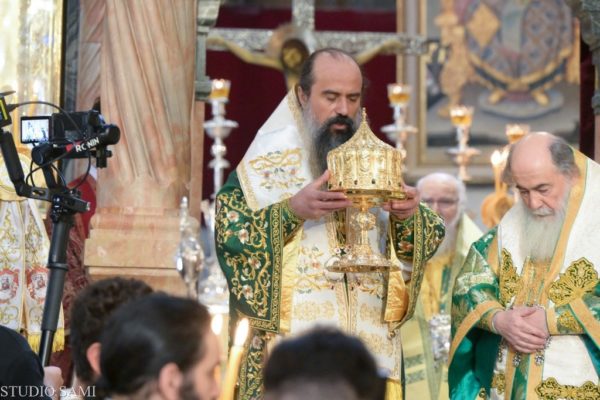
On Sunday, 14/27 September 2026, the Feast of the Universal Exaltation of the Precious Cross was celebrated at the Patriarchate.
On this Feast, the whole Church, and particularly the Church of Jerusalem, commemorates the fact that our Lord, who became incarnate, was “willingly lifted up upon the Cross” and, through the Cross, delivered us from the corruption of death. The Church also commemorates the event whereby the Archbishop of Jerusalem, Macarius, together with Saint Helen, exalted the Cross of the Lord, which had been found in the Church of the Resurrection that had been erected between 326 and 336 AD. In the presence of a multitude of Bishops, whom the Great Constantine had ordered to come, and of a great multitude of people, they repeatedly proclaimed, Lord, have mercy, Lord, have mercy, Lord, have mercy, as we too repeat on this day of the Exaltation of the Precious Cross.
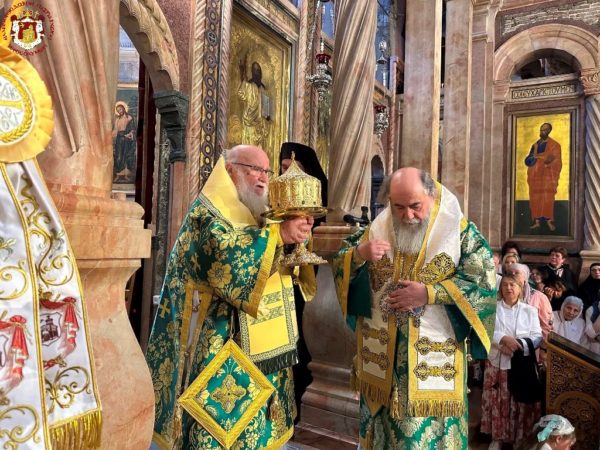
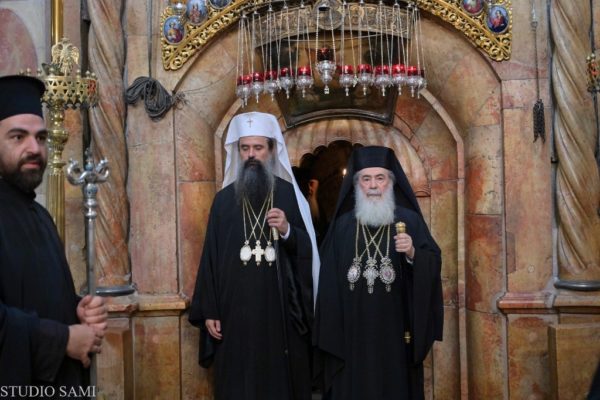
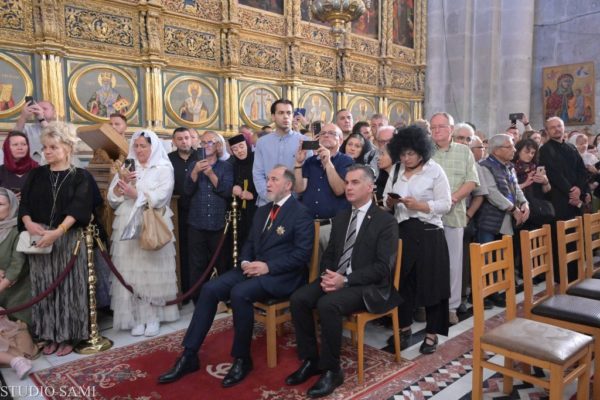
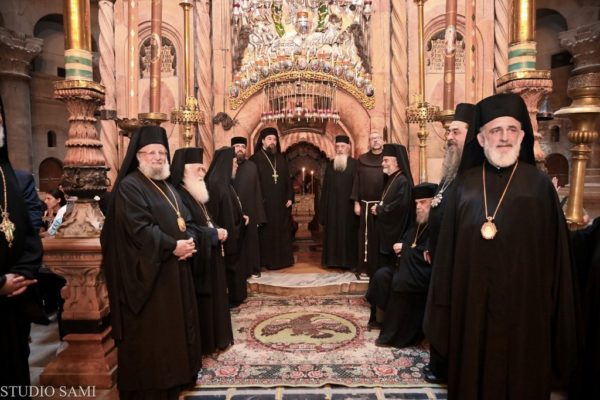
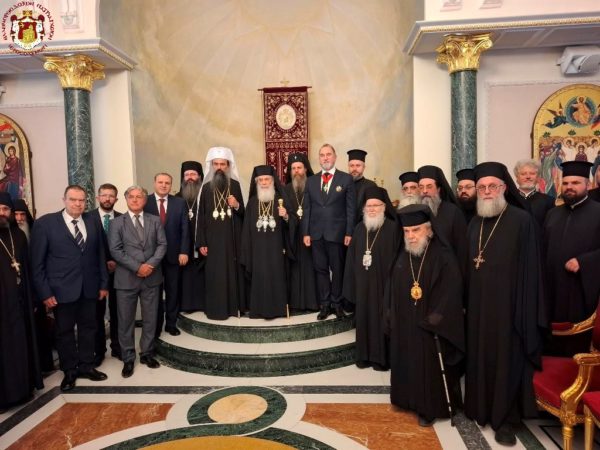
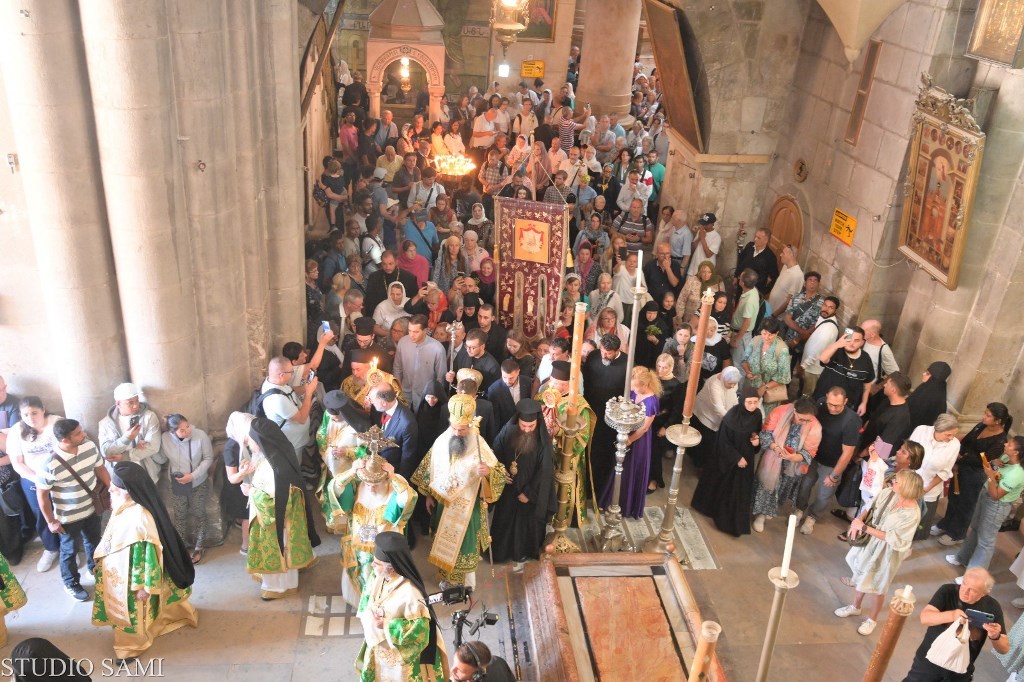
The Feast was celebrated with the Divine Liturgy at the Katholikon of the Church of the Holy Sepulchre, presided over by His Beatitude the Patriarch of Jerusalem, with His Beatitude the Patriarch of Bulgaria and Metropolitan of Sofia, Daniel, who was making a peaceful visit to the Patriarchate, concelebrating together with his entourage, as well as the Hierarchs of the Holy Sepulchre Brotherhood and other Hieromonks of the Patriarchate.
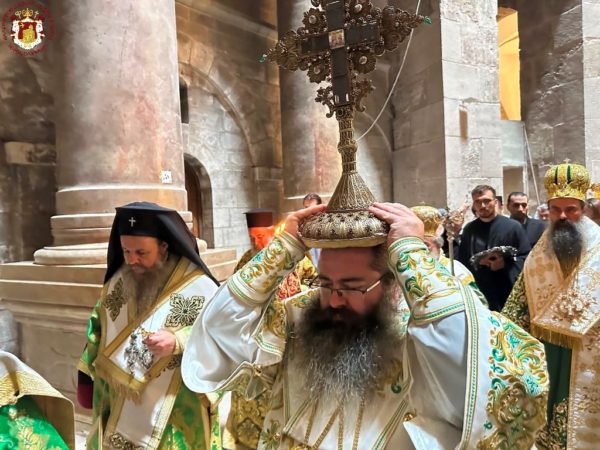
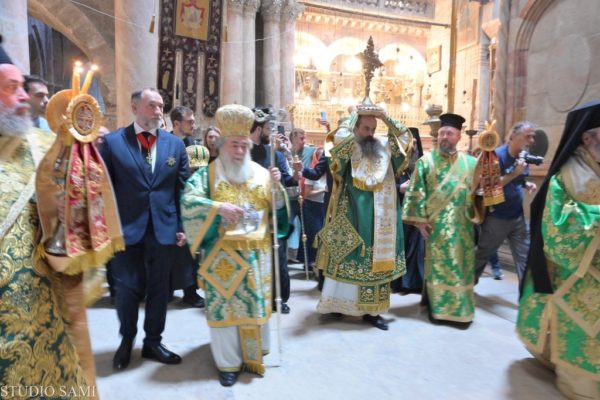
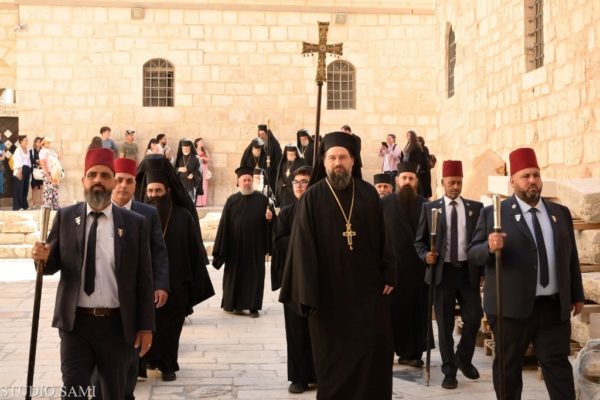
Following the dismissal of the Divine Liturgy, the procession began from the solea of the Katholikon and proceeded through the Chapel of “Touch Me Not” towards the Chapel of Saint Helen. There, the Armenians opened the doors of their Holy Altar, and the Deacons censed the Holy Altar and the throne.
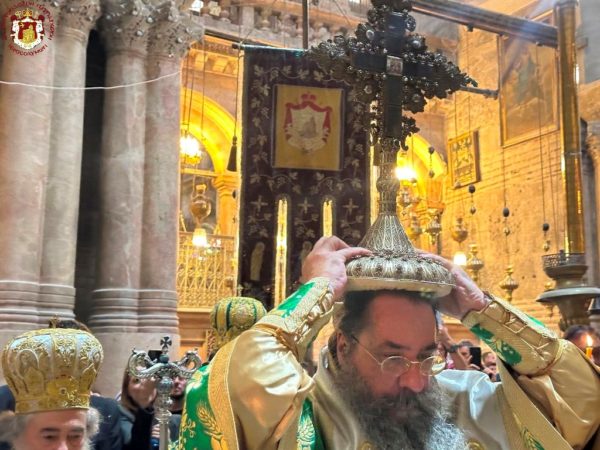
Thereafter, His Beatitude, together with dignitaries of the Holy Sepulchre Brotherhood, Hierarchs and priests, descended into the cave of the Finding of the Precious Cross, where, according to the prescribed order, the Exaltation took place towards the four points of the horizon, for the sanctification of mankind and of all creation.
This was followed by the ascent and the procession three times around the Holy Sepulchre, and thereafter the ascent to the Horrendous Golgotha, where the Exaltation of the Precious Cross took place once again at the very place of the Crucifixion of the Lord, followed by the veneration at the place where the venerable Wood had been set.
From Golgotha, the procession descended to the Holy Altar of the Katholikon, after which the Patriarchal entourage ascended, carrying branches of blessing, while the bells were rung, and proceeded to the Patriarchate.
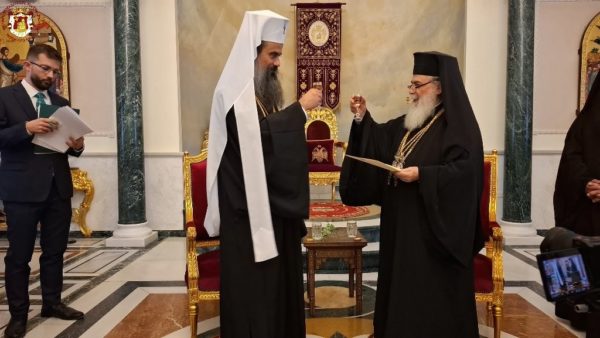
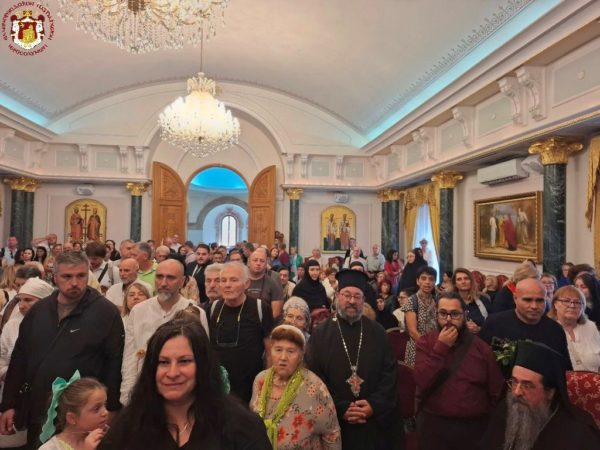
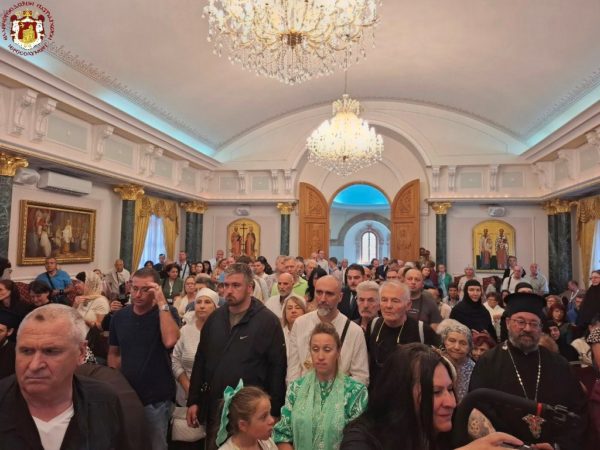
At the Patriarchate, a reception was held in honour of the Patriarch of Bulgaria, during which the addresses appropriate to the occasion were delivered in Greek and Russian:
The Address of His Beatitude Patriarch of Jerusalem Theophilos III:
“Your Beatitude the Patriarch of Bulgaria and Metropolitan of Sofia, Most Beloved and Dearly Cherished Brother and Concelebrant with Our Mediocrity in Christ our God, Mr Daniil,
“God forbid that I should boast except in the cross of our Lord Jesus Christ” (Galatians 6:14), the divine Paul proclaims.
Today, the Church of Jerusalem rejoices with spiritual joy and exults in the Lord, welcoming Your Beatitude on Your first Peaceful and Pilgrimage Visit to the Holy City of Jerusalem as Primate of the sister and Orthodox Church of Bulgaria.
Here, the prophetic word was fulfilled: “For out of Zion shall go forth the law, and the word of the Lord from Jerusalem” (Isaiah 2:3). Here, the great mystery of the Divine Providence, namely salvation in Christ, was accomplished, and from here the proclamation of repentance and the forgiveness of sins went forth to all the ends of the inhabited world, according to the word of the Lord: “And you shall be witnesses to Me in Jerusalem … and to the end of the earth” (Acts 1:8).
Your presence assumes particular spiritual significance, as it coincides with the solemn commemoration of the Universal Exaltation of the Precious and Life-giving Cross. Here, the Cross is not merely a memorial, but a living witness to the mystery of the Divine Providence; for upon Fearsome Golgotha the Son of Man was lifted up, that through the Cross He might destroy “him who had the power of death, that is, the devil” (Hebrews 2:14), and transform the wood of condemnation into the wood of life and salvation.
The Exaltation of the Precious Cross reveals the paradox of the Christian faith: that humility becomes glory, suffering becomes victory, death becomes life, and the Tomb becomes a source of resurrection. Therefore, in lifting up the Precious Wood, the Church sets before us not merely the instrument of the Passion, but the trophy of Christ’s victory and the sign of the reconciliation of heaven and earth.
And we today, Your Beatitude, here in these very places of the saving Passion and radiant Resurrection, partake of the mystery of the Cross and the Resurrection, as our predecessor, Saint Cyril of Jerusalem, says: “Others merely hear, but we both see and touch.” Our communion with You in the Lord’s Body and Blood seals the deeper meaning of this peaceful visit: our unity in the Crucified and Risen Lord.
“For He Himself is our peace” (Ephesians 2:14), says the divine Paul concerning Christ, Who reconciled those who were divided “through the cross” (Ephesians 2:16). Golgotha, therefore, before which the Precious Cross has today been exalted, the “divine navel of the earth,” according to Saint Sophronius of Jerusalem, becomes a sign of sacrifice, reconciliation, unity and peace.
Your Beatitude,
The contemporary world, troubled by wars, divisions, injustice and various forms of intolerance, earnestly seeks peace. Yet the Church does not proclaim peace as an abstract idea; she bears witness to the Crucified and Risen Christ, Who is the peace, reconciliation and hope of the world.
Herein also lies the significance of Your Peaceful Visit. The presence of two sister Churches around the same Chalice and beneath the shadow of the same Cross bears witness that unity in Christ is not a human agreement, but a gift of the Holy Spirit and the fruit of our common Apostolic faith, for “through Him we both have access by one Spirit to the Father” (Ephesians 2:18), “endeavouring to keep the unity of the Spirit in the bond of peace. There is one body and one Spirit” (Ephesians 4:3). “Now, therefore, you are no longer strangers and foreigners, but fellow citizens with the saints and members of the household of God” (Ephesians 2:19).
This first pilgrimage visit of Your Beatitude to the Holy Land as Patriarch of Bulgaria renews and strengthens the centuries-old spiritual bonds between the Jerusalem Church and the Most Holy Church of Bulgaria, bonds sealed by our common Orthodox faith, liturgical tradition and common witness to the mystery of Christ’s Cross and Resurrection.
Our fellowship with Your Beatitude likewise strengthens the Christian witness and presence in this Holy Land. Here, where “the tribes go up, the tribes of the Lord” (Psalm 122:4), the Church of Jerusalem continues throughout the ages to proclaim the mystery of the Divine Providence, preserving and ministering as places of worship the sites of the Birth of our Saviour Christ, His saving Passion, the Life-giving Cross, His radiant Resurrection, His divine Ascension and Pentecost.
Your Beatitude and Holy Brother,
In the power of our peaceful and Eucharistic communion in Christ, and in the light of the Feast of the Universal Exaltation, as we behold Fearsome Golgotha and venerate the Life-giving and Empty Tomb, we are called to make the mystery of the Cross the way of our ecclesiastical ministry: a way of sacrifice, humility, reconciliation and love.
As for us, the Order of the Spoudaioi (Studious), that is, the Holy Sepulchre Brotherhood, appointed by Divine Providence to this task, we remain sleepless guardians and servants of the place where the Cross was planted and from which the light of the Resurrection dawned.
You, however, Your Beatitude, together with Your honourable entourage, returning to Your beloved homeland, carry with You to the devout Bulgarian people the blessing of the “city of the living God, the heavenly Jerusalem, to an innumerable company of angels, to the general assembly and church of the firstborn who are registered in heaven” (cf. Hebrews 12:22–23), and the imperishable message of the Precious Cross: that through the Cross joy has come into all the world; through the Cross enmity is abolished; and through the Cross the way to the Resurrection is opened.
On this holy and festal day, therefore, from Holy Jerusalem and the City of the Great King, as we gaze upon the Precious Cross being exalted, we proclaim together with the Church:
“Thy Cross we venerate, O Master,
and Thy holy Resurrection we glorify.”
Amen.”
His Beatitude Patriarch Daniil responded as follows:
“Your Beatitude the Patriarch of Jerusalem, beloved Brother and concelebrant in Christ, Primate of the Venerable Throne of Holy Jerusalem,
Your Eminences and Your Graces Holy Hierarchs,
Honourable Chargé d’Affaires of the Embassy of the Republic of Bulgaria in Israel,
Your Excellency, Consul of the Republic of Bulgaria to the Palestinian Authority,
Your Excellency, Consul General of the Hellenic Republic in Jerusalem,
Honourable representatives of the diplomatic missions in Jerusalem,
Respected representatives of the religious communities,
Beloved brothers in the Lord,
Allow us once again to express our gratitude and our joy for this fraternal gathering and our communion in Christ with Your Beatitude, the venerable Hierarchy surrounding you, the devout clergy and the Christ-loving faithful of the Most Holy Patriarchate of Jerusalem. During the days of our stay here, our conversations and our fraternal fellowship with you have been for all of us a source of consolation and spiritual strengthening, confirming us in faith, hope and love for our Lord Jesus Christ. For, as the Apostle Paul teaches, when we rejoice in the Lord, strengthen and encourage one another, and live in unity and peace, then the God of love and peace is with us (cf. 2 Corinthians 13:11).
On this most glorious day, on which the Holy Orthodox Church, according to the Old Calendar, celebrates the Universal Exaltation of the Precious and Life-giving Cross of the Lord, we have been deemed worthy to concelebrate and celebrate the Sacrament of the Divine Eucharist in this Most Holy Church of the Resurrection, erected upon the site of the saving Passion of Christ our Redeemer and His Most Holy Sepulchre. Yet this great Mystery of mysteries, the essence and heart of the Church, was itself instituted and first celebrated by the Lord in Jerusalem, in the Upper Room on Zion. There, also the miracle of Pentecost took place, through which the beginning of the Church of Christ in history was marked.
The Holy City is likewise associated with the earliest recorded celebration of the Divine Eucharist, the Divine Liturgy of Saint James the Brother of the Lord, which continues to be celebrated to this day in the Orthodox Church. It is numbered among the earliest liturgical forms translated in the Bulgarian State during the Middle Ages, following the Christianisation of the Bulgarian people, that is, during the second half of the ninth century, and from that time it became an organic part of the Bulgarian liturgical tradition. All these things take us back to the period of the earliest recorded contacts of Orthodox Bulgaria with the Holy City and the Most Holy Patriarchate of Jerusalem.
The relations between our Holy Churches have, as we have already emphasised, a history spanning a thousand years, which we have a duty to keep alive in our memory and to honour in practice. It is a history of fraternal friendship and mutual assistance, which continues to this day. The origins of these bonds go back to the missionary and enlightening work of the holy brothers, Saints Cyril and Methodius, and are connected with the earliest translations of liturgical books into the Old Bulgarian language, as well as with numerous Lives and writings of Saints of the Church of Jerusalem. The Old Bulgarian translation of the Catechetical Homilies of Saint Cyril of Jerusalem achieved particular circulation; it survives in numerous manuscripts and was widely used in the Bulgarian Church.
Also worthy of remembrance is the contribution of the monasteries of Jerusalem and Sinai to the preservation of many of the most important Glagolitic manuscripts of Old Bulgarian Christian literature, such as the Codex Assemanianus, the Sinai Psalter and the Sinai Euchologion. During difficult times for Orthodox Bulgaria, these precious manuscripts were brought to these holy monasteries by pilgrims and monks seeking refuge. There they were preserved as venerable treasures of our ecclesiastical and cultural tradition. Furthermore, here in the Holy City itself, not a few Old Bulgarian manuscripts were copied and translations of texts into the Old Bulgarian language were prepared.
The influence of the Jerusalem tradition upon Bulgaria is not confined to literature, but extends also to ecclesiastical art. A characteristic example is the famous Old Bulgarian rotunda of Saint John in Great Preslav, also known as the Golden or Circular Church, which was erected at the beginning of the tenth century, during the reign of the Bulgarian Tsar Simeon I the Great. As scholars of Christian art and archaeology have long established, this Church constitutes an architectural replica of the very Church of the Holy Sepulchre in Jerusalem. Also noteworthy are the numerous representations of Patriarchs and monks of the Church of Jerusalem in medieval Bulgarian art, as well as the iconographic compositions associated with the Holy Sepulchre, such as depictions of the holy Equal-to-the-Apostles Constantine and Helen with the Cross and of the Exaltation of the Precious Cross, which we celebrate today. As early as the tenth century, there is also evidence in Bulgaria of the established tradition of pilgrimage to the Holy Places, which is mentioned by the Bulgarian writer Cosmas the Presbyter in his well-known Homily Against the Bogomils.
The relations between the Orthodox Church of Bulgaria and the Holy City of Jerusalem are likewise attested throughout the following centuries. Contacts were particularly close during the sorrowful years of the Union of Lyons in 1274. According to ecclesiastical historians, the Most Holy Patriarchate of Jerusalem and our Patriarchate of Tarnovo unanimously rejected the union concluded between Constantinople and Rome. In Bulgaria, we particularly associate those difficult years for our Holy Orthodoxy with the martyrdom of the twenty-six Venerable Martyrs of Zograf Monastery, Athonite monks of Bulgarian origin. Testimonies from that period also survive according to which Orthodox Bulgarian boyars and representatives of the clergy of Tarnovo sent an embassy to Your predecessor, Patriarch Gregory I of Jerusalem, entreating him to oppose the principal architects of the Union.
During the period of the Ottoman Empire, from the sixteenth to the eighteenth century, the historians of the Patriarchate of Jerusalem confirm the presence of Bulgarian monks residing and working in the Holy Monasteries of Saint Sabbas and the Holy Archangels. They also testify that, towards the end of the sixteenth century, the Bulgarians had their own chapel within one of the churches of Jerusalem, where the Divine Services were celebrated in Church Slavonic. During the same period, the presence of monks of the Holy Sepulchre Brotherhood in Bulgarian lands is also recorded, as is the existence of dependencies of the Patriarchate of Jerusalem, in which travelling monks resided, collecting alms for the Holy Places. In this offering we discern the practical expression of the gratitude of the Orthodox Bulgarian people towards the Holy Church of Jerusalem for all that, throughout the centuries, we have received from her in our spiritual and ecclesiastical life.
During the second half of the seventeenth century, Your illustrious predecessor, the learned Patriarch of Jerusalem Dositheos Notaras, travelled through the Bulgarian lands three times, collecting financial assistance for the Brotherhood of the Holy Sepulchre. Patriarch Chrysanthos Notaras of Jerusalem likewise devoted himself to this ministry, visiting our country on several occasions for the same purpose. A valuable testimony to his journeys is the surviving travel account of 1720, which contains a record of thousands of names, principally from southern Bulgaria.
We shall never forget the assistance and fraternal support offered by the Patriarchate of Jerusalem, through Your worthy predecessor, the late Patriarch Diodoros of Jerusalem, to the Patriarchate of Bulgaria during the Great and Supreme Council of 1998 in Sofia, which was convened to heal the schism in Bulgaria caused by political interference.
Many further examples could be cited as additional confirmation of the traditional and centuries-old fraternal relations and mutually beneficial cooperation between our respective Orthodox Churches. It is incumbent upon us today to safeguard these strong bonds and to continue the cooperation established throughout the centuries, to the glory of our Lord Jesus Christ, for the preservation of our ecclesiastical unity and for the good of the people of God entrusted to us by Christ our Master. We assure Your Beatitude that it is our sincere desire and our willing intention to continue and further cultivate this cooperation in the future. We believe and recognise that Your Beatitude, as well as the entire Holy Church of Jerusalem, likewise cherish this good and sincere disposition; and therefore, from the depths of our heart, we thank you.
Today, the Middle East is shaken by terrible conflicts and armed confrontations, which sow suffering and uncertainty everywhere. Under these grievous circumstances, ever greater numbers of Christians, although their presence in these lands already spans two millennia, are being compelled to leave their ancestral homes. The Christian communities are continually diminishing, while the Most Holy Patriarchate of Jerusalem, the most ancient Orthodox Church in this place and the Mother of all Churches, is undergoing severe trials.
We wish to assure Your Beatitude that, in these difficult and sorrowful times, we are spiritually close to you and to the God-loving flock entrusted to your care. Your sorrows are our sorrows, and your hopes are our hopes. You and your flock are always present in our prayers, our thoughts and our hearts.
With deep respect and great hope, we have welcomed the noble initiative of Your Beatitude to mediate towards the achievement of a stable and lasting peace between Ukraine and Russia and the ending of the grievous war, in which so many of our Orthodox brethren have lost their lives. In this peacemaking initiative, we recognise a living witness to the mission of the Church, which heals the wounds of division and ministers to reconciliation, even when the voice of peace appears not to be heard.
And today, here, at this very centre of Christendom, where our Lord and Saviour Jesus Christ rose from the dead, we raise His life-giving and victorious Cross with unwavering faith that evil does not have the final word, that peace is possible, and that after the Crucifixion comes the Resurrection!
Standing upon this most holy place, where the Cross and the Resurrection transcend mere remembrance and become a living witness, we recall the words of the great Hierarch of the Holy City, Saint Cyril of Jerusalem: “I confess the Cross because I know the Resurrection”
(Catechetical Lecture XIII, 4; PG 33, 776B–777A).
As a prayerful remembrance of this peaceful visit of ours, accept, Your Beatitude, this wooden Cross, as a token of our sincere fraternal love and our deepest respect for your venerable person and for the Most Holy Patriarchate of Jerusalem under your care.
This offering is humble, but it is made from the depths of our heart, on behalf of ourselves and the Patriarchate of Bulgaria, so that it may keep alive the memory of this blessed day of our fraternal encounter. Concerning this day, we may truly repeat the Psalmist’s verse: “This is the day which the Lord hath made; we will rejoice and be glad in it” (Psalm 117:24).
May the love of God, His grace and His great mercy, as well as the power of the Life-giving Cross of Christ, always be with us all!
Many blessed returns!”
His Beatitude the Patriarch of Bulgaria, Mr Daniel, presented His Beatitude the Patriarch of Jerusalem with a beautiful wooden relief Cross of blessing.
At midday, a Lenten luncheon was hosted at the American Colony Hotel in honour of His Beatitude the Patriarch of Bulgaria and his entourage, by His Beatitude the Patriarch of Jerusalem and his entourage, in thanksgiving and glorification to God for this spiritual blessing which He has bestowed upon us.
Present at this luncheon were; His Eminence the Metropolitan of Nazareth, Mr Kyriakos, who was celebrating the fortieth anniversary of his ordination to the episcopate; numerous Hierarchs and priests of the Patriarchate; the Ambassador of Greece to Israel, Ms Maya Solomou; the Consul of Greece in Jerusalem, Mr Dimitrios Angelosopoulos; the Diplomatic Representative of Bulgaria in Ramallah, Mr Plamen Iconomov, and his Attaché, Mr Vesselin Delchev; the Ambassador of Jordan to the Palestinian Authority; the Representative of the Patriarchate of Moscow, Archimandrite Vassian; the Representative of the Patriarchate of Romania, Archimandrite Ioann; the Representative of the Scouts Corps; and many others.
May the power of the Precious and Life-giving Cross continue to strengthen the Orthodox Churches, the faithful, and the whole world. Amen.
From the Chief Secretariat