
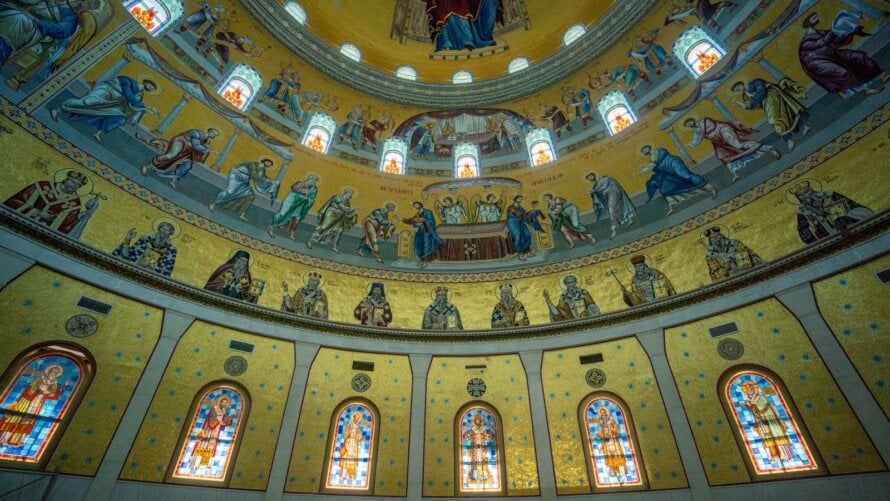
Crafted using a technique that blends traditional methods with high-quality modern materials, the stained glass windows of the National Cathedral are a remarkable project.
Created by Romanian artisans under the direction of artist Lucian Butucariu, a professor at the National University of Arts specialising in glass and stained glass art, the works highlight local craftsmanship.
A standout achievement is the façade window depicting the Ascension of the Lord — 15 meters high and 5.5 meters wide, made of 29 panels and completed in a record three months.
French, Italian and Greek translations available below.
The Stained Glass of the National Cathedral
The making of the stained-glass windows of the National Cathedral was a remarkable process, led by the artist Lucian Butucariu, professor at the National University of Arts, specialising in the art of glasswork and stained glass, filling the gap of a relatively limited historical tradition in this field on Romanian soil. For much of history, such works had come predominantly from Western workshops. The craft, however, experienced a revival in the 1970s–1980s during the restoration of national monuments, when the first nucleus of specialists was formed.
This spirit of autonomy and innovation, born out of necessity, laid the foundation for the Cathedral’s stained-glass project to be realised entirely by Romanian artists and technicians, who assumed complex responsibilities ranging from the processing of materials to the development of execution techniques.
The project represents a close collaboration between the artistic vision of the iconographer Daniel Codrescu, coordinator of the entire iconographic programme, and the technical mastery of Lucian Butucariu. The latter independently oversaw the execution of the stained glass, transposing the complex compositions into glass and lead. The first works produced were those of the Cathedral’s altar, depicting our Lord Jesus Christ surrounded by holy hierarchs – a task which, from the outset, required advanced technical solutions in order to render faithfully the chromatic range and details of the compositions.
An outstanding achievement of the project is the monumental stained-glass window on the façade, illustrating the Ascension of the Lord. Measuring 15 metres in height and 5.5 metres in width, this impressive work, composed of 29 panels, was completed in record time – only three months. Its completion was made possible by a small but highly synchronised team. The accelerated pace was dictated by a strict deadline, linked to the visit of Pope Francis to Romania (May 31 – June 2, 2019), and demonstrated the extraordinary capacity of the team for mobilisation.
The execution technique combines traditional methods with modern, high-quality materials, most of them imported from Germany. The process begins with coloured glass, cut with precision according to the design. Figurative details – essential for the representation of saints and symbolic scenes – are executed by hand using enamels and grisaille. Each piece of glass is then fired in special kilns at temperatures between 580–610°C, a process which permanently fixes the painting. The stained glass is subsequently integrated into a metal framework. Meticulousness is a defining trait: the details of the faces and the finishing touches are executed with a precision visible even from close range.
The scope of the work goes far beyond the central pieces, encompassing the entire suite of the Cathedral’s windows. The rose window of the western façade was produced, as well as the stained-glass windows of 11 metres in height, and those of the dome, both interior and exterior. The stained-glass artist Victor Săraru also contributed, particularly to the execution of the apse windows, thus completing a project of unprecedented scale in Romania.
The durability of this work is ensured by the technique employed, similar to that of the stained-glass windows of the great Gothic cathedrals of Europe of the 14th–16th centuries, which have endured to the present day. The body-tinted glass does not degrade over time, and the painting becomes an integral part of the material. With proper maintenance, these stained-glass windows are designed to last for centuries, becoming not only an artistic component of the Cathedral but also a spiritual and cultural inheritance for future generations.