
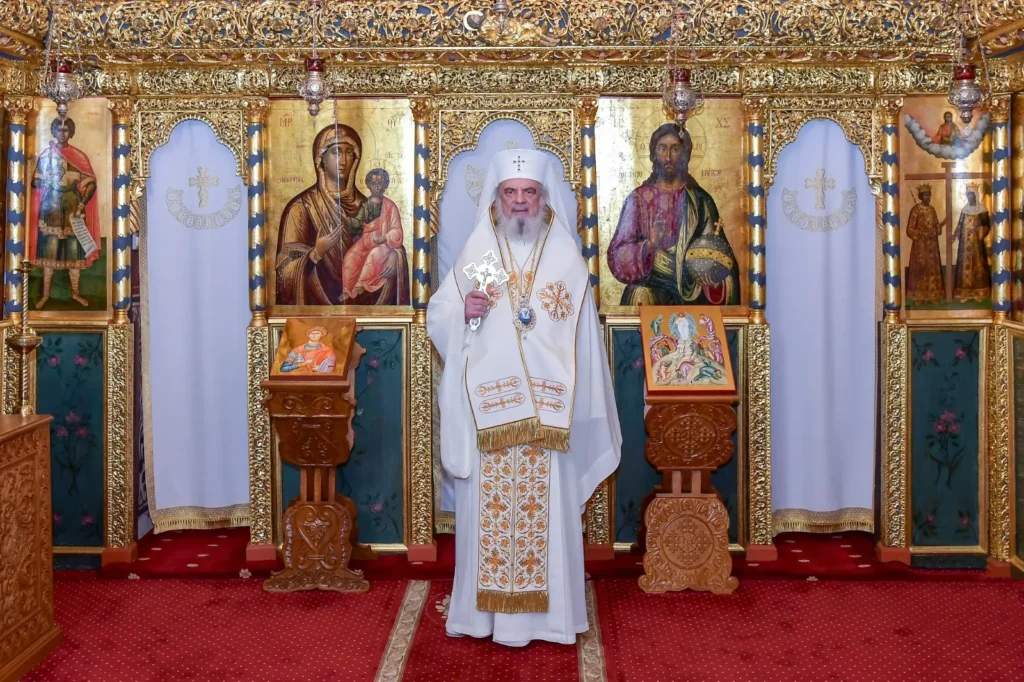
His Beatitude Patriarch Daniel of Romania explained on Wednesday that the Feast of the Transfiguration of the Lord represents “the radiant icon of every church.”
Speaking at the end of the Divine Liturgy celebrated in the historic Chapel of Saint George the Trophy-bearer at the Patriarchal Residence, the Patriarch of Romania said that “according to the hymns of this feast, the glory of Christ revealed at His Transfiguration must be understood not only as the glory of His Resurrection and Ascension, but also as the glory of His Second Coming at the end of the world. That is why the feast is placed in the final month of the liturgical year.”
Patriarch Daniel highlighted the timing of the feast, saying, “On the sixth day, man was created; and nine days later comes the Feast of the Dormition of the Theotokos, which shows her departure from this world—passing through death, yet not remaining in it, as she was taken to heaven by her Son.”
Through the Transfiguration, Christ revealed that “the human nature He assumed from the Holy Spirit and the Virgin Mary was brought to the state of deification, a complete union of human and divine nature,” the Patriarch said.
Christ Revealed His Church on Mount Tabor
On Mount Tabor, Christ revealed the image of His Church in a miraculous way.
“There, Christ united in the glory of His Kingdom both Moses, representing the Law, and Elijah, representing the Prophets—both embodying the righteous of the Old Testament. He also took with Him the three disciples—Peter, James, and John—thus revealing the image of His Church as a gathering in the glory and joy of the Holy Trinity, of both prophets and apostles,” Patriarch Daniel explained.
“The Transfiguration of the Lord shows that the Law and the Prophets were fulfilled in Christ. The Law was a guide toward Him, and the prophecies prepared for His coming,” he added.
The light of Tabor is granted to those who pray deeply. As the Desert Fathers of Egypt said, “The purpose of Christian life is the purification of the heart and the vision of Divine Grace.”
The Fruits of Prayer and Light
Patriarch Daniel explained that this is why hesychast monastic communities—those devoted to unceasing prayer or the prayer of the heart—emerged.
In Romania, one remarkable figure among these great prayerful ascetics was Saint Theophano Basarab, a member of the Wallachian royal family.
This spiritual movement was revived and strengthened in 18th-century Moldavia around Saint Paisius Velichkovsky of Neamț (1722–1794), who gathered hundreds of monks from various countries.
In conclusion, Patriarch Daniel reaffirmed that the Feast of the Transfiguration “is the radiant icon of every church, whether monastic or parish.”
Recalling the tradition of blessing the first grapes of the vineyard on this feast, the Patriarch drew a parallel: “Just as a sour grape becomes sweet through the warmth and ripening light of the sun, so too does a person—through prayer and grace—become transformed, improved, merciful, humble, and loving toward their neighbor.”
Photo: Lumina Newspaper