
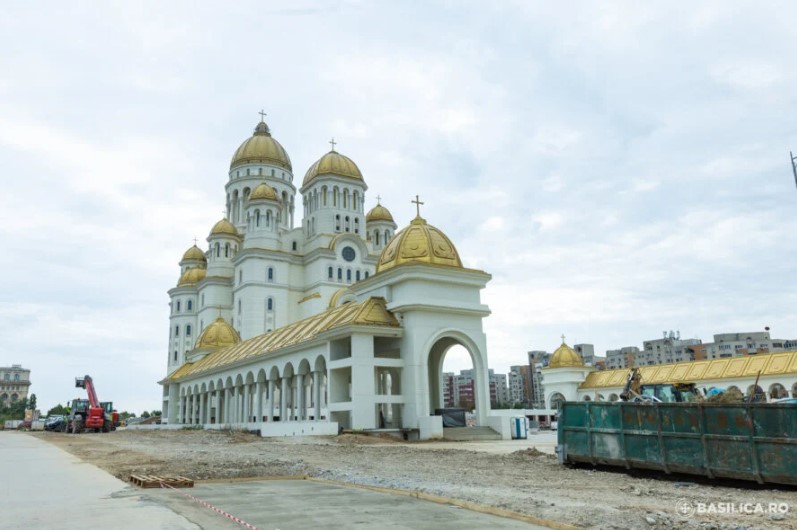
In just eleven days, you will be able to witness the Great Consecration of the National Cathedral. Ecumenical Patriarch Bartholomew and Patriarch Daniel will celebrate the service. Beginning on Sunday, 26 October 2025, the faithful will have the opportunity to enter the Cathedral and venerate even in the Holy Altar until the end of the month.
Before stepping inside the Cathedral, you may wish to take some time to admire the exterior elements of the architectural ensemble of the National Cathedral of the Salvation of the Nation — the porticoes, the square, and the towers. All these components contribute to defining this sacred space within the urban landscape of Bucharest, standing as a testimony to Romanian history and spirituality.
One detail that can only be seen from an aerial view is that the entire ground on which the National Cathedral stands has been shaped in the form of a chalice — a reference to the Holy Eucharist, the central Mystery of the Church and the one that will be most frequently celebrated in this Cathedral.
Please find the French, Italian and Greek translations below.
The Porticoes, Esplanade, and Towers of the National Cathedral
The exterior elements of the architectural ensemble of the National Cathedral – the porticoes, the esplanade, and the towers – contribute to defining this sacred space within the urban landscape of Bucharest, as a testimony to Romanian history and spirituality, a synthesis of tradition and modernity.
Porticoes
Inspired by the Brâncovenesque porches, the porticoes of the National Cathedral fulfil both an aesthetic and a practical role, defining the space of the esplanade. The main access is from the two porticoes (north-western and south-western), leading into a porch with arches which marks the entrance to the Cathedral. On the northern and southern sides of the esplanade, the porticoes delimit the area of the Outdoor Altar, creating an appropriate framework for services celebrated in the open air.
Esplanade
In front of the Cathedral extends a broad esplanade (square), designed to facilitate participation in the divine services. This open space, with an area of 11,600 sqm, not only highlights the monumentality of the church but can also accommodate 23,200 persons during outdoor liturgical events.
Beneath the esplanade lies a vast underground space, larger than the footprint of the Cathedral itself, symbolically named the “Urban Cave of Saint Andrew the Apostle”, with a total volume of 87,505.67 cbm and a capacity of 6,900 persons. It is intended for cultural, catechetical, and social activities, as well as for setting up a museum.
The 8 Towers
The Cathedral’s silhouette is defined by its eight towers, which combine architectural elements from different regions of Romania – such as the slender Transylvanian towers – with the monumentality characteristic of Western cathedrals. The central ensemble consists of one principal tower and four secondary towers, and to the West, three more large towers.
The main Pantocrator Tower reaches a height of 120 metres to the base of the cross. Inside, the dome of this tower houses a monumental mosaic icon of Christ Pantocrator (the Almighty), with a diameter of 12 metres and a surface of over 150 sqm. The cross atop the principal tower measures 7 metres in height and weighs 7 tonnes.
The bell tower, located on the western side above the exonarthex, houses the six bells of the Cathedral, cast in Innsbruck by the renowned Grassmayr foundry. With a combined weight of 33 tonnes, they are set at a height of 60 metres, and the principal bell, with free swing, weighs 25 tons. The bell tower is flanked by two large towers.
Everything in the Cathedral has significance
“The exterior and interior artistry are two components of particular importance in establishing a climate of spiritual communication. Tradition will not be abandoned, but interpreted as a state of continual deepening. The artistic expression must convey the canonical Orthodox message, so that nothing in the construction or in the interior decoration should be arbitrary or without spiritual meaning.
The volume of the Cathedral is to represent the place housing the Mystery of the Holy Eucharist, the Church itself, with the ground plan in the form of a chalice. The whole construction rises heavenwards through eight golden towers. The largest one, the Pantocrator, represents Jesus Christ, the Head of the Church, accompanied by four smaller towers symbolising the Four Evangelists: Matthew, Mark, Luke, and John. To the west, the bell tower represents the Mother of God, while the adjacent towers represent Saints Andrew and Philip the Apostles, who began the Christianisation of the Romanian (Geto-Dacian) people. The length of the Cathedral (120 m) is equal to the height of the Pantocrator Tower, for Christ Who was crucified and buried is the same Christ Who is risen and ascended into heaven.
This meaning of the architectural composition may be considered a call to spiritual elevation: that through Jesus Christ we may become partakers of the eternal life and joy of the Most Holy Trinity.”
† DANIEL
Patriarch of the Romanian Orthodox Church
Presentation leaflet in English about the exterior of Romania’s National Cathedral: free download.