Lecture “The Council of Nicaea: Challenges and Opportunities for the Church Today” at Catholic University of America
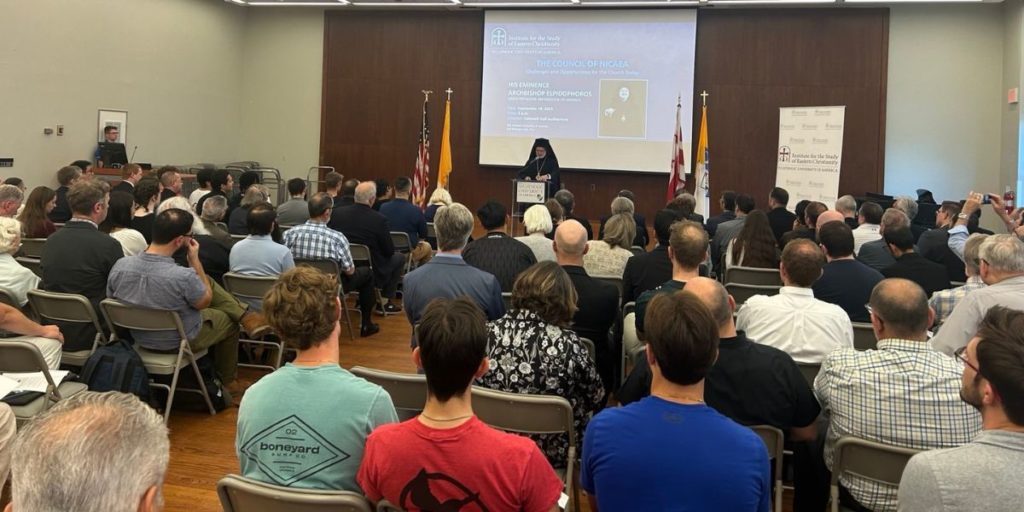
His Eminence Archbishop Elpidophoros
Lecture – “The Council of Nicaea”
Challenges and Opportunities for the Church Today
September 19, 2024
The Catholic University of America
Washington, DC
My Beloved Brothers and Sisters in Christ,
First and foremost, allow me to thank the Institute of the Study of Eastern Christianity and the Catholic University of America for the gracious invitation to deliver this lecture – which is extremely timely, given the fast approaching anniversary of seventeen hundred years from the First universally recognized Ecumenical Council, held in the Bithynian City of Nicaea – now called Iznik.
Because I was the Metropolitan of Bursa before my election to be Archbishop of America, a city only seventy-five kilometers from Νίκαια, (as it was then known in Greek), I have a special affinity for the place – its spiritual topography as the home of the First and the Seventh Ecumenical Councils recognized by both the Orthodox and Roman Catholic Churches.
Between these two Councils in Nicaea – the first in 325 CE, and the second in 787 CE, a veritable spiritual constitution of Christianity was composed over centuries of inquiry, controversy, and the life and death struggles of the Empire, known then as “Roman” and now as “Byzantine.”
The occasion of the seventeen hundredth anniversary of the First Ecumenical Council of Nicaea presents to all Christians both opportunities and challenges, as the very title of this lecture observes. Consider the circumstances surrounding the Council.
Nicaea takes place only fourteen years after the Edict of Toleration that ended the Diocletian Persecution – one of the worst periods of oppression the Church experienced since Nero – and only twelve years after the Edict of Milan that made Christianity a legal religion of the Roman Empire.
Thus, in a single generation, Christianity went from a treasonous and despised faith to the preferred religious tradition of the Roman Empire. For when Christianity became the faith of the Emperor, then it was certainly inviting for those who sought his favor. And remember, at this time, Christianity is estimated to have accounted for perhaps only ten percent of the population of the Empire.
From a time when the Emperors of Rome were declared to be gods themselves – beginning with Augustus in whose reign the Lord Jesus was born – we now arrive to the Nicene declaration that the Rabbi of Galilee, crucified under Roman Law, is:
Φῶς ἐκ Φωτός, Θεὸν ἀληθινὸν ἐκ Θεοῦ ἀληθινοῦ, γεννηθέντα, οὐ ποιηθέντα, ὁμοούσιον τῷ Πατρί
Light of Light, True God of True God, begotten, not made, consubstantial with the Father!
This truly amazing and indeed, miraculous transformation expressed by Nicaea, becomes a mere fifty-five years later, and despite the continuing fractiousness over Arianism and the brief reign of Julian the Apostate (the last pagan Emperor of Rome), the official and only legal religion of the Roman Empire. A truly remarkable about-face if there ever was one! The impact of the Council of Nicaea is truly impossible to overstate.
As a Hierarch of the Orthodox Christian Church, and especially one born and raised in the region, I feel deeply about this Council, particularly because of the conciliar model that it manifested for the Church. In considering its relevance for today, I see many more opportunities than challenges because of the following. The structural, dogmatic, and institutional fragmentation of Christianity since Nicaea already exists and is well documented. It is counterproductive to even try to reverse the course of the history which has delivered us to this moment. It is the essence of ecumenicity that we accept one another where we are and for who we are.
But the faith expressed by Nicaea, and the remarkable transformation that it witnessed in a mere generation, still demand our attention, now more than ever. For like an inviting hearth that sheds light and warmth, Nicaea can offer to any Christian community the most essential elements that invigorate and nourish the spiritual life. This anniversary of Nicaea presents us with the openings to not merely return to a shared expression of our faith tradition, but also a model for conciliarity that has stood the test of time, and is ready to bring us into a renewed sense of unity with one another.
In saying this, I must stress that the Creed as we have it today in use in our liturgical context, is the product of the formulation offered to the Church at the Second Ecumenical Council in Constantinople. Nevertheless, it is the Faith of Nicaea, summed up with laconic elegance by Saint Athanasios the Great:
Αὐτὸς γὰρ ἐνηνθρώπισεν, ἵνα ἡμεῖς θεοποιηθῶμεν.
“For He [the Lord] became a human being, so that we might become divine.”1
Those who see the controversies around the definition of Nicaea, which is affirmed again and again by the later Councils, as mere splitting of hairs, risk missing the greater import of the Council. By establishing once and for all the fullness of Christ’s Divinity, and setting the Church on a course of experiencing God as Trinity, Nicaea becomes the standard by which every subsequent experience of the Godhead is not only relatable, but also intelligible – at least to the degree that any human mind can apprehend the Uncontainable God.
The plumb-line of Nicaea stretches across the centuries of understanding the person of the Lord Jesus Christ. It was an attempt to respond to Christ’s question: “Who do you think I am?” (Matthew 16:15) For it is in the vision of His message, of His meaning and of His Person, that the Church exercises Her mission. In the enhanced Nicene-Constantinopolitan Creed, the article that affirms the Church as “One, Holy, Catholic, and Apostolic” also relates to the person of our Savior. He is one person – a definition enhanced through subsequent Councils, but fully expressed in the original form of the Creed.
As many of you already know, the form of the Nicene Creed was influenced by the early Baptismal Creeds. This makes perfect sense, because Baptismal Creeds could be easily memorized and avail the illiterate classes of society with a comprehensive view of the Faith into which they were entering. The Creed’s formula encapsulated the fullness of the teaching of the New Testament, at a time when the New Testament was still being formed. Even today, the final Nicene-Constantinopolitan Creed is recognized as having Twelve Articles, one for Each of the Twelve Apostles, and is used in the majority of the world’s Christian Churches as a Baptismal Creed once again, coming full circle.
The oneness of the person of the Lord is joined to His holiness issuing forth from His Divinity, His applicability to all people (the “catholic” attribute), and finally, the apostolic authenticity of the teaching about Him in the authentic tradition of His Disciples. All of these characteristics are then imputed to the Body of Christ, the Church, because they issue from the Head of the Body.
These same characteristics not only help to define relationships within ecclesiastical bodies, but their interrelationships as well. The idea of “Oneness” has, for example, led to all kinds of theories about the visibility and invisibility of this characteristic. For the Roman Catholic and Orthodox Churches, we usually maintain that the unity is indeed visible, while at the same time we try not to deny where the Spirit might choose to blow.2
In the majority of Protestant traditions, the “oneness” of the Church may not be perceptible by human powers of apprehension, but it is still most definitely One Church! This affirmation alone is a cause for hope in our inter-Church relations, because it takes the declaration of essential oneness and unity and leaves it in place, in spite of any and all apparent evidence to the contrary. Ultimately, if we Christians are to apprehend our fellowship with one another, we have to at least have faith in “the assurance of things hoped for, the conviction of things not seen.”3 In the same vein, His All-Holiness Ecumenical Patriarch Bartholomew stated in his historic opening address to the Holy and Great Council of the Orthodox Church, convened in Crete in June 2016:
“The Church constitutes a single body in the entire world, united in the same faith and the same Divine Eucharist and sacramental life, which is why it also needs synodality on the global level. This need was expressed and is fulfilled by the Ecumenical Councils, which were indeed convened whenever there was a call to secure the unity of all the local Churches on a global level, as well on matters of faith, administration and pastoral concern. These Councils represented all of the Churches in the world and were accepted by all inasmuch as they constituted and constitute the supreme authority in the Church, thereby preserving its unity.”
The creedal formula is a call to renewal for all Christians – a basis upon which not only can good ecumenical relationships be built, but also be a foundation for re-integration and even, re-unification. We must be careful not to press the latter too early and too far, making interested parties reticent to embrace a full-throated embrace of one another.
But the Creed, as we have inherited it, is a starting point on which we can all agree, except a very small minority of Christian bodies. Even this has historical precedent, because just as the Christian Church of the first three centuries had divergences – especially with the so-called Gnostic systems of belief, Nicene Christianity became the harmonious composite of intellection and experience, allowing for the expansion of the Faith of the Lord Jesus throughout the Empire, and eventually leading to its Christianization. There were always variances, as there are today, but they remain a minority position.
The phenomenon of historical factionalism and Christian “Denominationalism” – now represented by well over forty thousand instantiations, show us that having a single source to which we all can lay claim is a genuine cause for solidarity and spiritual harmony. We are not going to reverse centuries of institutional, dogmatic, and biblical interpretive variation; yet, despite this degree of fragmentation, the Council of Nicaea of 325 CE is the dominant and inclusive paradigm for our future relationships.
It is important to remember that the ecumenical movement is only a recent phenomenon – a little more than one hundred years in duration thus far. I believe that this is exceedingly important to stress, because although Roman Catholics and Eastern Orthodox Christians (together with the Ancient Oriental Churches) represent far and away the majority of the world’s Christians, the incredible diversity of the Protestant minority also holds, for the most part, to the Nicaean plumb-line of dogmatic formulation, expressed in the Nicene Creed, and later amplified by the Second Ecumenical Council in Constantinople in 381 CE, which happened one year after the legal mandate for Nicene Christianity. This one fact alone manifests the merits and value of not only celebrating the impending Anniversary, but also engaging how the models that emerged from Nicaea are relevant to our ecumenical and inter-Church relationships today.
An exceptional Ecumenical Patriarch of Constantinople, Saint Photios the Great – who faced troubled times and troubled relations with the Western Church in the Ninth Century – still saw that the universal, ecumenical Faith that commences with Nicaea could be maintained while there were differences of all kinds. He stated:
“The fact that other customs and laws are kept by others, yet without violating the Faith or departing from common and universally-held decrees, will not lead the discerning observer into thinking either that those who keep them fall into the wrong, or that those who do not accept them violate the law.”
Unity in Faith and diversity in practice. Well before the Ecumenical Movement in which we so rightly take pride, the Christians of the First Millennium understood what was essential for the Church to hold fast.
The Second Millennium saw a splintering of the Churches that defies imagination, and yet, the Faith expressed by Nicaea abides. And again, that is why this Anniversary is such an opportunity for ecumenically-inclined believers.
For we are now at the dawn of the Third Millennium of our glorious Faith in Christ, and sharing a re-affirmation of Nicene Christianity may be the key to unlock many doors that have, heretofore, been shut by historical and even political exigencies. The passage of time has hardened the perimeters of our respective Churches, making them seem impenetrable to reintegration. But the faith of Nicaea is able to soften these boundaries and make them permeable and flexible, such that we can distinguish the small “customs and laws” from the essentials of the Faith. I borrow here the words of Metropolitan Kallistos of Diokleia, of blessed memory: “The Creed belongs only to those who live it.”
With this kind of openness and receptivity, we will find ourselves prepared to accept one another without conditions and demands that make impossible the fellowship of the Saints to which we are all called.
Nicaea is our key, through which we may unlock the closed doors that have been built up through the centuries, and open our ecumenical relationships to new possibilities.
The decisions of the Council of Nicaea had tremendous repercussions for the future of the Church, and established a model that all Christians practice to this day. Leadership in the Church – any Church – is rarely seen as prophetic (a category usually reserved for unaffiliated communities dependent on individual personalities). Rather, it is conciliar paradigm that brings together the disparate members of the Body and unifies them through a process of dialogue, exchange, consultation, and finally, consensus.
This model has been used throughout the centuries, and both preceded and followed the First Ecumenical Council. Before and after Nicaea, there were Local Councils that attended to local needs, and their solutions were often adopted by the larger Council. The plumb-lines that we call “canons” are the most obvious example of this process.
All of Christianity reckons the number of Ecumenical Councils differently, but everyone starts with Nicaea. This manifests a basic truth that, were we all to embrace it, would easily reveal we have more in common than we hold differently.
Conciliarity will always be the way forward for the Church, irrespective of the issue to be addressed. But we must be willing to approach the issues honestly and in the light of Nicaea, which continues to illuminate the landscape of the Church as it has for the last seventeen hundred years.
Finally – even though there are many avenues that lead from Nicaea, I must mention the teleological model for humanity that the Nicene Creed proposes. For the full Divinity of Jesus is the pattern for the divinization (theosis) of every human being. We return to Saint Athanasios:
Αὐτὸς γὰρ ἐνηνθρώπισεν, ἵνα ἡμεῖς θεοποιηθῶμεν.
“For the Lord became a human being, so that we might become divine.”
The realization of our divinity, ensconced in the image of God in which each of us is created, is based in the total and complete Divinity and Humanity of the Person of our Lord Jesus Christ. All that the Lord attained through His Incarnation, Ministry, Teaching, Passion, Crucifixion, Death, Burial, Resurrection, and Ascension is included in the Nicene definition. Thus, the faith of Nicaea is the faith that leads us heavenward.
As the leader of the Greek Orthodox People of America, a Hierarch of the Ecumenical Patriarchate of Constantinople, and as a believer in Nicene Christianity, I see opportunities everywhere in the Anniversary of Nicaea. The challenges are already present. We do not need to make them more complicated than they already are. But we all have a responsibility to find ways to elevate what is most essential – what is Nicaea in its simplicity.
Are we willing to trust, to believe, that seventeen hundred year-old affirmation of faith can still be useful in our modern era? Can we see the differentiation in our worship and practice is not enough to overcome the truth of the Nicene-Constantinopolitan Creed?
The substance – the οὐσία – of our Faith in Christ is indeed enough to actualize the ὁμοούσιον – the consubstantiality between us, which we affirm in the Creed exists from all eternity and all infinity between our Lord and His Heavenly Father, and which extends to the Holy Spirit.
This is the very basis for our understanding of the Holy Trinity – a doctrine nowhere explicit in the Gospels, but everywhere implicit in the life and experience of the Church.
May we all be blessed in the coming year of 2025 to actualize the ὁμοούσιον in our own lives and in the lives of our Church communities, that we may ever give all glory, honor, and worship to the All-Holy, Good, and Consubstantial Trinity, Who is forever blessed unto the ages of ages. Amen.
Thank you for your kind attention.
1 De Incarnatione Verbi 54.
2 Cf. John 3.8.
3 Hebrew 11:1.
H αναδημοσίευση του παραπάνω άρθρου ή μέρους του επιτρέπεται μόνο αν αναφέρεται ως πηγή το ORTHODOXIANEWSAGENCY.GR με ενεργό σύνδεσμο στην εν λόγω καταχώρηση.
 Ακολούθησε το ORTHODOXIANEWSAGENCY.gr στο Google News και μάθε πρώτος όλες τις ειδήσεις.