Archbishop Elpidophoros presides from the Patriarchal throne
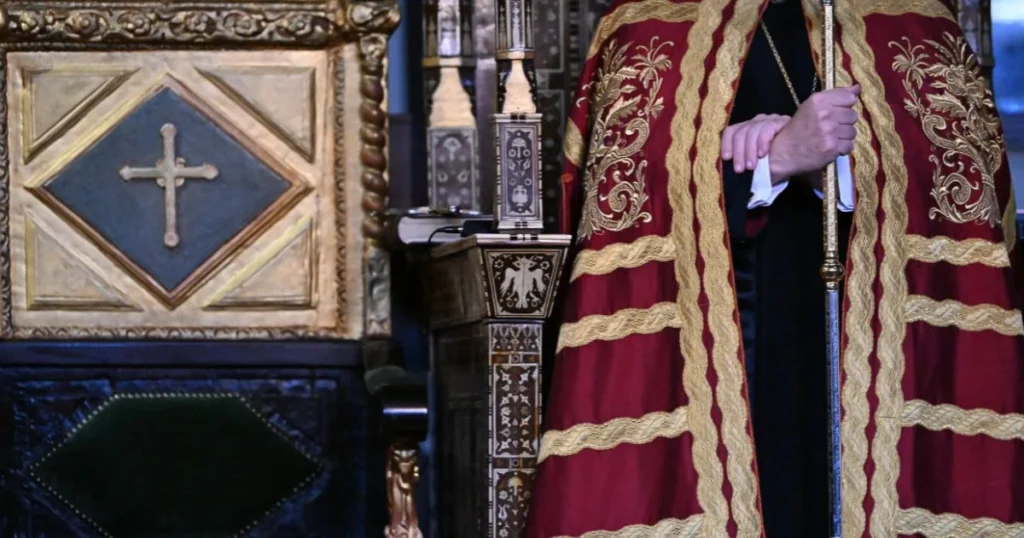
After a memorable time in Rome, today faithful belonging to the Orthodox-Catholic pilgrimage “From Rome to New Rome” spent their first day in Istanbul, Türkiye, visiting the Ecumenical Patriarchate of Constantinople. The day began with another significant and moving experience: attending the Divine Liturgy (Chorostasia) at the Venerable Patriarchal Church of Saint George, the principal cathedral of the Ecumenical Patriarchate. His Eminence Archbishop Elpidophoros of America presided over from the Patriarchal throne, which His All-Holiness Ecumenical Patriarch Bartholomew noted as a particular joy.
Following the liturgy, His All-Holiness greeted the pilgrims, expressing his hope that their time in the Queen of Cities will deepen their faith, renew their hope, and stir their love for both the Church and one another. Continuing, he assured the faithful of the Ecumenical Patriarchate’s prayers, blessings, and “abiding commitment to walk together, Orthodox and Catholics, as fellow disciples of the risen Lord.” The Ecumenical Patriarch also returned the greetings of His Holiness Pope Leo XIV and conveyed his condolences at the recent strike on the only Roman Catholic church in Gaza, Palestine, condemning the attacks on Holy Family Church and calling for an immediate ceasefire.
Afterward, the Orthodox and Catholic pilgrims were honored to receive a private audience with His All-Holiness, who shared his excitement at visiting the U.S. once again this September. Archbishop Elpidophoros and His Eminence Cardinal Tobin exchanged gifts with the Ecumenical Patriarch, and Cardinal Tobin shared that if asked what he and the other pilgrims have experienced on their journey, he would say they’ve experienced a bit of what Ecumenical Patriarch Athenagoras and Pope Paul VI experienced during their historic meeting: “a dialogue of love.”
The faithful also spent time with a guide who explained the history of St. George Church and provided information about the site’s religious items and relics. The current building was originally reconstructed and refurbished around 1614 by Patriarch Timothy II, and has been restored and redecorated under Ecumenical Patriarch Bartholomew. The church contains relics of Sts. Euphemia, Theophano, and Solomone, as well as those of Sts. Gregory the Theologian and John Chrysostom, returned by the Roman Catholic Church in 2004.
Among the site’s most precious items is a portion the column of Christ’s flagellation, where our Lord was bound and whipped by Roman soldiers before his crucifixion. Other treasured artefacts include the patriarchal throne, which is legendarily attributed to the renowned 4th-century patriarch of Constantinople St. John Chrysostom; on the two annual feasts of St. John Chrysostom, an icon of the saint is placed with a bishop’s staff on this throne, as though he were presiding. The pulpit is also attributed to St. John Chrysostom, whose homiletic renown earned him his epithet “Chrysostomos,” meaning “the golden-mouthed.”
Following their time at the Ecumenical Patriarchate, the pilgrims then traveled to the nearby Chora Church, so named for its position outside the city walls built in 408-450. Chora, now converted to “Kariye Mosque,” is globally-known for its iconography representing the pinnacle of Late Byzantine art. Primarily completed under the 14th-century patronage of Theodoros Metochite, these mosaics and frescoes depicts Biblical scenes and the lives of Christ and the Theotokos.
The focal point of the outer narthex is a large fresco depicting the Anastasis and Christ’s descent into Hades. Pictured over the broken doors and locks of death, who is anthropomorphically depicted bound in chains, in this icon Christ forcefully pulls Adam and Eve from their tombs, representing his defeat over sin and death in the Resurrection.
Much of the church’s iconography focuses on the Theotokos, and one unique mosaic depicts her with Christ still in her womb, often understood as representing the Theotokos’s quality of containing the uncontainable. Another piece shows the Theotokos with her parents as a child, exhibiting a more intimate, everyday image of the family.
Photo by Orthodox Observer/Brittainy Newman
Article by Corinna Robinson
H αναδημοσίευση του παραπάνω άρθρου ή μέρους του επιτρέπεται μόνο αν αναφέρεται ως πηγή το ORTHODOXIANEWSAGENCY.GR με ενεργό σύνδεσμο στην εν λόγω καταχώρηση.
 Ακολούθησε το ORTHODOXIANEWSAGENCY.gr στο Google News και μάθε πρώτος όλες τις ειδήσεις.