The Orthodox Volunteer Corps has worked another year. Here are the stories of two volunteers
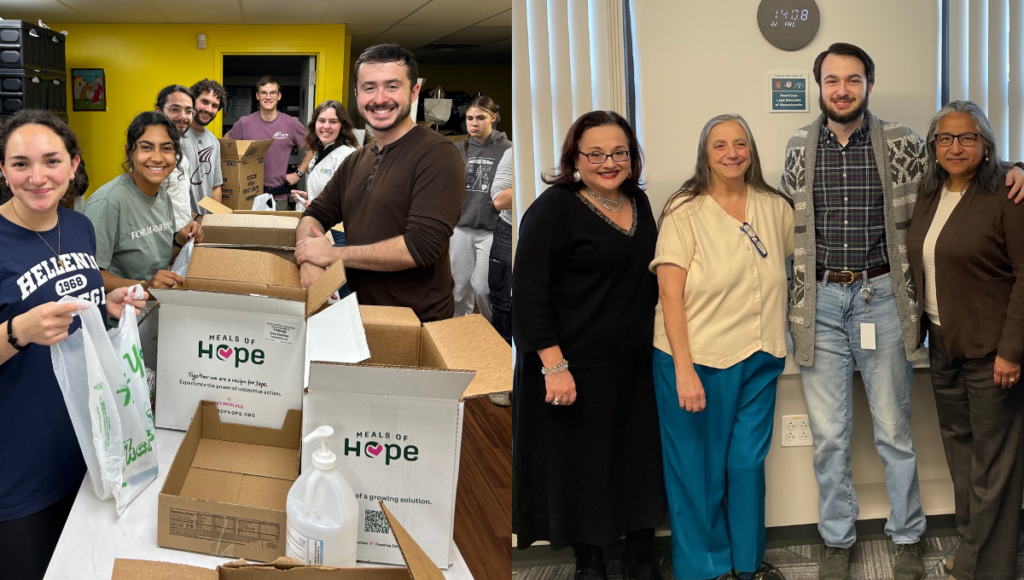
The patron saint of the Orthodox Volunteer Corps (OVC), an organization that places twentysomethings in lines of volunteerism in Pittsburgh and Boston, is Mother Maria of Paris—a Russian poet, nun, and member of the Parisian resistance who was killed in the Holocaust and later canonized as a saint by the Ecumenical Patriarchate. Her life of service, Boston OVC volunteer Harry Parks points out, was two-fold.
In one world she was aiding the refugees of Paris hands-on—feeding White Émigrés who fled the aftermath of the Russian Revolution, and protecting the Jews from deportation to concentration camps as the dark reality of Nazi occupation itself drew nearer to the city.
In the very same world however, St. Maria of Paris was a monastic and poet. Even after her capture and imprisonment at the all-female Ravensbrück concentration camp, and up to her murder by poison gas, she advocated for her fellow prisoners, ministering to them the Gospel in the midst of horrific conditions.
“At present, monastics possess only one monastery, the whole wide world,” said Parks, quoting St. Maria in Sergei Heckel’s Pearl of Great Price, the biography on her life and work the volunteers at OVC read as part of the program’s seminar. “At the same time, the more we go out into the world, the more we give ourselves to the world, the less we are of the world. For the worldly do not give the world an offering of themselves.”
“I understand it as the missing link in how we theologically speak about Christian service,” Parks said, and that the quote, as well as the life of Maria of Paris encapsulates “the radicalness” of what he thinks Christian service to be.
In many ways, the work of OVC volunteers reflects St. Maria’s dual reality of Christian service—one that is heavy, experiential, practical, and necessitated by the plain logistics of providing immediate care to the people who need it most. Simultaneously, the work also secures its purpose in things more ephemeral—laws, and social realities that can only be addressed through systemic change.
Parks, 23, spent the last year placed at the Massachusetts Law Reform Institute (MLRI), an anti-poverty legal advocacy center that hosts practice groups engaged in a thorough array of anti-poverty laws. Parks was placed with MLRI’s statewide language access attorney Iris Eileen Coloma-Gaines, whose job is to advocate for more robust laws around language access.
Those deemed Limited English Proficient (LEP) have trouble engaging in the government services and programs they are entitled to due to a language barrier.
In Boston, where there is a large Haitian-Creole-speaking community, advocacy is key to ensuring that the rights of a non-English speaking community are protected, particularly vulnerable to bureaucratic malaise in what are often complicated legal processes.
“If your preferred language is Haitian-Creole and you go to housing court because your landlord is trying to evict you, even though by federal law you have a right to language access, you might face delays in getting an interpreter,” said Parks. “To interpret both what the judge and other attorneys are saying, and to interpret you and what you’re saying, you could face delays in getting translations for important documents relating to your case.”
The list of delays one might experience goes on, but the consequences of language barriers costs someone more than time. In some cases, a lack of language access can create a lack of access to justice.
“In some circumstances you can end up agreeing to things that are to your disadvantage, but you don’t entirely understand because you don’t speak the language,” said Parks. This disconnect becomes an issue regarding access to equal opportunity for everyone, regardless of the language spoken.
While Parks’s direct interactions with LEP clients were limited, he says he’s gained a greater appreciation for the tangible effect communal advocacy has.
“Nonetheless, it became something that I really came to have a passion for and became invested in,” Parks said. “I came to have a better appreciation for not only community and legal advocacy in the legislative process, but also state governance in general, thinking about how impactful and not seen, or unrecognized, the laws that are passed on a state level really are to people.”
Parks worked with the Mass Speaks Coalition, led by his supervisor, Coloma-Gaines, to redraft legislation filed to prompt the expansion of language access rights in Massachusetts.
Anastasia Friesen, 24, left her home state of Minnesota to volunteer with the OVC. She was placed with Catholic Charities as a caseworker, and for the next year, she would work with mothers struggling to provide for their children, and people who were homeless, in the streets of Pittsburgh.
Friesen says that even though she had a desk in an office space, she was constantly on the move.
“There is a huge physical load that is required to get these things done,” said Friesen. “To pack these boxes—we usually had about 25 boxes go out a week, which doesn’t seem like a huge number but if you’re packing that every week, and trying to talk to the clients, and trying to do all of the other stuff, it certainly took a physical toll.”
“The physical toll of getting these things to the people certainly requires a lot of partnership,” said Friesen.
Friesen recalls the Christmas she spent with her OVC cohort. It was the culmination of all her hard work, she said. It was a Saturday, a day she wasn’t even supposed to be in the office.
“We had an auditorium full of Christmas gifts,” said Friesen. “There were so many Christmas gifts. You are making kids Christmas, for families that really could not afford gifts otherwise.” 500 kids received Christmas presents delivered by Catholic Charities volunteers.
Friesen worked with 25 people in the area, who all needed help, but to her, one stands out—a woman struggling with post-partum depression she calls Deserae. Deserae has 3 kids, and the youngest lives with a heart defect that prevents Deserae from working.
After screening Deserae as a potential client, Friesen admitted she didn’t have an answer for that problem, but something told her Deserae should still be in the program, that they could help in some way.
“She had a really flat affect, one word answers all of the time, so it was hard to get to know her, but I knew she was a good person to be in the program, so I tried to be open to what she needed,” Friesen said. “We weren’t going to solve all the problems, but alleviating some can create bandwidth for others.”
Friesen would call her every week, and for a while, she says it felt like it wasn’t going anywhere. Then, Deserae began to open up about her trauma. She told Friesen she had been abused, and had had multiple miscarriages. By March, Friesen had built enough trust with Deserae to learn that she was struggling with a mental health crisis—this was the hardest day of the whole program, Friesen said.
“That would be the most challenging day,” Friesen said. “We handled that, then I went home. I had my work phone, and I didn’t exactly turn the ringer off. When we talk about people’s lives, it’s hard to disconnect.”
It was the longest day, but the most blessed, Friesen added. Other days, she said she felt she was doing good work, but ultimately not making a difference. “Putting bandaids on problems that are larger, and more systemic,” Friesen said.
“We learned about this concept of radical hospitality, and this idea of really being open and being compassionate, and going beyond yourself to create space—create space for others and create space for Christ to work through you, to then serve others.” Friesen said. “She was really the one that gave me the experience to understand that. She’ll always be on my heart.”
Friesen said her work was focused on the “small things,” and while changing things on larger platforms like the law matters, so too do the immediate pains of people. And although it sometimes feels like an unending task, that’s where faith comes in.
“This year I saw this paradox of the value of the small things that we do,” said Friesen. “Getting someone food matters, getting someone diapers matters, listening to someone who has no one else to talk to matters. Also, working at bigger levels and system levels also matters, and we can’t do one without the other.”
At the end of Friesen’s time with the OVC, Deserae’s case was handed off to her colleagues at Catholic Charities. At the end of an intensive 10-month program which took Friesen through the winter and into the next summer, she was offered a job at Catholic Charities, so she will be returning to the same work, likely working with future volunteers.
“We live in this paradox, in this interesting in-between, where we move forward, just doing the best we can,” said Friesen.
H αναδημοσίευση του παραπάνω άρθρου ή μέρους του επιτρέπεται μόνο αν αναφέρεται ως πηγή το ORTHODOXIANEWSAGENCY.GR με ενεργό σύνδεσμο στην εν λόγω καταχώρηση.
 Ακολούθησε το ORTHODOXIANEWSAGENCY.gr στο Google News και μάθε πρώτος όλες τις ειδήσεις.