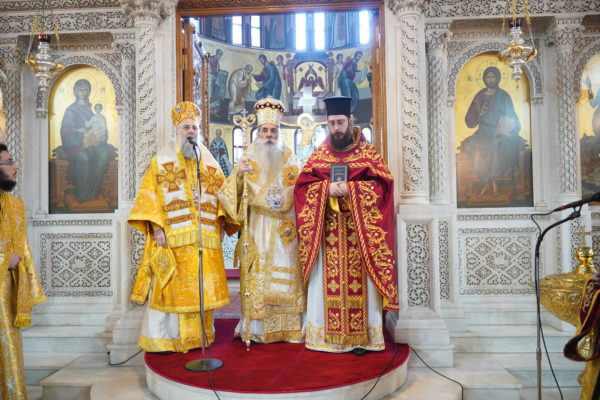
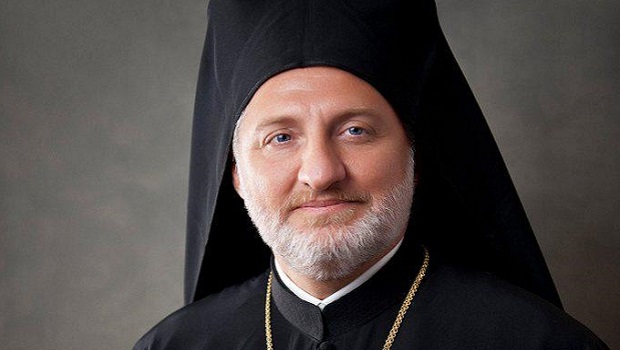
Archbishop Elpidophoros Homily at the Third Salutations to the Theotokos, March 21, 2025, Holy Trinity Greek Orthodox Cathedral in Columbia, South Carolina
Beloved and Dear Faithful,
This evening, gathered in this beautiful Cathedral Sanctuary, we intone the Third Stanza of the Akathist Hymn to the Theotokos. Throughout this magnificent poem, there are more than the praises of the Virgin Mother of God woven into the Salutations. There are also calls to action for us – like this one:
Ξένον τόκον ἰδόντες, ξενωθῶμεν τοῦ κόσμου, τὸν νοῦν εἰς οὐρανὸν μεταθέντες.
Beholding this strange birth, let us estrange ourselves from this world, translating our minds unto Heaven. 1
As in all of God’s interactions with His fallen world, when He sets things aright, it looks very strange to us. The ξένον τόκον, the “strange birth” is the miracle of the Virgin Birth of our Lord Jesus Christ. And it is strange, because coming forth as a Perfect Man from a perfected Woman, in His very Body and Blood, the Lord reunites our human nature, and makes possible a new way of living for every human being.
And what is this new way of living? Nothing less than a “strange birth” within our hearts – a birth of capacities to love, to forgive, to be merciful, and to be compassionate.
That is why the Hymn enjoins us to “estrange ourselves from this world.” This does not mean forsake the world, but rather, to transform our lives while yet in the world. While our feet are planted firmly on earth, our minds are to be translated to Heaven itself. Such an elongation of the self is not a physical reality, but a simple stretch of our imaginations.
One of the most marvelous things about this precious human life that God has granted us is the ability that we have to reach beyond our immediate environs. Our minds can travel across galaxies, and can drill down to contemplate the smallest particles of matter. We have such capacities because they have been endowed upon us by our Creator. But these abilities are designed for more than enhancing our perceptions of the material universe. They are for the immaterial as well.
As we consider how God chose to save the world, we see in His “strange birth” the model for our activities in this world: humility, innocence, inclusion, and above all else, the love of a mother.
The embrace of the Panagia of her Divine Son is a call to each and every one of us to be as loving to one another, as a mother would be to her only child. And yet, our Panagia watched her Child perish on the Cross, fulfilling the Scripture that says:
God so loved the world, that He gave His Only-Begotten Son to the end that all who believe on Him might not perish, but have everlasting life. 2
The strength of the mother’s love of the Panagia allowed her to be present when her Son was crucified. And it cleared the way for her to receive the Good News of the Resurrection, for according to a tradition, the Lord appeared to His Mother first on that first Sunday of Pascha. 3
And that, my friends, is how we traverse the strange path that leads from birth, to death, and then to eternal life – by magnifying our love as we journey.
This is indeed a strange way of living, redolent with the astonishing character of Pentecost when we sing of ξένοις ῥήμασι, ξένοις δόγμασι, ξένοις διδάγμασι, τῆς ἁγίας Τριάδος – strange utterances, strange beliefs, strange teachings of the Holy Trinity. And what makes them strange?
Because we choose love over hate.
We choose forgiveness of resentment.
We choose compassion over contempt.
And we choose mercy over judgment.
Imagine if everyone in the world embraced this strange way of living? With their feet on the ground and their minds in Heaven? It’s a stretch; I know it. But it is the worthiest of goals. One that we all can embrace.
And when we do, we make of earth a Paradise once again.
May we all live to see such strange things on earth, even as it is in Heaven. Amen.
* * *
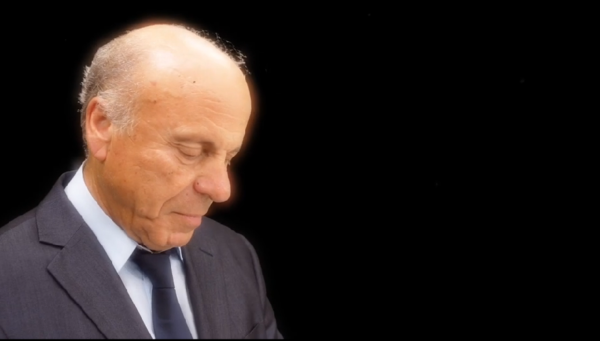
And now, before we depart in peace, I would call forward your fellow parishioner, Dr. Michael Amiridis, the President of the University of South Carolina, so that he may be invested with his Offikion, granted in 2023 by His All-Holiness, Ecumenical Patriarch Bartholomew.
Dr. Amiridis was unable to receive the Offikion at that time, but since we are here in Columbia for an Archon Conference on religious liberty, it seemed the most appropriate moment for you to receive the investiture.
His All-Holiness is the one who chooses the title of every Archon, and the Office that he selected for you, dear friend, is Archon Προστάτης τῶν Γραμμάτων, the Protector of Letters. This is a special title reserved for those in the tradition of the Three Hierarchs: Saint Basil the great, Saint Gregory the Theologian, and Saint John Chrysostom.
Dr. Amiridis, your distinguished and life-long career in academics, and leading this exceptional Institution of Higher Learning, more than merit this title and this award. Your community is proud of you, as is the entirety of the Omogeneia.
May God always bless you and your family with good health and spiritual prosperity, as you continue your worthy endeavors in education and the promotion of the values we all hold so dear. ΑΞΙΟΣ!
H αναδημοσίευση του παραπάνω άρθρου ή μέρους του επιτρέπεται μόνο αν αναφέρεται ως πηγή το ORTHODOXIANEWSAGENCY.GR με ενεργό σύνδεσμο στην εν λόγω καταχώρηση.
 Ακολούθησε το ORTHODOXIANEWSAGENCY.gr στο Google News και μάθε πρώτος όλες τις ειδήσεις.