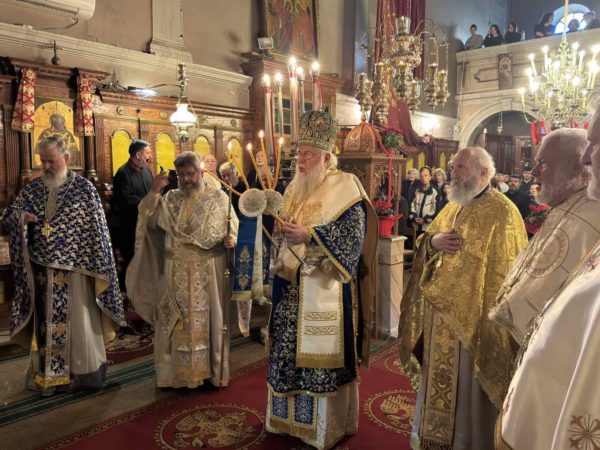
H.E. Metropolitan Cleopas’ Homily on the 7th Sunday of Matthew
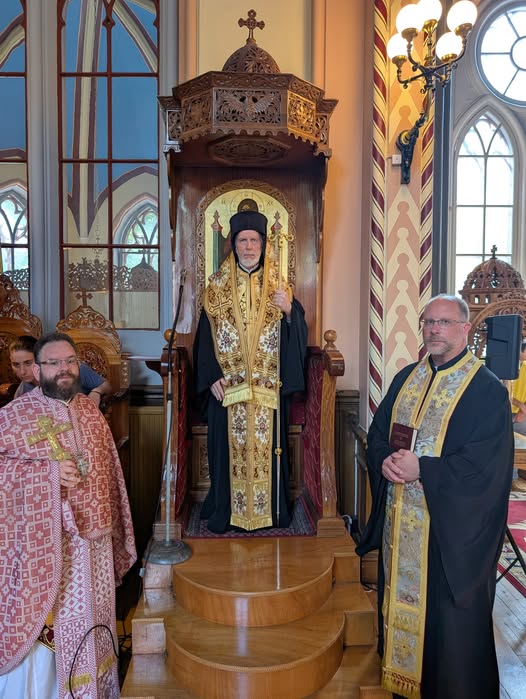
St. George Cathedral of Stockholm
Sunday, July 24, 2025
V. Rev. Fr. Bartholomew,
Rev. Fr. Simon,
Dearly Beloved Brothers and Sisters in Christ,
Beloved children,
Today’s Gospel reading brings us face to face with the mercy and healing power of our Lord. We hear of two blind men crying out with faith, “Son of David, have mercy on us,” and a mute man possessed by a demon who is restored by Christ’s divine touch. These healings are not just miraculous events of the past; they are revelations of God’s compassionate heart and reminders of how He comes to us in our own blindness, our silence, and our brokenness.
The blind men’s plea, “Son of David, have mercy on us,” is more than a request for healing. It is a cry of faith in the identity of Jesus as the Messiah.
St. John Chrysostom emphasizes that these men, though blind in body, had the spiritual sight to recognize Christ as the promised Savior. Their persistence — following Jesus even when He entered the house — shows that true faith is not passive, but perseveres through all obstacles.
St. Cyril of Alexandria notes that Christ did not heal them immediately but waited until they were indoors. Why? To test and strengthen their faith — to draw them into a deeper trust and personal encounter. Likewise, our prayers are not always answered instantly, because the Lord desires to purify our hearts and build in us a steadfast faith.
Jesus says to them, “According to your faith, be it unto you.” This is a principle echoed throughout the Gospels: our faith cooperates with the grace of God.
St. Gregory Palamas teaches that while healing is ultimately a divine gift, the Lord does not force His grace upon us — He respects our freedom and invites our participation.
After healing the blind men, Jesus encounters a man who is both mute and possessed by a demon. This healing shows that sin and spiritual bondage can silence a person — preventing them from praising God, from speaking truth, from being fully human.
This as a sign of what happens to the soul enslaved to passions: it becomes mute to prayer, deaf to the Word of God, and disconnected from true communion.
St. Maximos the Confessor writes that demonic influence often begins in the mind and heart, where distorted thoughts and desires take root. Christ’s healing restores not only physical speech, but spiritual wholeness.
At the end of the reading, we see two different reactions: the crowd marvels, saying “Never was anything like this seen in Israel,” but the Pharisees, hardened in their pride, accuse Jesus of casting out demons by the prince of demons.
Here we see that the human heart can either respond to God’s grace with wonder and humility, or with suspicion and arrogance.
Christ’s healings are not just historical events. As Orthodox Christians, we encounter the same healing through the sacraments, especially in Confession and Holy Communion.
Let us approach Him with the humble and persistent faith of the blind men. Let us cry out, “Son of David, have mercy on us,” not just with our lips but with our lives. And may He grant us the healing of our souls and bodies. Amen!
H αναδημοσίευση του παραπάνω άρθρου ή μέρους του επιτρέπεται μόνο αν αναφέρεται ως πηγή το ORTHODOXIANEWSAGENCY.GR με ενεργό σύνδεσμο στην εν λόγω καταχώρηση.
 Ακολούθησε το ORTHODOXIANEWSAGENCY.gr στο Google News και μάθε πρώτος όλες τις ειδήσεις.