Message of His Beatitude the Patriarch of Jerusalen Theophilos III for the feast of Pascha 2026
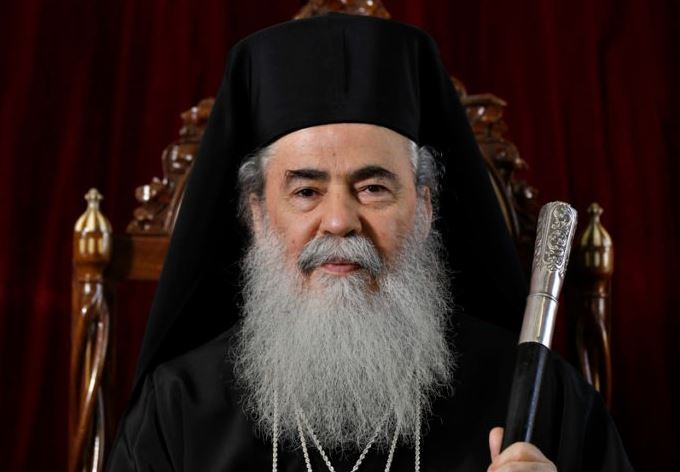
THEOPHILOS III
By the mercy of God, Patriarch of the Holy City of Jerusalem
and all Palestine,
to all the fullness of the Church, grace and mercy and peace
from the All-Holy and Life-giving Tomb
of the Risen Christ.
“Rejoice, O peoples, and be glad;
an angel sat upon the stone of the tomb;
he proclaimed glad tidings unto us, saying:
Christ is risen from the dead,
the Saviour of the world,
and hath filled all things with fragrance.”
(Sticheron of the Praises, Sunday of the Second Tone)
Truly indeed, during this holy, saving, and radiant night, the Church experiences and proclaims the wondrous, beyond-nature mystery of the holy Resurrection of Christ.
The Only-begotten Son and Word of God, “the Word Who was in the beginning” (John 1:1), He Who became man and “was found in fashion as a man” (Phil. 2:7), “went about doing good, and healing” (Acts 10:38), was crucified and willingly buried. The sons of those whom He had saved sealed His tomb together with the guards, supposing that they had erased His memory; yet they were proved vain, for “the Lord bringeth the counsel of the heathen to nought, and maketh the devices of princes of none effect” (Ps. 32:10).
Hades, likewise, the all-devouring, was deceived; for it imagined that it had received a mortal man, but “encountered God”. Though Christ “was crucified through weakness” (2 Cor. 13:4) for our sake, yet being the living Word and true God, He conquered death, shattered everlasting bars, arose, and “liveth by the power of God” (2 Cor. 13:4), delivering those held captive in Hades from ages past and leading them into Paradise. “Death was shown to be brought to nought; the dawn of life hath shone forth.”
The myrrh-bearing women were the first to receive the experience of the Resurrection, for they came “very early in the morning” unto the tomb and heard from the angel: “Be not affrighted… He is risen; He is not here” (Mark 16:6). And the Risen Lord met them, saying: “All hail” (Matt. 28:9). Likewise, He appeared unto the Apostles saying, “Peace be unto you,” showing them the print of the nails and breathing upon them the Holy Spirit (John 20:19–28). He appeared unto them “by many infallible proofs” (Acts 1:3) until the fortieth day after the Resurrection, when He was taken up, and a cloud received Him, and He ascended into heaven and sat at the right hand of the Father (Acts 1:9). The sitting of Christ at the right hand constitutes both His glory and the glory of mankind, because the human nature, which He assumed, was exalted unto heaven.
According to the Apostle Paul, “Christ is risen from the dead” (1 Cor. 15:20), and therefore the event of the Resurrection is not merely a remembrance of something belonging to the past, but subsists as a living and active reality, grounded in the mystical power of the Cross: “the preaching of the cross… is the power of God” (1 Cor. 1:18). In the sacrifice of the Cross and the victory of the Resurrection, Christ abolished the dominion of death and granted unto man the prospect of new life, “that we also should walk in newness of life” (Rom. 6:4). Saint Cyril of Alexandria teaches that through the Resurrection, human nature was renewed and clothed with incorruption, because the life-giving Word conquered corruption and made us partakers of divine life.
From the glorious throne of the Holy Trinity, Christ sent forth His Holy Spirit and established the Church, which continues His work of salvation, opposing the powers of evil and proclaiming peace and righteousness to those afar off and to those near.
The Church of Jerusalem, together with her pious flock, constitutes the unfailing and living witness to the mystery of the Resurrection, that is to say, to the fulfilment of the Divine Providence. She ceaselessly hearkens unto the Lord’s command: “Lo, I am with you alway” (Matthew 28:20), not as the remembrance of some past reality, but as a living and active presence, transcending times and seasons, human limits, and the laws of nature. For Christ, as Saint John of Damascus bears witness, raised together in His divine Hypostasis the nature which He assumed from the pure blood of the Ever-Virgin Mary. This signifies that the Resurrection of Christ constitutes the sure pledge of eternal life (cf. 1 Corinthians 15:20–22), namely of the Kingdom of God, wherein “death hath no more dominion” (Romans 6:9), but life triumphs unto the ages. Heeding also the words of the Lord, “Fear not, little flock” (Luke 12:32), she calls upon her flock throughout her entire jurisdiction in Israel, Palestine, Jordan, and Qatar to remain in their ancestral homeland of the Holy Land, so that the saying of Saint John of Damascus may be fulfilled: “Lift up thine eyes round about, O Jerusalem, and behold; for behold, thy children come unto thee, shining with divine light as luminaries, from west and north, from sea and east, hymning Christ Who is risen unto the ages.”
In the Holy City of Jerusalem, PASCHA 2026
With paternal prayers and Patriarchal blessings,
A fervent supplicant unto the Lord,
THEOPHILOS III
Patriarch of Jerusalem
H αναδημοσίευση του παραπάνω άρθρου ή μέρους του επιτρέπεται μόνο αν αναφέρεται ως πηγή το ORTHODOXIANEWSAGENCY.GR με ενεργό σύνδεσμο στην εν λόγω καταχώρηση.
 Ακολούθησε το ORTHODOXIANEWSAGENCY.gr στο Google News και μάθε πρώτος όλες τις ειδήσεις.