Patriarch Daniel: Romanian carols are a confession of the Incarnation of the Son of God
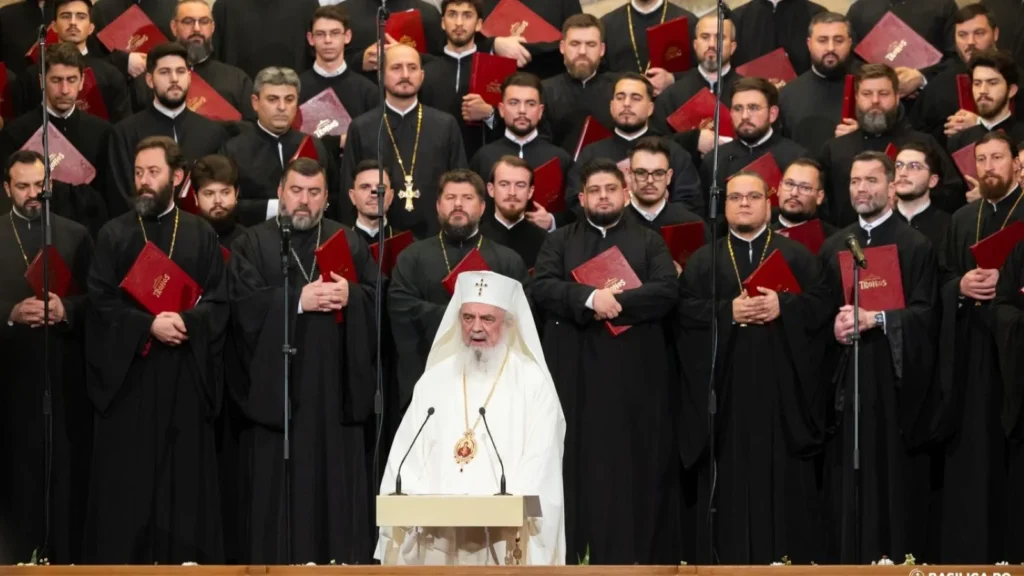
At the conclusion of the annual Christmas carol concert organised by the Romanian Patriarchate, held on Tuesday evening at the Palace of the Patriarchate, Patriarch Daniel of the Romanian Orthodox Church delivered a message reflecting on the theological, cultural and historical significance of the Romanian Christmas carol tradition.
Addressing clergy, performers and the faithful gathered for the concert “The Dayspring from on High,” His Beatitude emphasised that Romanian carols are not merely expressions of popular piety, but authentic confessions of faith rooted in the doctrine of the Incarnation of the Son of God, as formulated by the Church at the First Ecumenical Council of Nicaea.
Recalling the 1,700th anniversary of that Council, Patriarch Daniel noted that the truth of Christ’s Incarnation, confessed by the Church Fathers, was later preserved and transmitted by the faithful through carols, shaped in a form that is “theologically profound, yet musically and linguistically accessible.”
“The carol,” the Patriarch said, “is an artistic expression of the Romanian people that contains the living confession of the Mystery of the Incarnation of the Son of God.”
His Beatitude also drew attention to the role of carols during periods of persecution, particularly under the atheist communist regime, when Romanian spiritual fathers and confessors preserved the faith in churches, monasteries, homes and even in prisons.
“The carols of those who suffered in prisons or under persecution,” Patriarch Daniel stated, “remain a living memorial that still resounds today, reminding us that the joy of the Nativity of the Lord cannot be extinguished by any persecution.”
In this context, the Patriarch linked the Christmas carol tradition to the Romanian Patriarchate’s decision to designate 2025 as both the Centennial Year of the Patriarchate and the Commemorative Year of the Romanian Orthodox spiritual fathers and confessors of the twentieth century, whose witness continues to inspire the life of the Church.
The message concluded with words of gratitude to the choirs and institutions involved in organising the concert, as well as with a pastoral exhortation that, through listening to and passing on the carols, especially to younger generations, the faithful may deepen their living faith and welcome Christ into “the cave of life and the manger of the soul.”
Please find below Patriarch Daniel’s full message.
Romanian Christmas Carols – A Confession of the Incarnation of the Son of God
Seventeen hundred years ago, the shepherds of the Church from throughout the world gathered in Nicaea to formulate the truth of faith concerning the Incarnation of the Son of God, solemnly affirming the Orthodox teaching that Jesus Christ is the Only-Begotten Son of God, begotten of the Father before all ages, and that, for us men and for our salvation, He came down from heaven and was incarnate of the Holy Spirit and the Virgin Mary and became man.
This confession of faith also became a source of inspiration for Christmas carols, in which the revealed truth was shaped by the people into a form that is theologically profound yet musically and linguistically simple, in order to facilitate its transmission by word of mouth.
The carol is an artistic expression of the Romanian people that contains the living confession of the Mystery of the Incarnation of the Son of God, grounded in the apostolic testimony: “And the Word became flesh and dwelt among us” (John 1:14).
Through carols, the Romanian people have preserved and transmitted throughout the centuries the central truth of the Christian faith: God became man so that man might become god by grace, as Saint Athanasius the Great affirms—one of the Fathers who formulated and confessed the Orthodox doctrine of faith at the First Ecumenical Council of Nicaea (325).
The Orthodox faith has been confessed by God’s people throughout history, regardless of geographical or linguistic context or political regime.
The Romanian spiritual fathers who confessed the Orthodox faith during the difficult years of the atheist communist regime inspired the Holy Synod of the Romanian Orthodox Church to proclaim 2025 as the Centennial Year of the Romanian Patriarchate and the Commemorative Year of the Romanian Orthodox spiritual fathers and confessors of the twentieth century.
Their confession unfolded in churches and monasteries, in the homes of Christians or in secrecy, through sermons and writings, through translations of Philokalic texts, as well as in prisons and forced-labour camps.
The carols of those who suffered in prisons or under persecution remain a living memorial that still resounds today, reminding us that the joy of the Nativity of the Lord cannot be extinguished by any persecution. The truth that “Christ is born” in Bethlehem is a proclamation that penetrates beyond walls, just as does the truth that “Christ is risen from the dead, trampling down death by death, and upon those in the tombs bestowing life.”
Therefore, as we listen to the carols at this concert, “The Dayspring from on High,” we remember all those confessors who used carols—even whispered—in communist prisons as a confession of the Christ Child, but also as comfort and hope in times when human freedom and dignity were violated.
Romanian folk carols, inspired by the liturgical hymns of the Church, are not merely melodious songs; they are true confessions of faith, expressions of the joy that “Today He Who is without beginning is born, as the prophets foretold.”
These carols unite us today with past generations, and by interpreting them and encouraging children to learn and sing them, we increase the ranks of confessors of the Orthodox faith, as well as the joy born of living faith.
We give thanks to God for the gift of carols as an act of proclaiming our ancestral faith. We pray that, through the intercessions of all the holy confessors of the twentieth century, we may be made worthy to receive Christ—“the Messiah, radiant in countenance”—in the cave of our life and in the manger of our soul.
In conclusion, we express our gratitude to the carollers: the children’s and youth choir Symbol–Jean Lupu, the Nicolae Lungu Choral Ensemble, and the Tronos Byzantine Chant Group. We also thank the BASILICA Media Centre, the Conference Centre of the Patriarchal Palace, and the Chancellery of the Holy Synod for organising the Romanian Patriarchate’s Christmas Carol Concert “The Dayspring from on High,” and we congratulate all those who took part in this event, wishing you all blessed holidays.
† Daniel
Patriarch of the Romanian Orthodox Church
Photo: Basilica.ro / Mircea Florescu
H αναδημοσίευση του παραπάνω άρθρου ή μέρους του επιτρέπεται μόνο αν αναφέρεται ως πηγή το ORTHODOXIANEWSAGENCY.GR με ενεργό σύνδεσμο στην εν λόγω καταχώρηση.
 Ακολούθησε το ORTHODOXIANEWSAGENCY.gr στο Google News και μάθε πρώτος όλες τις ειδήσεις.