Pilgrims recite Nicene-Constantinopolitan Creed at Site of First Ecumenical Council
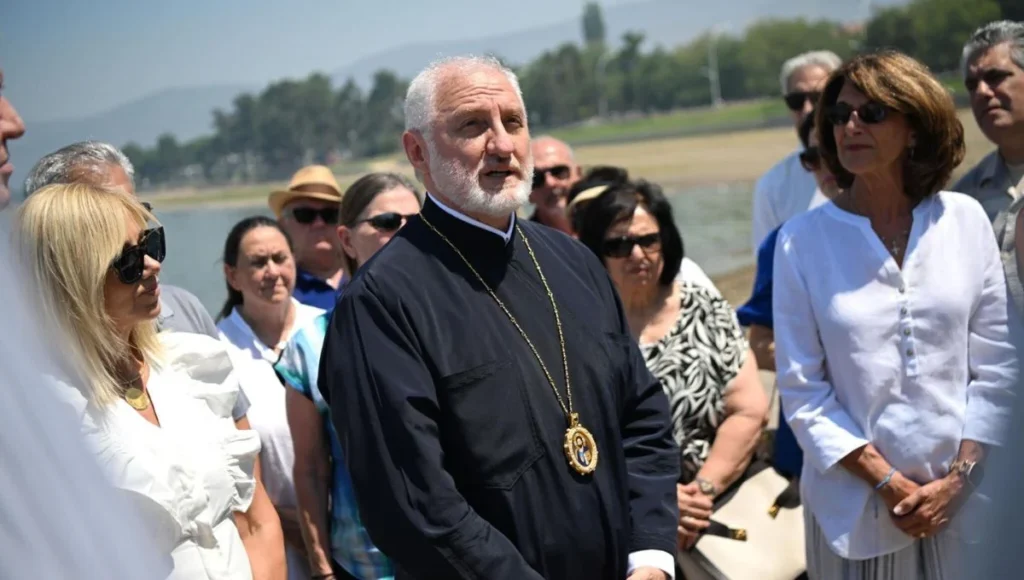
Nearing the end of their pilgrimage, today Orthodox and Catholic faithful commemorated the 1700th anniversary of the First Council of Nicaea by reciting the Nicene-Constantinopolitan Creed on the shores of Lake İznik, at the site of the council’s convening in 325 C.E. Led by His Eminence Archbishop Elpidophoros of America and His Eminence Cardinal Joseph Tobin, the moment was particularly poignant given that due to centuries-old persecution and church-conversions, virtually no visible evidence remains of the city’s Christian past.
The faithful spent the day in the city of Nicaea (modern-day İznik, Türkiye), a surreal experience as they walked in the footsteps of the First Ecumenical Council’s attendees, including both Emperor Constantine the Great and St. Athanasius of Alexandria. In addition to visiting the council’s site, they also visited what remains of the city walls of Nicaea and the original Church of Holy Wisdom (now converted into a mosque).
On the drive to the province of Bursa, Archbishop Elpidophoros explained the key results of the council, which included the establishment of the date of Pascha, Christological decisions concerning Christ’s divinity, and the construction of the first part of the Nicene-Constantinopolitan Creed.
In 325 C.E., Constantine gathered Church leaders from across the Roman Empire—roughly representing at that time the extent of the Christian oikumene or “inhabited world”—primarily to adjudicate the controversial teachings of Arius, an Alexandrian priest who held that Jesus Christ, the Son of God, was neither co-eternal with the Father nor fully divine. The 318 bishops present at the council voted to excommunicate Arius and his followers for their refusal to renounce these false teachings and affirm the Son’s full divinity and co-eternal relationship to the Father.
To dispel further controversy and confusion, the Fathers of Nicaea composed a statement of the Christian faith. This would be supplemented decades later at the Council of Constantinople (381) to form what is today known as the Nicene-Constantinopolitan Creed. The Council of Nicaea is also noteworthy for having established the formula still used to calculate the date of Easter. However, since there is no longer a shared consensus regarding the astronomical inputs to this formula, the unfortunate result is that Christians occasionally celebrate Easter on different dates of the same year.
His Eminence also shared that yesterday, during a meeting at the Ecumenical Patriarchate, he received word that the Turkish government will allow the restoration of certain church ruins sites–a project he began during his time as Metropolitan of Bursa. Though long overdue, this hopeful news served as a reminder that even in the face of oppression, Orthodox Christian communities persevere across the world, from Türkiye to Palestine and Egypt.
As a site of universal or ecumenical Christian heritage, Nicaea symbolizes the legacy of an undivided Church. Traveling here on a journey from Rome to New Rome, the pilgrims had an unique opportunity to experience this chapter of Church history as a living reality—both in terms of their visible unity as Catholics and Orthodox, but also as a reminder of the more subtle and intangible unity shared by those who live according to the fruits of the Spirit (Gal 5:22-23). In fact, St. Paul’s counsel here proves strikingly relevant to contemporary Orthodox-Catholic relations: “If we live in the Spirit, let us also walk in the Spirit. Let us not become conceited, provoking one another, envying one another” (Gal 5:25-26). Today, Archbishop Elpidophoros and Cardinal Tobin traveled the road to Nicaea as fellow archbishops, not of the same tradition yet following the same Spirit of unity.
Photos by Orthodox Observer/Brittainy Newman
Article by Corinna Robinson/Ben Malian
H αναδημοσίευση του παραπάνω άρθρου ή μέρους του επιτρέπεται μόνο αν αναφέρεται ως πηγή το ORTHODOXIANEWSAGENCY.GR με ενεργό σύνδεσμο στην εν λόγω καταχώρηση.
 Ακολούθησε το ORTHODOXIANEWSAGENCY.gr στο Google News και μάθε πρώτος όλες τις ειδήσεις.