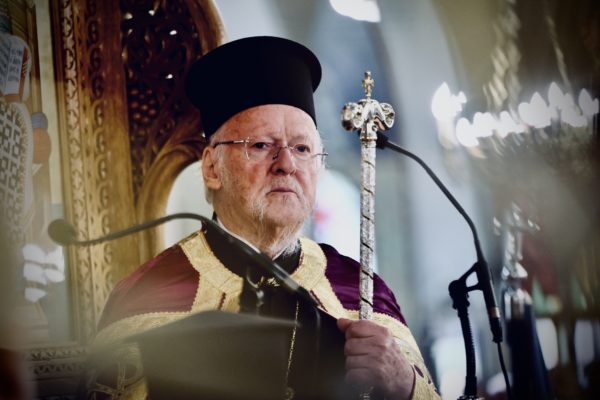
Statement of His Eminence Archbishop Nikitas
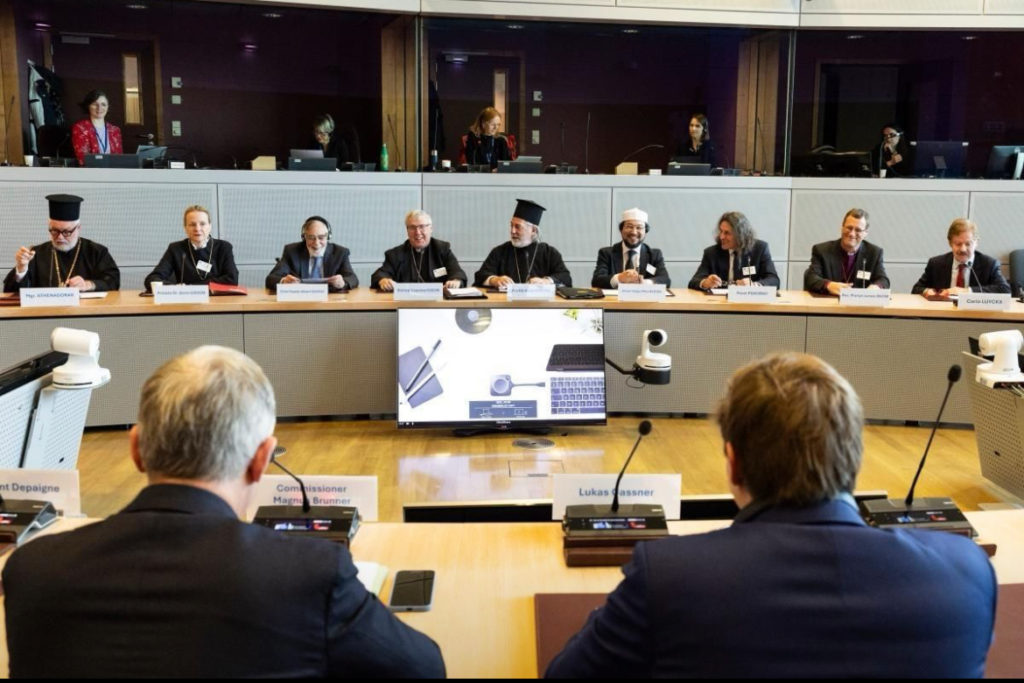
High – level Meeting with Religious Leaders – 17 Nov, 2025
It is my honour to represent the Conference of European Churches, more commonly referred to as CEC, and share a few thoughts with you.
The tone of public conversation has become more divisive and harsher in recent years, as evidenced in so many ways. Respectful dialogue, which was once central to community life has been replaced by quick judgments, emotional reactions, verbal attacks, and a type of “mudslinging”, if I might use that term. We find that people are increasingly speaking at each other rather than speaking with one another. This has placed “walls” of sorts between people, communities, and various groups. Along with the barriers that have developed, there seems to be a loss of empathy and patience, especially on sensitive, moral, political and social issues. While this may be true on one hand, Churches, religious communities and faith-based institutions must encourage a return to dialogue grounded in love, truth, honesty, humility, and genuine acceptance, not just an arena of tolerance. CEC stresses these values.
In our world of progress, growth and development, one can see that social media have amplified both good and harmful speech. While they can connect people, they can also spread anger, hate and misinformation on such a rapid level that it is almost beyond our comprehension. Fake news and other means of misinformation are feeding the flames of division. In some cases, we are either too late or unable to stop the intended results. It is, therefore, the responsibility of faith leaders to guide people to use technology both ethically and responsibly. Along with this principle, it is critical that in the use of technology one must know how to discern truth from manipulation and any and all falsehoods. Digital literacy is a moral and educational challenge.
Artificial Intelligence holds great promise in relation to all of the above, as it can be a tool for education, healthcare and communication, if used in the right and proper manner. It can, though, bring to light some serious ethical questions. How is AI used – what is the purpose – what is the goal? We must ensure that AI preserves human dignity and the common good and not allow the manipulation of this tool.
Current Artificial Intelligence systems are relatively effective at detecting explicit forms of hate speech, such as direct insults, slurs, or openly hostile language. Yet, they often struggle with more subtle or complex expressions of hatred: those conveyed through irony, sarcasm, language-image pairing, or coded language. Even in English, where AI research is most advanced, these forms of hate speech are difficult for machines to recognize. The challenge becomes even greater for languages that are underrepresented in AI research, such as Greek, Romanian, Spanish, and so many others, where there is little or no expert-annotated data sets to train reliable models. This imbalance risks creating new forms of digital inequality, where certain voices and communities remain unseen or unheard in the development of global technologies. The universal Church, then, must remind society that technology must remain human-centered, guided by compassion, moral responsibility and the sacredness of life.
In the communities that comprise CEC, we reject all forms of hate speech and violence, whether based on religion, race, ethnicity or any other difference. The universal Church and all true religious institutions remind us that every human being is created in the image and likeness of God and, therefore, worthy of respect and compassion. These basic lessons are found in Scripture and so many religious texts. While we know that words can heal and build bridges, they can also wound and cause serious damage, especially in relationships – damage which may never be repaired. When language is used to divide or to dehumanize, it harms not only individuals but also the moral fabric of our society.
Of course, we must preserve the space for honest and respectful dialogue – the freedom of expression, though, comes with the responsibility to use our words and expressions wisely and, if I might add, carefully. It is for these reasons that we encourage education, empathy and bridge-building within and beyond our own communities. Religious leaders, educators, parents, and all public voices share a duty to promote understanding, rather than hostility and hatred. Overcoming hate is not only a legal or technological challenge; it is a moral and spiritual one, calling each of us to repentance, renewal of conscience, and a return to our true humanity in God’s image.
Like other communities, Christians have experienced moments and the results of hate speech and we have been the victims of violent attacks – churches have been vandalized, symbols defaced, clergy and lay people have been mocked or insulted for our faith. These incidents are certainly painful but are not limited to Christians, our churches and houses of worship; people of all backgrounds and beliefs have been targeted in similar ways. These actions and practices reveal a wider loss of empathy and respect, fuelled by fanaticism and ignorance. Our response must never be one of anger or retribution, but dialogue, education and prayer, helping people understand that hatred toward one group is, in truth, a threat to everyone.
Prejudice and hatred are not inborn traits – they are taught and many times what is learned cannot be unlearned. With faith, education, and genuine friendship, we can nurture hearts capable of love and build a better future for all. This is the hope and dream of CEC.
H αναδημοσίευση του παραπάνω άρθρου ή μέρους του επιτρέπεται μόνο αν αναφέρεται ως πηγή το ORTHODOXIANEWSAGENCY.GR με ενεργό σύνδεσμο στην εν λόγω καταχώρηση.
 Ακολούθησε το ORTHODOXIANEWSAGENCY.gr στο Google News και μάθε πρώτος όλες τις ειδήσεις.