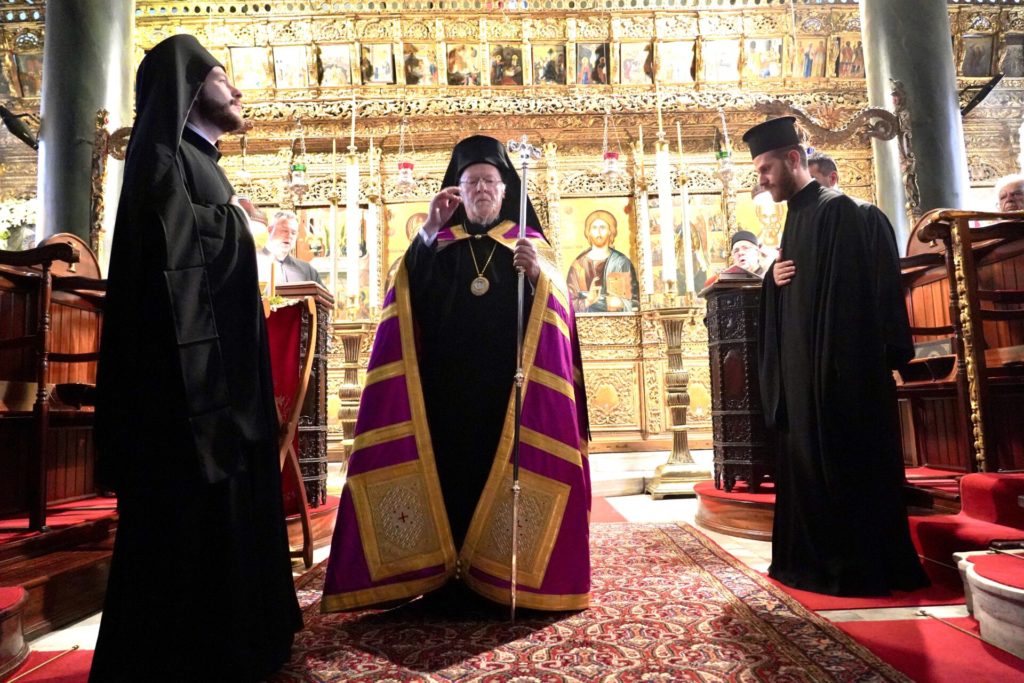
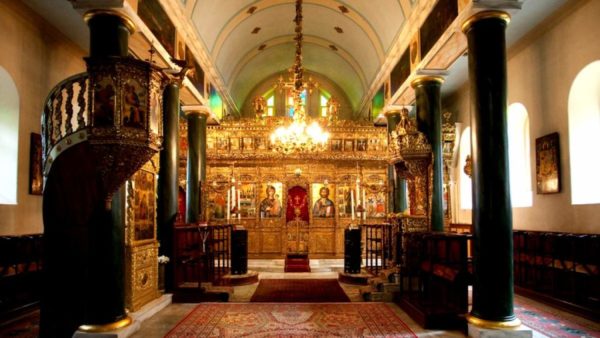
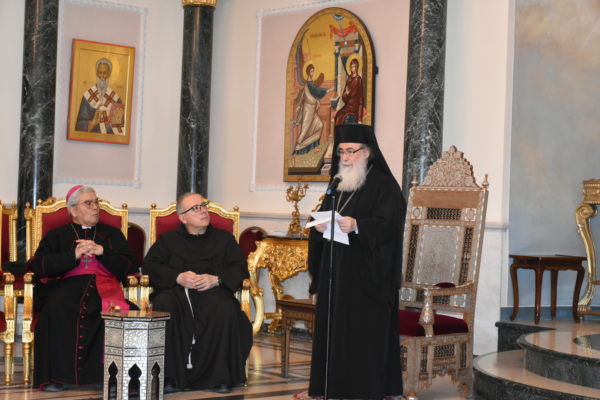
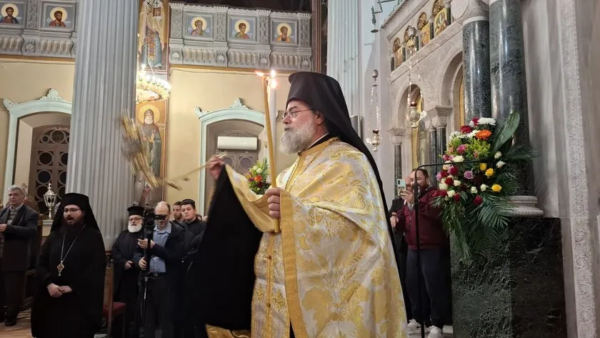
The Sermon of the Secretary of the Holy and Sacred Synod, Hierodeacon Simeon Spyropoulos, at the Vespers Service of the Fourth Sunday of Lent at the Catholicon of the Church of the Holy Sepulchre
Your Eminence,
“And behold, a ladder set up on the earth, and the top of it reached to heaven: and behold the angels of God ascending and descending on it. And the Lord stood above it, and said, I am the Lord God of Abraham thy father, and the God of Isaac… and behold, I am with thee, and will keep thee in all places whither thou goest… for I will not leave thee, until I have done that which I have spoken to thee of… And he was afraid, and said, How dreadful is this place! this is none other but the house of God, and this is the gate of heaven.” (Genesis 28:12-17).
A ladder, dear brethren, a ladder, which Jacob saw. A ladder set upon the earth, the top of which reaches to heaven, to become a path of ascent for us, the inhabitants of the earth. The angels of God ascended and descended upon it, to help those who are ascending and to support those who are falling, “for he shall give his angels charge over thee, to keep thee in all thy ways.” (Psalm 91:11). The Lord stood above it and said, “I am the God of thy father Abraham and the God of Isaac; I am with thee, and will keep thee in all places whither thou goest; I will not leave thee until I have done that which I have spoken to thee of,” that is, those promises which I have made to you, that those who take upon them my yoke and follow me shall inherit. And Jacob feared, and said, “How dreadful is this place! This is none other but the house of God, and this is the gate of heaven!”
This Heavenly Ladder, which Jacob saw, was taken up by the Holy Father John of Sinai, the one called “of the Ladder,” who, having received and interpreted the Ladder from the book of Genesis, viewed it as a ladder of spiritual struggle, a ladder of ascent from a lowly and passionate life to the heavenly life of dispassion and divine participation. The work of Saint John, The Ladder, is considered the quintessential reading of the Holy and Great Lent. For this reason, the ancient liturgical texts prescribe that it be read continually during the services of the Great Lent. Without a doubt, this work serves as a guide—a navigator—for every struggling person, whether monk or not, because, as the Saint notes: “For the monks, the angels are their light, but for people, the monastic life is their light.” (Step 6:23). This proverbial phrase from The Ladder is also a response to the very relevant saying of the Prophet Isaiah about those who “call evil good, and good evil; that put darkness for light, and light for darkness.” (Isaiah 5:20). Therefore, we will humbly attempt to draw a ray of light from our Holy Father John, the one called of the Ladder, to help us in this intermediate stage of the Holy Fast.
The well-known Saint John of the Ladder lived in the 6th century and served as the Hegumen of the Sacred Monastery of the God-trodden Mount Sinai. His namesake, John, the Hegumen of Raitho, wrote to him, asking him to compose and send to them “whatever he saw at the moment when he gazed upon God, just as the old Moses did on the same Mount Sinai.” He hopes that soon the God-written tablets will be sent to him, which will be “like a ladder that will reach the gates of heaven, and will lift up there the souls of those who wish to go, safe and unharmed.”
In response to his namesake, Saint John of the Ladder informs him that he accepts the command to uphold obedience. Possessing the gift of humility in Christ, the Saint believes that the Hegumen of Raitho will receive what is requested due to his faith and the assistance of God, and not because of the spiritual knowledge of the author. Notably, the Saint states: “We are still in the order of those being taught.”
Thus, obeying the Hegumen of Raitho, Saint John begins with a brief introduction, titled “The Ladder of Divine Ascent,” stating that “this present book clearly indicates the best path for those who wish to have their names written in the book of life.” He continues, saying that “it presents us with a ladder that begins from earthly things and reaches to the heavenly, with God leaning upon its top.” He writes further, “I believe that even the foot of Jacob… beheld this while he slept and rested upon his ascetic bed.”
The Ladder is divided into 30 chapters. This division undoubtedly carries a Christological significance, as our Lord Jesus Christ began His public ministry at the age of 30. Thus, by setting an equal number of chapters, the Holy Father prepares us in such a way that “we all come to the unity of the faith and the knowledge of the Son of God, unto a perfect man, unto the measure of the stature of the fullness of Christ.” (Ephesians 4:13).
The goal of the Ladder is to proclaim the high duty we have to restore the ancient beauty, and by moving from the image to reach the likeness, to be truly elevated—not in a moralistic way, but in reality, becoming “partakers of the divine nature.” (2 Peter 1:4). In many parts of the work, it is emphasized that spiritual progress is made gradually and steadily, “with time and patience and little by little.” (Step 7:22).
A core teaching of the Holy Father is that, for spiritual ascent, the focus should not be on physical austerities, but on the attitude of the soul. Priority should be given to obedience, humility, and simplicity of heart.
Regarding obedience, the Holy John states that “obedience means action without examination, a voluntary death, a life without curiosity, freedom from worry about any bodily danger, freedom from concern about what you will answer to God, not fearing death, travelling on the sea without danger, walking on land carefree as if you were sleeping.” (Step 4:3). He refers to those zealous workers of obedience as “boxers” (Step 4:1), and he describes obedience as “martyrdom,” without which no one from the passionate will ever succeed in seeing the Lord. (Step 4:10).
Regarding humility, the sacred writer makes a remark that may seem radical when compared with ascetic writings. He charmingly notes: “For the sake of dispassion, the highest and the wealth of gifts and miracles, strength and power of foreknowledge, many wear out their bodies in vain, forgetting that pains are not the cause, but rather humility is the mother of all these things.” (Step 30:25). In other words, “for the acquisition of perfect love, abundant gifts, and the power of miracles and foresight, many torment and wear out their bodies unjustly, forgetting, the poor souls, that it is not the labours but chiefly humility that is the mother of them all.” He also observes elsewhere that “bodily exercises do not bestow heavenly gifts when the simplicity of the heart and humility are absent.”
The Holy John characterizes humility as “an inexpressible treasure, the name of God and the gift of God” (Step 95:3). Humility is the “grace” of the soul (Step 95:3), which is acquired as a degree but is perfected under the shadow of divine grace in the effort of becoming “like Christ”, in other words, in the actualization of “I live; yet not I, but Christ lives in me” (Galatians 2:20).
The 30th and final step of the Ladder, “whose head reaches to heaven,” is Love! What else can one say except “God is love, and anyone who remains in love remains in God, and God in them” (1 John 4:16)? The holy Father points out that “love, in its quality, is likeness to God; in its operation, it is intoxication of the soul; and in its attributes, it is a source of faith, an abyss of patience, and a sea of humility” (Step 50:3). This Self-love, the Patriarch Jacob saw at the top of the Ladder (Step 50:18), as interpreted by the God-bearer John. All the steps of this spiritual Ladder represent the effort and struggle to meet this Love, which is equated by Saint John the Evangelist with the Knowledge of God. “Love is of God; everyone who loves is born of God and knows God. Whoever does not love does not know God, for God is love. In this, the love of God was revealed to us, that God sent His only Son into the world, so that we might live through Him. This is love: not that we loved God, but that He loved us and sent His Son as an atoning sacrifice for our sins. Dear friends, if God so loved us, we also ought to love one another. No one has ever seen God; if we love one another, God lives in us, and His love is made complete in us” (1 John 4:7-12).
We have attempted to briefly highlight some of the key aspects of the teachings of our Holy Father John of the Ladder. Obedience, humility, simplicity of heart, and the queen of all virtues, love, are the primary virtues pursued in the spiritual struggle, and at the same time, they are the most difficult to achieve. One thing is certain: each of these virtues helps and supports the other. The book of the Ladder is a work that, no matter how many times one studies it, provides numerous teachings and offers saving insights. The purpose of this present talk is not to aim elsewhere but to encourage all of us to dedicate ourselves willingly to the careful study of this God-inspired book.
“Ascend, ascend, brothers,” Saint John of the Ladder urges us through the mouth of the Prophet Isaiah: “Come, let us go up to the mountain of the Lord, to the house of our God” (Isaiah 2:3). The ascent is hard and laborious. However, the promised goods give us the courage to continue the ascent, believing that it leads us to the Gate of Heaven, where we will enter the Heavenly Kingdom, which, may we attain through the intercessions of our Holy Father John of the Ladder and all the saints who have loved God throughout the ages. Amen.
H αναδημοσίευση του παραπάνω άρθρου ή μέρους του επιτρέπεται μόνο αν αναφέρεται ως πηγή το ORTHODOXIANEWSAGENCY.GR με ενεργό σύνδεσμο στην εν λόγω καταχώρηση.
 Ακολούθησε το ORTHODOXIANEWSAGENCY.gr στο Google News και μάθε πρώτος όλες τις ειδήσεις.