Romania: Document on the Consecration of the National Cathedral’s Painting
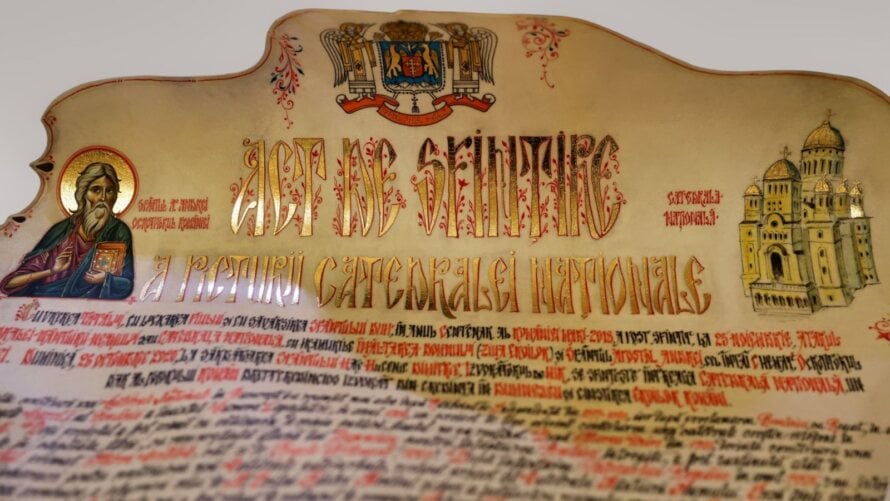
Auxiliary Bishop Varlaam of Ploiești read the Document on the Consecration of Romania’s National Cathedral on October 26, 2025. It has been signed by Ecumenical Patriarch Bartholomew I, Patriarch Daniel of the Romanian Orthodox Church, and all the other Romanian hierarchs:
Document on the Consecration of the National Cathedral’s Painting
By the will of the Father, through the work of the Son, and with the power of the Holy Spirit, in the Centennial Year of the Great Union of Romania – 2018, on November 25, the Altar of the People’s Salvation Cathedral, also known as the National Cathedral, was consecrated. The Cathedral is dedicated to the Ascension of the Lord (Heroes’ Day) and Saint Andrew the Apostle, the First Called, Protector of Romania. On Sunday, October 26, 2025, on the feast of Saint Demetrius the Great Martyr, the Myrrh-gusher, the entire National Cathedral is consecrated—an offering of the faithful Romanian people, born out of their faith in God and their reverence for Romanian Heroes.
The need to build a National Cathedral in Bucharest was especially felt after the War of Independence (1877–1878). Following the proclamation of the Kingdom of Romania in 1881, King Carol I of Romania submitted to the Legislative Chamber, in 1884, a draft law regarding the construction of an Orthodox Christian cathedral in Bucharest. Although the project was met with public enthusiasm, the ideal was not achieved. After the Great Union of 1918, the desire to build a cathedral in the capital city of the country—as a sign of gratitude to God for the unification of Romania—was supported by both Metropolitan-Primate Miron Cristea and King Ferdinand (in 1920). After the establishment of the Romanian Patriarchate in 1925, numerous initiatives were undertaken to build the new Patriarchal Cathedral, based on the original project of the “People’s Salvation Cathedral.” However, all efforts were thwarted by the economic crisis, the outbreak of the Second World War, and subsequently the establishment of the communist regime in Romania, which lasted for 45 years.
After 1990, the project of the new Cathedral was resumed by the Patriarch Teoctist Arăpașu of venerable memory, who—despite numerous difficulties and opposition, including the repeated relocation of the Cathedral’s proposed site to various areas of the capital—managed to secure, with the support of the authorities, its final location on Arsenal Hill, through Government Emergency Ordinance no. 19 of March 17, 2005.
Fulfilling the desire of his predecessors, His Beatitude Patriarch Daniel, after his enthronement as Primate of the Romanian Orthodox Church (September 30, 2007), took over the project of the People’s Salvation Cathedral and officiated the foundation stone laying ceremony at the current site on November 29, 2007, on the eve of the Feast of Saint Andrew the Apostle, the First Called, Protector of Romania. After extensive preparatory work between 2008 and 2010, the Romanian Patriarchate officially began the construction works at the end of 2010. The process was closely supervised by His Beatitude Patriarch Daniel, who maintained frequent consultations with experts in the field, the appointed coordination team, project designers, and construction contractors.
The consecration of the Altar of the National Cathedral on November 25, 2018, was a tribute marking the centenary of the Great Union of 1918—when all Romanian provinces were united into a single state, the Kingdom of Greater Romania. The first major benefit following this Union was the elevation of the Romanian Orthodox Church to the rank of Patriarchate, on February 4, 1925, an act officially recognized by Ecumenical Patriarch Basil III through Tomos no. 1579, issued on July 30, 1925.
Following the consecration of the Altar of the National Cathedral in 2018, the work continued with the interior wall decoration in mosaic technique, covering a surface of 17,000 square meters. This monumental project was carried out by over 200 mosaic specialists under the coordination of church painters Daniel and Alina Codrescu. The exterior base of the Cathedral was clad in Rușchița marble, while the columns of the four porches were made of Vratsa stone. The chandeliers, crafted from brass and steel in Vienna, incorporate angelic figures holding three lights, symbolizing the grace of the Holy Trinity. Entry to and exit from the Cathedral is provided through 27 bronze doors, designed to allow for rapid evacuation in case of emergency.
A particularly moving moment was the placement of the Holy Cross atop the highest dome of the Cathedral, the Pantocrator dome, on April 8, 2025. Now standing at a height of 127 meters, the cross atop the main dome of the National Cathedral stands as a visible symbol of Christ’s love and the blessing of the Holy Trinity upon the Capital city and the entire Nation.
In the centennial year 2025, the Romanian Orthodox Church, seeking to crown the celebration of 100 years since the proclamation of the Romanian Patriarchate and 140 years since the recognition of its Autocephaly, gives thanks to God for the help offered to the Romanian people in preserving the apostolic faith received from Saint Apostles Andrew and Philip, and for the unity and dignity of the Romanian people.
The consecration service of the National Cathedral’s painting was celebrated on Sunday, October 26, 2025, by His Holiness Ecumenical Patriarch Bartholomew I and His Beatitude Patriarch Daniel of Romania, together with a large host of hierarchs, priests, and deacons, in the presence of important central and local state authorities, as well as numerous guests, both clergy and laity, from Romania and abroad.
The presence of His Holiness Bartholomew I, Ecumenical Patriarch of Constantinople, at both the 2018 and 2025 consecration events of the National Cathedral in Bucharest, shows that the Ecumenical Patriarchate has promoted throughout history the administrative freedom and dignity of the Orthodox Churches of various peoples, while preserving their dogmatic, liturgical, and canonical unity.
By the grace of God, the generosity of the Government of Romania, and the contributions of clergy and faithful alike, the Romanian Orthodox Church now has in Bucharest a cathedral that stands as a representative expression of the faith and piety of the majority of the Romanian people. The new cathedral in Bucharest is called the National Cathedral because it is located in the Capital city of Romania and hosts ceremonies of national symbolic significance. Through its traditional Byzantine and Romanian architectural style, the Cathedral is a vivid synthesis of Brâncovenesque porches, Moldavian recessed niches, and slender Transylvanian towers. The mosaics of the National Cathedral depict saints of the universal Orthodoxy, as well as saints from all Romanian provinces, including the Romanian saints canonized in 2024 and 2025.
The construction and consecration of the National Cathedral represent the fulfilment of an ideal—a mission entrusted to us, as Patriarch, together with the Holy Synod, the clergy, and the faithful, by our venerable predecessors. The accomplishment of this ideal took on concrete form especially through the cooperative efforts of all the hierarchs of the Holy Synod in supporting this project, both by adopting the necessary synodal decisions and by continuing the implementation of the national church collection across the dioceses.
We extend blessings and sincere gratitude to the state authorities who supported the construction of the National Cathedral: the Governments of Romania during the years 2011–2025, the Municipality of Bucharest, other municipalities in the capital city and across the country, as well as various County Councils. We also thank the benefactors and sponsors for their support in fulfilling this Romanian ideal, along with all donors from within the country and abroad, whose generosity contributed to the realization of this spiritual and national ideal—an ideal first voiced in 1881 by the poet Mihai Eminescu, and later by the Kings of Romania, Carol I and Ferdinand, as well as by all the Patriarchs of Romania—as a symbol of the faith, freedom, and dignity of the Romanian people.
Lord, bless the founders, benefactors, servants, and worshippers of this Holy National Cathedral, and the entire Romanian people everywhere!
Foto credit: Arhid. Vasile Pop
basilica.ro
H αναδημοσίευση του παραπάνω άρθρου ή μέρους του επιτρέπεται μόνο αν αναφέρεται ως πηγή το ORTHODOXIANEWSAGENCY.GR με ενεργό σύνδεσμο στην εν λόγω καταχώρηση.
 Ακολούθησε το ORTHODOXIANEWSAGENCY.gr στο Google News και μάθε πρώτος όλες τις ειδήσεις.